
Effective leak detection is a must have tool for anyone trying to quickly diagnose and pinpoint an elusive evap leak. Few things are more maddening than a stubborn EVAP code or a misfire with no clear culprit. Nine times out of ten, the root cause is a tiny vacuum leak you could chase for hours with carb cleaner and never see. A proper automotive smoke machine removes the guesswork: it pressurizes the system and lets the smoke point straight to the problem.
I’ve spent a lot of time digging through what’s on the market at realistic budgets. What I found runs the gamut from genuinely capable diagnostic tools to bargain units that won’t survive real shop use. The difference comes down to details: compressor quality, whether it can hold steady pressure, and if the smoke is dense enough to reveal a 0.5mm crack in a fitting.
This guide filters the noise. You’ll see what to buy, who it suits, and — just as important — where each option falls short.
Quick Recommendation
Not sure which unit fits your needs? Start here:
Buy the AutoLine Pro Shop Series Plus if:
✔ You run a shop and need continuous EVAP testing at up to 1 PSI with steady pressure and no vapor fade
✔ You want class-leading smoke volume and a ceramic smoke coil that won’t fry after a handful of jobs
✔ You value build quality and fluid efficiency more than saving $35
Buy the AutoLine Pro HyperSmoke™ (with 2x Fluid) if:
✔ You’re a DIYer who needs a capable 12V unit with a built-in compressor for under $55
✔ You already have a gas cap adapter and want extra smoke fluid for longer sessions
✔ Cost matters, but you’re not willing to compromise on OEM-approved fluid
Buy the Solary Leak Detector if:
✔ You want a 12V DC EVAP diagnostic tester from a non–AutoLine Pro brand
✔ You’re targeting leaks on motorcycles, ATVs, or small engines with lower PSI requirements
✔ You prefer a single-brand, purpose-built tool over a broad accessory ecosystem


How I Evaluate an Auto Smoke Machine Before Recommending It
I don’t rank these on packaging or star ratings alone. The fundamentals matter first. A leak detector that can’t maintain stable pressure doesn’t just waste time — it can mislead you. The primary goal is to detect leaks safely. You must ensure the intake system and all exhaust systems are tightly sealed using a proper plug.
Here’s what I actually weigh when testing:
Compressor motor quality: A 12V DC built-in compressor should deliver consistent airflow (L/min) without overheating after 5 minutes. Cheap motors taper off; good ones keep pace.
Maximum PSI limits: EVAP testing lives around 1 PSI. If a unit can’t regulate below that reliably, it’s a risk to sensitive fuel system components.
Smoke fluid type: OEM-approved, mineral-based diagnostic fluid is critical. Off-brand formulas can leave oily deposits on O2 and MAP sensors — creating new headaches.
Adapter compatibility: A cone adapter and gas cap EVAP adapter should be in the box. Without them, you’re improvising seals with tape and clamps, which ruins pressure integrity.
Smoke output volume: Wispy smoke won’t reveal a 1mm crack. High-volume, dense output from a quality coil is non-negotiable for intake and exhaust work.
Build material and drop resistance: Shops are hard on tools. Flimsy housings don’t survive concrete and steel.
I also factor in the 12V power connection — battery clamps versus cigarette lighter — because on a freezing morning, a stubborn lighter socket can waste more time than you think.
Amazon buyer feedback gets weight when the sample size is solid, but I always cross-check with spec sheets. A 4.9-star average from 12 reviews tells me less than a 4.5 from 300.
The Best Automotive Smoke Machine Reviewed
AutoLine Pro EVAP High Volume – Shop Series Plus
This is the unit I’d hand to a working shop, no hesitation. Priced at $89.95 with a 4.9-star rating, it earns the praise because its standout trait — smoke volume — separates it from peers at this tier. The ceramic coil produces thick, slow-dispersing vapor that makes pinhole leaks in intake hoses visible from a couple of feet away. No squinting at faint wisps.
The built-in pump keeps pressure steady in the EVAP-safe range — right around 1 PSI — with no surging or bleed-off. That’s crucial when pressurizing a fuel tank where you don’t want to compromise a float or seal. The included cone and gas cap EVAP adapters are cut tighter than the $40 crowd, so fitment on a Tacoma or modern turbo setup is less of a fight.
Now the trade-off: for nearly $90, the plastic housing feels underbuilt. The lid latch, especially, seems like it belongs on a cheaper unit. Drop it from bench height and you’re more likely to test the warranty than the engine. The reservoir cap also needs two hands to seal properly — not ideal when your other hand is pinning a hose to an intake port.
Price: $89.95
Rating: 4.9 stars
Best for: Professional shop duty, high-volume EVAP work, turbo intake leak hunts
Includes: Premium cone adapter, gas cap adapter, top-rated smoke fluid
AutoLine Pro HyperSmoke™ – With Cone and Gas Cap Adapter
Got a check engine light with an EVAP code and a free weekend? This is the kit to grab. At $64.99 with a 4.7-star rating, the HyperSmoke™ plus adapters covers a full EVAP test right out of the box — no improvisation needed.
The adjustable pressure feature deserves attention. It’s not fluff: dialing back airflow for a motorcycle fuel system compared to a full-size truck’s EVAP port actually matters. The 12V compressor runs via battery clamps, and yes, the hum is louder than expected. Not obnoxious, but audible in a busy bay — which doubles as a handy “it’s on” cue.
The weak spot is the cone adapter’s longevity. If the rubber seal sits in UV or around ozone, it ages fast. After a season, some buyers report it struggles to seal on large intake openings. It’s a cheap part to replace, but it’s exactly the kind of hiccup that shows up on a Saturday when parts counters are closed.
Price: $64.99
Rating: 4.7 stars
Includes: Cone adapter, gas cap EVAP adapter, OEM-approved smoke fluid
AutoLine Pro HyperSmoke™ – 2x Smoke Fluid Bundle
Let’s be blunt: if you already own the previous HyperSmoke™ kit, this isn’t a real hardware upgrade. You’re paying $52.99 — $12 less than the cone kit — for the same machine but with two bottles of OEM-approved fluid and no adapters.
That’s intentional. This bundle targets users who already have a cone or who only test via the EVAP service port with the included hose fitting. The 4.7-star rating mirrors the cone version because the compressor, adjustable pressure, and HyperSmoke™ coil are unchanged.
The value is the extra runtime. Two bottles carry you much farther than a single-fluid kit, helpful if you’re testing a small fleet. Just remember: more fluid doesn’t equal stronger performance. Smoke output capability is the same as the pricier SKU, and if you end up buying the cone separately, that $12 advantage disappears quickly.
Price: $52.99
Rating: 4.7 stars
Best for: Repeat users restocking fluid or owners who already have adapters
Includes: OEM-approved smoke fluid x2 (no cone adapter)
Csttler 12V DC – Built-in Air Pump, No Pressure Gauge
For the backyard mechanic working on bikes, ATVs, boats, and a daily driver, this Csttler 12V unit at $53.99 with a 4.3-star rating can get the job done — but the rating gap versus AutoLine Pro exists for a reason.
The integrated pump is adequate for smaller systems and low-displacement engines. The catch: there’s no pressure gauge. You’re partially blind on system pressure, which is a real liability for modern EVAP work with tight tolerances. You can over-pressurize without realizing it until something complains.
Build quality is the main drawback — the plastic seam work feels thin, and the battery clamp leads are shorter than competitors, making reach a problem if the battery lives in a trunk or under a seat. Fine on trucks; annoying on compacts. Smoke density also trails the AutoLine units at similar runtimes, so larger exhaust leak hunts demand patience.
Price: $53.99
Rating: 4.3 stars
Vehicles: Cars, motorcycles, trucks, boats, ATVs
Power: 12V DC
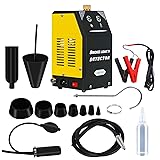
Csttler 12V DC – With Pressure Gauge and Adjustable Pressure
Same brand, but now with the one upgrade that matters: a pressure gauge and adjustable control. At $55.99 — just $2 more than the gauge-less model — this is the only Csttler I’d recommend beyond basic tests. A readable gauge turns guesswork into a process.
Stable pressure is achievable, and the control knob helps you stay below the sub-1 PSI threshold for safe EVAP diagnostics. Airflow from the pump is steady enough for basic intake and hose checks. At this price, it’s a fair entry point if you’re new to smoke testing and not ready to jump to a $90 shop-grade tool.
However — and it’s a real caveat — the small-diameter gauge face is hard to read in dim spaces, which is exactly where you’ll be using it (under-hood, tight bays, poorly lit garages). The 4.2-star rating is the lowest here, and some of that stems from inconsistent smoke output over longer sessions. The coil doesn’t appear to be ceramic, so long-term durability under daily use is uncertain.
Price: $55.99
Rating: 4.2 stars
Key upgrade over base Csttler: Pressure gauge, adjustable pressure control
Motor: Features a reliable built-in air compressor (often functioning as a standard air compressor) to maintain test pressure.
Power: 12V DC
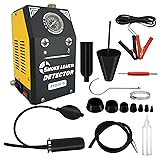
Solary 12V DC EVAP Vacuum Diagnostic Tester
The quiet overachiever on this list. At $64.99 with a 4.6-star rating, it lands in the same bracket as the HyperSmoke™ with cone, which makes the head-to-head inevitable — and on raw specs, Solary trails.
Where Solary stands out is pipe system work. If your main job is chasing vacuum leaks in intake runners, intercooler piping, or exhaust joints rather than strict EVAP testing, the layout makes sense. Hose routing and fittings feel thoughtfully designed for that workflow.
The compressor runs notably quieter than both Csttler models and quieter than HyperSmoke™. In shared spaces, or when you need to listen for faint hiss, that’s a real plus. Still, smoke volume sits a tier below the AutoLine Shop Series Plus, and the adapter kit is thin — you’ll probably need a universal easy intake adapter for larger bores. The housing finish also feels cheaper than the promo photos suggest.
Price: $64.99
Rating: 4.6 stars
Power: 12V DC
Best for: Pipe system leak checks, vacuum leak tracing on turbo and intake setups

AutoLine Pro EVAP High Volume – Shop Series (Original)
This is the predecessor to the Plus. At $69.99 with a 4.5-star rating, the original Shop Series remains a capable EVAP smoke tester — but in 2026 you need a good reason to pick it over the Plus, which brings a better coil and tighter tolerances at $89.95.
The ceramic coil here still outperforms both Csttler units. Output is dense, and the compressor handles continuous EVAP port work without the heat-induced throttling cheaper designs suffer. For DIYers who want near shop-grade performance and can’t stretch to the Plus, it fills the gap.
Complications? The included smoke fluid has since been reformulated in the Plus. Multiple buyers note the older fluid leaves more residue on intake sensors than the newer blend. Not disastrous, but at $70, getting the older stock feels like a miss. The exterior design also shows its age — knobs and toggles feel cheaper than they should, and the friction-fit hose fittings need clamps for a proper seal on high-flow tests.
Price: $69.99
Rating: 4.5 stars
Best for: DIY users wanting shop-level smoke output on a mid-range budget
Includes: Ceramic smoke coil, smoke fluid

Common Mistakes in Buying an Automotive EVAP Smoke Machine — and How to Avoid Them
The EVAP smoke machine aisle is full of products that look alike but behave very differently once they hit the bay. These are the pitfalls I see most often:
Ignoring Maximum PSI Limits for EVAP Work
This one’s the big risk. Modern EVAP systems — especially post-2010 — are designed for very low pressures. Push past 1 PSI and you can damage charcoal canister bladders or deform purge valve diaphragms. Any machine without a visible gauge or adjustable control puts components in harm’s way.
Confirm you can set pressure below 1 PSI before connecting to a fuel system
Use the lowest pressure that still produces visible smoke
For intake and exhaust, you get more headroom — but 3 PSI is still a smart ceiling for most pipe systems
Underestimating the Importance of Smoke Fluid Quality
Many budget units ship with mystery fluid. Non–OEM-approved mineral oils can contaminate O2, MAF, and MAP sensors if drawn through the system. That turns a simple leak hunt into a sensor replacement bill. Always verify the fluid is rated for automotive diagnostics.
Skipping Adapter Compatibility Checks
A cone that won’t seal on your intake opening is dead weight. Make sure the kit includes — or you can easily add — a universal easy intake adapter that fits your use case. Turbo intercooler systems, for instance, often need specific diameters that basic kits miss.
Buying Without Considering Air Flow Rate
An underpowered pump with low L/min output won’t pressurize a large fuel tank fast enough to keep pressure steady during the test window. That’s especially true for big vehicles — trucks and SUVs — where EVAP volume dwarfs compacts. Weak compressors also make thin smoke that dissipates before you can trace it.
Treating All 12V DC Units as Equivalent
“12V DC” only tells you the input. It says nothing about motor quality, ceramic versus standard coil, or whether you’ll get 10 minutes of dense output or two. A $40 dc evap vacuum diagnostic tester and a $90 one are not the same tool with different stickers — the engineering differences show up in accuracy and durability.
Look specifically for a ceramic coil — it keeps smoke output consistent over longer sessions
Adjustable pressure should be a baseline for professional-level diagnostics
Battery clamp leads should be 18–24 inches at minimum — short leads are a daily nuisance
Final Verdict
If you’re in a shop or wrench regularly — even as a serious DIYer — the AutoLine Pro Shop Series Plus is the pick. At $89.95, the ceramic coil, dense smoke, and stable pressure put it a step ahead. The latch feels cheap and the housing won’t win awards, but performance is what counts.
On a tight budget under $55 and need adapters included? The HyperSmoke™ cone adapter version at $64.99 is the go-to for most weekend mechanics. It covers standard EVAP and intake leak checks without chasing extra fittings. The 2x fluid bundle at $52.99 makes sense only if you already own adapters or you’re replenishing fluid.
Pick Solary if you value a quieter compressor for shared spaces and spend more time on vacuum and pipe system leaks than on EVAP tanks. It’s not stronger than the AutoLine Shop Series Plus overall, but its strengths are different.
Skip the Csttler without a gauge. The $2 jump to the pressure-gauge version is mandatory for safe EVAP work. And the original AutoLine Shop Series at $69.99 is hard to recommend now that the Plus exists — unless you catch a steep discount.
FAQ
What PSI should I use when smoke testing an EVAP system on a modern car?
Industry best practice is at or below 1 PSI of stable pressure. Most OEMs call for 0.5–1 PSI max to protect purge valves, charcoal canisters, and bladder components in the vapor recovery system. Start as low as possible while still getting visible smoke, then increase only if necessary.
Can I use a 12V DC automotive smoke machine on a motorcycle or ATV EVAP system?
Yes. Smaller displacement systems often benefit from the lower airflow produced by many 12V units. The key is adjustable pressure so you can stay under the system’s rated limit. Buyers frequently report success with units like the Csttler and Solary on bikes and ATVs, alongside full-size vehicles.
What’s the difference between a ceramic smoke coil and a standard coil in a smoke leak detector?
Ceramic coils tolerate higher operating temperatures and degrade more slowly than standard resistance wire coils. Practically, that translates to denser, more consistent smoke over longer sessions and a much longer service life. For frequent or shop use, ceramic is the right call — it’s a major reason the AutoLine Pro Shop Series Plus sits at the top.
Will smoke fluid from an automotive smoke machine damage O2 sensors or MAP sensors?
It can if the fluid isn’t OEM-approved. Generic mineral oils not formulated for diagnostics leave deposits on sensor elements when pulled through the intake. OEM-approved smoke fluid is designed to vaporize cleanly without residue. During EVAP and intake testing, fluid quality matters as much as the hardware.
How do I find an exhaust leak using a smoke machine if I can’t pressurize from the EVAP service port?
For exhaust leaks, block the tailpipe with a cone (or an inflatable bladder on large outlets) and feed smoke from the outlet side while working upstream. Seal all known exits — including secondary air injection ports — so smoke only escapes through the leak. This controlled test prevents any dangerous leakage that could eventually result in a severe fuel leak. Keep PSI low and give it 30–60 seconds to migrate. A bright work light at a low angle makes escaping smoke stand out against exhaust surfaces.
Are automotive smoke machines safe for turbocharged engines?
Yes, but with strict limitations. Turbocharged intake systems can handle higher pressures than standard EVAP setups, but you should still never exceed 3 to 5 PSI during testing. Over-pressurizing can damage sensitive oil seals inside the turbocharger turbo or pop off delicate vacuum lines.
Can an EVAP smoke machine help detect intake manifold leaks?
Absolutely. It is one of the most effective tools for this job. By sealing the throttle body and introducing dense vapor into the intake system, smoke will quickly escape from cracked gaskets, failed manifold runners, or dry-rotted vacuum hoses that are impossible to see with the naked eye.
Effective leak detection is a must have tool for anyone trying to quickly diagnose and pinpoint an elusive evap leak. Few things are more maddening than a stubborn EVAP code or a misfire with no clear culprit. Nine times out of ten, the root cause is a tiny vacuum leak you could chase for hours with carb cleaner and never see. A proper automotive smoke machine removes the guesswork: it pressurizes the system and lets the smoke point straight to the problem.
I’ve spent a lot of time digging through what’s on the market at realistic budgets. What I found runs the gamut from genuinely capable diagnostic tools to bargain units that won’t survive real shop use. The difference comes down to details: compressor quality, whether it can hold steady pressure, and if the smoke is dense enough to reveal a 0.5mm crack in a fitting.
This guide filters the noise. You’ll see what to buy, who it suits, and — just as important — where each option falls short.
Quick Recommendation
Not sure which unit fits your needs? Start here:
Buy the AutoLine Pro Shop Series Plus if:
- ✔ You run a shop and need continuous EVAP testing at up to 1 PSI with steady pressure and no vapor fade
- ✔ You want class-leading smoke volume and a ceramic smoke coil that won’t fry after a handful of jobs
- ✔ You value build quality and fluid efficiency more than saving $35
Buy the AutoLine Pro HyperSmoke™ (with 2x Fluid) if:
- ✔ You’re a DIYer who needs a capable 12V unit with a built-in compressor for under $55
- ✔ You already have a gas cap adapter and want extra smoke fluid for longer sessions
- ✔ Cost matters, but you’re not willing to compromise on OEM-approved fluid
Buy the Solary Leak Detector if:
- ✔ You want a 12V DC EVAP diagnostic tester from a non–AutoLine Pro brand
- ✔ You’re targeting leaks on motorcycles, ATVs, or small engines with lower PSI requirements
- ✔ You prefer a single-brand, purpose-built tool over a broad accessory ecosystem
How I Evaluate an Auto Smoke Machine Before Recommending It
I don’t rank these on packaging or star ratings alone. The fundamentals matter first. A leak detector that can’t maintain stable pressure doesn’t just waste time — it can mislead you. The primary goal is to detect leaks safely. You must ensure the intake system and all exhaust systems are tightly sealed using a proper plug.
Here’s what I actually weigh when testing:
- Compressor motor quality: A 12V DC built-in compressor should deliver consistent airflow (L/min) without overheating after 5 minutes. Cheap motors taper off; good ones keep pace.
- Maximum PSI limits: EVAP testing lives around 1 PSI. If a unit can’t regulate below that reliably, it’s a risk to sensitive fuel system components.
- Smoke fluid type: OEM-approved, mineral-based diagnostic fluid is critical. Off-brand formulas can leave oily deposits on O2 and MAP sensors — creating new headaches.
- Adapter compatibility: A cone adapter and gas cap EVAP adapter should be in the box. Without them, you’re improvising seals with tape and clamps, which ruins pressure integrity.
- Smoke output volume: Wispy smoke won’t reveal a 1mm crack. High-volume, dense output from a quality coil is non-negotiable for intake and exhaust work.
- Build material and drop resistance: Shops are hard on tools. Flimsy housings don’t survive concrete and steel.
I also factor in the 12V power connection — battery clamps versus cigarette lighter — because on a freezing morning, a stubborn lighter socket can waste more time than you think.
Amazon buyer feedback gets weight when the sample size is solid, but I always cross-check with spec sheets. A 4.9-star average from 12 reviews tells me less than a 4.5 from 300.
The Best Automotive Smoke Machine Reviewed
AutoLine Pro EVAP High Volume – Shop Series Plus
This is the unit I’d hand to a working shop, no hesitation. Priced at $89.95 with a 4.9-star rating, it earns the praise because its standout trait — smoke volume — separates it from peers at this tier. The ceramic coil produces thick, slow-dispersing vapor that makes pinhole leaks in intake hoses visible from a couple of feet away. No squinting at faint wisps.
The built-in pump keeps pressure steady in the EVAP-safe range — right around 1 PSI — with no surging or bleed-off. That’s crucial when pressurizing a fuel tank where you don’t want to compromise a float or seal. The included cone and gas cap EVAP adapters are cut tighter than the $40 crowd, so fitment on a Tacoma or modern turbo setup is less of a fight.
Now the trade-off: for nearly $90, the plastic housing feels underbuilt. The lid latch, especially, seems like it belongs on a cheaper unit. Drop it from bench height and you’re more likely to test the warranty than the engine. The reservoir cap also needs two hands to seal properly — not ideal when your other hand is pinning a hose to an intake port.
- Price: $89.95
- Rating: 4.9 stars
- Best for: Professional shop duty, high-volume EVAP work, turbo intake leak hunts
- Includes: Premium cone adapter, gas cap adapter, top-rated smoke fluid
AutoLine Pro HyperSmoke™ – With Cone and Gas Cap Adapter
Got a check engine light with an EVAP code and a free weekend? This is the kit to grab. At $64.99 with a 4.7-star rating, the HyperSmoke™ plus adapters covers a full EVAP test right out of the box — no improvisation needed.
The adjustable pressure feature deserves attention. It’s not fluff: dialing back airflow for a motorcycle fuel system compared to a full-size truck’s EVAP port actually matters. The 12V compressor runs via battery clamps, and yes, the hum is louder than expected. Not obnoxious, but audible in a busy bay — which doubles as a handy “it’s on” cue.
The weak spot is the cone adapter’s longevity. If the rubber seal sits in UV or around ozone, it ages fast. After a season, some buyers report it struggles to seal on large intake openings. It’s a cheap part to replace, but it’s exactly the kind of hiccup that shows up on a Saturday when parts counters are closed.
- Price: $64.99
- Rating: 4.7 stars
- Includes: Cone adapter, gas cap EVAP adapter, OEM-approved smoke fluid
AutoLine Pro HyperSmoke™ – 2x Smoke Fluid Bundle
Let’s be blunt: if you already own the previous HyperSmoke™ kit, this isn’t a real hardware upgrade. You’re paying $52.99 — $12 less than the cone kit — for the same machine but with two bottles of OEM-approved fluid and no adapters.
That’s intentional. This bundle targets users who already have a cone or who only test via the EVAP service port with the included hose fitting. The 4.7-star rating mirrors the cone version because the compressor, adjustable pressure, and HyperSmoke™ coil are unchanged.
The value is the extra runtime. Two bottles carry you much farther than a single-fluid kit, helpful if you’re testing a small fleet. Just remember: more fluid doesn’t equal stronger performance. Smoke output capability is the same as the pricier SKU, and if you end up buying the cone separately, that $12 advantage disappears quickly.
- Price: $52.99
- Rating: 4.7 stars
- Best for: Repeat users restocking fluid or owners who already have adapters
- Includes: OEM-approved smoke fluid x2 (no cone adapter)
Csttler 12V DC – Built-in Air Pump, No Pressure Gauge
For the backyard mechanic working on bikes, ATVs, boats, and a daily driver, this Csttler 12V unit at $53.99 with a 4.3-star rating can get the job done — but the rating gap versus AutoLine Pro exists for a reason.
The integrated pump is adequate for smaller systems and low-displacement engines. The catch: there’s no pressure gauge. You’re partially blind on system pressure, which is a real liability for modern EVAP work with tight tolerances. You can over-pressurize without realizing it until something complains.
Build quality is the main drawback — the plastic seam work feels thin, and the battery clamp leads are shorter than competitors, making reach a problem if the battery lives in a trunk or under a seat. Fine on trucks; annoying on compacts. Smoke density also trails the AutoLine units at similar runtimes, so larger exhaust leak hunts demand patience.
- Price: $53.99
- Rating: 4.3 stars
- Vehicles: Cars, motorcycles, trucks, boats, ATVs
- Power: 12V DC
Csttler 12V DC – With Pressure Gauge and Adjustable Pressure
Same brand, but now with the one upgrade that matters: a pressure gauge and adjustable control. At $55.99 — just $2 more than the gauge-less model — this is the only Csttler I’d recommend beyond basic tests. A readable gauge turns guesswork into a process.
Stable pressure is achievable, and the control knob helps you stay below the sub-1 PSI threshold for safe EVAP diagnostics. Airflow from the pump is steady enough for basic intake and hose checks. At this price, it’s a fair entry point if you’re new to smoke testing and not ready to jump to a $90 shop-grade tool.
However — and it’s a real caveat — the small-diameter gauge face is hard to read in dim spaces, which is exactly where you’ll be using it (under-hood, tight bays, poorly lit garages). The 4.2-star rating is the lowest here, and some of that stems from inconsistent smoke output over longer sessions. The coil doesn’t appear to be ceramic, so long-term durability under daily use is uncertain.
- Price: $55.99
- Rating: 4.2 stars
- Key upgrade over base Csttler: Pressure gauge, adjustable pressure control
- Motor: Features a reliable built-in air compressor (often functioning as a standard air compressor) to maintain test pressure.
- Power: 12V DC
Solary 12V DC EVAP Vacuum Diagnostic Tester
The quiet overachiever on this list. At $64.99 with a 4.6-star rating, it lands in the same bracket as the HyperSmoke™ with cone, which makes the head-to-head inevitable — and on raw specs, Solary trails.
Where Solary stands out is pipe system work. If your main job is chasing vacuum leaks in intake runners, intercooler piping, or exhaust joints rather than strict EVAP testing, the layout makes sense. Hose routing and fittings feel thoughtfully designed for that workflow.
The compressor runs notably quieter than both Csttler models and quieter than HyperSmoke™. In shared spaces, or when you need to listen for faint hiss, that’s a real plus. Still, smoke volume sits a tier below the AutoLine Shop Series Plus, and the adapter kit is thin — you’ll probably need a universal easy intake adapter for larger bores. The housing finish also feels cheaper than the promo photos suggest.
- Price: $64.99
- Rating: 4.6 stars
- Power: 12V DC
- Best for: Pipe system leak checks, vacuum leak tracing on turbo and intake setups
AutoLine Pro EVAP High Volume – Shop Series (Original)
This is the predecessor to the Plus. At $69.99 with a 4.5-star rating, the original Shop Series remains a capable EVAP smoke tester — but in 2024 you need a good reason to pick it over the Plus, which brings a better coil and tighter tolerances at $89.95.
The ceramic coil here still outperforms both Csttler units. Output is dense, and the compressor handles continuous EVAP port work without the heat-induced throttling cheaper designs suffer. For DIYers who want near shop-grade performance and can’t stretch to the Plus, it fills the gap.
Complications? The included smoke fluid has since been reformulated in the Plus. Multiple buyers note the older fluid leaves more residue on intake sensors than the newer blend. Not disastrous, but at $70, getting the older stock feels like a miss. The exterior design also shows its age — knobs and toggles feel cheaper than they should, and the friction-fit hose fittings need clamps for a proper seal on high-flow tests.
- Price: $69.99
- Rating: 4.5 stars
- Best for: DIY users wanting shop-level smoke output on a mid-range budget
- Includes: Ceramic smoke coil, smoke fluid
Common Mistakes in Buying an Automotive EVAP Smoke Machine — and How to Avoid Them
The EVAP smoke machine aisle is full of products that look alike but behave very differently once they hit the bay. These are the pitfalls I see most often:
Ignoring Maximum PSI Limits for EVAP Work
This one’s the big risk. Modern EVAP systems — especially post-2010 — are designed for very low pressures. Push past 1 PSI and you can damage charcoal canister bladders or deform purge valve diaphragms. Any machine without a visible gauge or adjustable control puts components in harm’s way.
- Confirm you can set pressure below 1 PSI before connecting to a fuel system
- Use the lowest pressure that still produces visible smoke
- For intake and exhaust, you get more headroom — but 3 PSI is still a smart ceiling for most pipe systems
Underestimating the Importance of Smoke Fluid Quality
Many budget units ship with mystery fluid. Non–OEM-approved mineral oils can contaminate O2, MAF, and MAP sensors if drawn through the system. That turns a simple leak hunt into a sensor replacement bill. Always verify the fluid is rated for automotive diagnostics.
Skipping Adapter Compatibility Checks
A cone that won’t seal on your intake opening is dead weight. Make sure the kit includes — or you can easily add — a universal easy intake adapter that fits your use case. Turbo intercooler systems, for instance, often need specific diameters that basic kits miss.
Buying Without Considering Air Flow Rate
An underpowered pump with low L/min output won’t pressurize a large fuel tank fast enough to keep pressure steady during the test window. That’s especially true for big vehicles — trucks and SUVs — where EVAP volume dwarfs compacts. Weak compressors also make thin smoke that dissipates before you can trace it.
Treating All 12V DC Units as Equivalent
“12V DC” only tells you the input. It says nothing about motor quality, ceramic versus standard coil, or whether you’ll get 10 minutes of dense output or two. A $40 dc evap vacuum diagnostic tester and a $90 one are not the same tool with different stickers — the engineering differences show up in accuracy and durability.
- Look specifically for a ceramic coil — it keeps smoke output consistent over longer sessions
- Adjustable pressure should be a baseline for professional-level diagnostics
- Battery clamp leads should be 18–24 inches at minimum — short leads are a daily nuisance
Final Verdict
If you’re in a shop or wrench regularly — even as a serious DIYer — the AutoLine Pro Shop Series Plus is the pick. At $89.95, the ceramic coil, dense smoke, and stable pressure put it a step ahead. The latch feels cheap and the housing won’t win awards, but performance is what counts.
On a tight budget under $55 and need adapters included? The HyperSmoke™ cone adapter version at $64.99 is the go-to for most weekend mechanics. It covers standard EVAP and intake leak checks without chasing extra fittings. The 2x fluid bundle at $52.99 makes sense only if you already own adapters or you’re replenishing fluid.
Pick Solary if you value a quieter compressor for shared spaces and spend more time on vacuum and pipe system leaks than on EVAP tanks. It’s not stronger than the AutoLine Shop Series Plus overall, but its strengths are different.
Skip the Csttler without a gauge. The $2 jump to the pressure-gauge version is mandatory for safe EVAP work. And the original AutoLine Shop Series at $69.99 is hard to recommend now that the Plus exists — unless you catch a steep discount.
FAQ
What PSI should I use when smoke testing an EVAP system on a modern car?
Industry best practice is at or below 1 PSI of stable pressure. Most OEMs call for 0.5–1 PSI max to protect purge valves, charcoal canisters, and bladder components in the vapor recovery system. Start as low as possible while still getting visible smoke, then increase only if necessary.
Can I use a 12V DC automotive smoke machine on a motorcycle or ATV EVAP system?
Yes. Smaller displacement systems often benefit from the lower airflow produced by many 12V units. The key is adjustable pressure so you can stay under the system’s rated limit. Buyers frequently report success with units like the Csttler and Solary on bikes and ATVs, alongside full-size vehicles.
What’s the difference between a ceramic smoke coil and a standard coil in a smoke leak detector?
Ceramic coils tolerate higher operating temperatures and degrade more slowly than standard resistance wire coils. Practically, that translates to denser, more consistent smoke over longer sessions and a much longer service life. For frequent or shop use, ceramic is the right call — it’s a major reason the AutoLine Pro Shop Series Plus sits at the top.
Will smoke fluid from an automotive smoke machine damage O2 sensors or MAP sensors?
It can if the fluid isn’t OEM-approved. Generic mineral oils not formulated for diagnostics leave deposits on sensor elements when pulled through the intake. OEM-approved smoke fluid is designed to vaporize cleanly without residue. During EVAP and intake testing, fluid quality matters as much as the hardware.
How do I find an exhaust leak using a smoke machine if I can’t pressurize from the EVAP service port?
For exhaust leaks, block the tailpipe with a cone (or an inflatable bladder on large outlets) and feed smoke from the outlet side while working upstream. Seal all known exits — including secondary air injection ports — so smoke only escapes through the leak. This controlled test prevents any dangerous leakage that could eventually result in a severe fuel leak. Keep PSI low and give it 30–60 seconds to migrate. A bright work light at a low angle makes escaping smoke stand out against exhaust surfaces.
Are automotive smoke machines safe for turbocharged engines?
Yes, but with strict limitations. Turbocharged intake systems can handle higher pressures than standard EVAP setups, but you should still never exceed 3 to 5 PSI during testing. Over-pressurizing can damage sensitive oil seals inside the turbocharger or pop off delicate vacuum lines.
Can an EVAP smoke machine help detect intake manifold leaks?
Absolutely. It is one of the most effective tools for this job. By sealing the throttle body and introducing dense vapor into the intake system, smoke will quickly escape from cracked gaskets, failed manifold runners, or dry-rotted vacuum hoses that are impossible to see with the naked eye.