
The best pressure washer is the one that matches your cleaning jobs, water supply, and storage space—not simply the machine with the largest PSI number. A compact electric model and a wheeled gas-powered machine can both belong on a homeowner’s shortlist, but they make different demands on the person using them. Start with what you need to wash, then compare pressure and flow at the same operating conditions.
My general-home starting point among these six configurations is the Westinghouse ePX3500. I would compare the Greenworks GPW3001 for a higher-pressure corded option, or the Westinghouse WPX3400 when a higher published flow rate justifies gasoline ownership. CRAFTSMAN provides a compact carry-style alternative; Sun Joe and DEWALT bring different equipment and documentation considerations.
Editorial Note: My recommendations are based on verified manufacturer specifications and independent reviews, not hands-on testing.
Key Takeaways: Choosing a Pressure Washer
Keep pressure and flow together. Greenworks documents one operating point at 3000 PSI and 1.1 GPM, and another at 100 PSI and 2.0 GPM. Those are not 3000 PSI and 2.0 GPM simultaneously. The comparison table keeps such conditions visible instead of multiplying unrelated headline maxima.
Plan the complete working setup. The practical purchase includes the water connection, an appropriate electrical supply or gasoline routine, room for the machine, and compatible spray equipment. A longer power cord does not increase the distance between the pump and the spray gun.
Do not choose accessories by quantity alone. Five tips can include a concentrated 0° nozzle rather than an additional gentle cleaning option. I would prioritize the spray pattern suitable for the surface, correct connections, and clear operating instructions over a bigger accessories count.
Top Picks Summary: Four Electric and Two Gas Options
Best Overall for General Home Use — Westinghouse ePX3500. My first comparison for a compact, rolling electric setup on relatively smooth ground.
Higher-Pressure Electric Pick — Greenworks GPW3001. A wheeled alternative with an explicitly documented pressure/flow pair, not a promise of gasoline-equivalent rinsing volume.
Compact Carry Pick — CRAFTSMAN CMEPW1700. The option I would examine for smaller tasks when carrying and storing the unit matter more than a large cart.
Dual-Detergent-Tank Candidate — Sun Joe SPX3000. Worth comparing for its two tanks, provided the seller resolves the mismatch between current specifications and the linked older manual.
Higher-Flow Gas Pick — Westinghouse WPX3400. My starting point within the gas pair when its published flow rate and documented package fit the job.
Pneumatic-Wheel Gas Alternative — DEWALT DXPW3300-S. A different cart and engine configuration; obtain the exact U.S. operating manual and support terms before ordering.
Pressure Washer Comparison: PSI, GPM, Reach, and Equipment
These are the six selected U.S. offers, not interchangeable brand families. All are cold-water machines. Figures are published specifications, not measurements from this guide. A pressure marked “Max” stays labeled that way; a more specific working condition takes precedence over an impressive product title.
| Product | Power / Format | Pressure & Flow Basis | Hose / Power Cord | Detergent / Key Qualification | Included Accessories |
|---|---|---|---|---|---|
| Westinghouse ePX3500 Manufacturer | Corded, 13 A Four swivel wheels | 2000 rated PSI / 1.2 rated GPM 2500 max PSI; 1.76 max GPM at lowest pressure | 25 ft high-pressure hose 35 ft cord | 20 oz onboard tank Current page differs slightly from older manual’s rated flow | Gun, steel wand, hose; 0°, 15°, 25°, turbo and soap tips |
| Greenworks GPW3001 Manufacturer | Corded, 14 A Brushless per brand; wheeled cart | 3000 PSI at 1.1 GPM 2.0 GPM max at 100 PSI | 25 ft Uberflex hose 35 ft GFCI cord | Soap application Continuous-run motor with thermal relief; not a trigger-stop design | Gun, wand, hose; 15°, 25°, 40°, soap and turbo tips |
| CRAFTSMAN CMEPW1700 Manufacturer | Corded, 13 A Compact carry format | 1700 max PSI / 1.2 GPM Brand specifies the 40° nozzle for both figures | 20 ft hose 35 ft cord | Separate soap applicator bottle No wheeled cart in this configuration | Trigger assembly, wand, hose, 40° tip, turbo tip, soap applicator |
| Sun Joe SPX3000 Current brand page | Corded, 13 A on current page Older linked manual: 14.5 A | Current: 2030 rated PSI / 1.2 GPM Linked older manual: 1450 rated PSI / 1.24 GPM | 20 ft hose 35 ft GFCI cord | Two 0.9 L tanks Confirm delivered revision and rating plate | Gun, extension wand, hose, garden-hose adapter, cleaning needle; 0°, 15°, 25°, 40° and soap tips |
| Westinghouse WPX3400 Manufacturer | Gas, 212 cc four-stroke Axial-cam pump; wheeled frame | 3400 rated PSI / 2.6 rated GPM | 25 ft high-pressure hose No electrical power cord | 1.6 L onboard tank Not the electric WPX3400e | Gun, lance, hose, five tips including 0° and soap; engine oil, funnel and assembly items |
| DEWALT DXPW3300-S Selected listing | Gas, 208 cc per listing Axial-cam pump; pneumatic wheels | 3300 PSI at 2.4 GPM, as advertised | 25 ft hose No electrical power cord | Soap tip listed; onboard tank not established Exact U.S. manual not retrieved | Gun, 16 in steel wand, hose; 0°, 15°, 25°, 40° and soap tips |
The Greenworks ASIN is GPW3001, not GPW3002 or GPW3002A. Sun Joe’s current page and the manual linked to the selected offer disagree materially. The ePX3500’s older manufacturer manual gives 1.24 rated GPM rather than today’s 1.2. These differences are not grounds for silently changing the supplied equipment’s rating.
Product Reviews: Which Pressure Washer Fits Your Jobs?
Westinghouse ePX3500 — Best Overall Electric Pressure Washer for General Home Use


The ePX3500 is my best overall starting point here for someone who wants a manageable electric pressure washer rather than an engine-powered cart. Its attraction is the whole arrangement: a low rolling body, onboard detergent storage, and separate spray tips. I would compare that arrangement for patio furniture, driveway touch-ups, and other compatible household tasks.
Westinghouse separates its ratings clearly: 2000 rated PSI and 1.2 rated GPM, versus 2500 max PSI and 1.76 max GPM at the lowest pressure. Its 19 lb body has four swivel wheels; the hose reaches 25 feet and the power cord 35 feet. I would weigh that documented working setup more heavily than the largest number on the box when comparing it with a heavier electric model.
Ease of use starts with the route between storage and the work area. For a smooth patio, I would favor the low, rolling package over repeatedly lifting a carry unit. For gravel, steps, or a route across a lawn, I would first consider whether small casters fit that route at all. “Anti-tipping” is a manufacturer design claim, not proof from this guide that the machine cannot overturn or follow a snagged hose.
The kit lists 0°, 15°, 25°, turbo, and soap tips, not a 40° fan nozzle. Its 20 oz tank supplies detergent, while the Total Stop System stops the pump when the trigger is released. Neither feature makes the narrow jet appropriate for every surface. An earlier manufacturer manual also gives a slightly different rated flow; retain the supplied manual rather than treating a rounded web figure as a replacement for it.
Against CRAFTSMAN, I would choose ePX3500 for its rolling layout and onboard tank, not because extra tips automatically improve safety. Against Greenworks, I would choose it when a smaller package matters more than a higher documented pressure setting. This is my general-home compromise within the shortlist, not an endorsement for removing paint from siding or attacking a car’s finish with the strongest spray.
Reasons to Buy
- Compact rolling layout with four swivel wheels.
- Published rated figures are separated from headline maxima.
- Onboard detergent tank and trigger-controlled pump stop.
Reasons to Avoid
- Small casters may not suit the route you need to cover.
- No 40° fan tip in the listed kit; assess surface-appropriate accessories.
Greenworks GPW3001 — A 3000 PSI Pressure Washer with Clearly Stated Flow Conditions
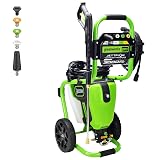
GPW3001 is the electric model I would compare when the job calls for a larger cart and a higher-pressure operating point than the smaller units here. The selected ASIN identifies GPW3001, so recommendations about similarly named Greenworks machines are not a substitute for checking this one.
The model-specific manufacturer page states 3000 PSI at 1.1 GPM and 2.0 GPM max at 100 PSI. That is an unusually useful distinction for evaluating cleaning power. The high-pressure setting does not deliver the maximum advertised rinsing volume. Anyone expecting the flow of the gas models alongside the 3000 PSI figure would be buying on an incorrect combination of numbers.
Its 25-foot Uberflex hose, 35-foot GFCI cord, and larger wheels make it a different ownership proposition from a small carry unit. I would sketch the route from outlet and faucet to driveway before deciding the cart is helpful. A hose described as kink-resistant is still something to route thoughtfully, particularly around parked vehicles, furniture legs, and edges that could snag it during a move.
There is also an operating distinction: Greenworks describes a continuous-run motor with thermal relief rather than the ePX3500’s trigger-stop arrangement. The GPW3001 manual explains shutdown and pressure relief, so I would read those instructions before the first break in a cleaning session. Its generic motor wording also differs from the brand’s brushless description; I do not turn that label into a measured noise or lifespan advantage.
The listed fan, soap, and turbo nozzle options provide several working choices without a 0° tip in this package. That does not make the turbo setting suitable for delicate paint or siding. For my purchase, GPW3001 earns consideration through its documented operating conditions and cart setup. I would choose a smaller electric washer for easier storage, or consider gas only when the intended workload supports that larger commitment.
Reasons to Buy
- Manufacturer pairs pressure with the corresponding flow.
- Wheeled cart and 25-foot Uberflex hose.
- Three fan tips plus soap and turbo options are listed.
Reasons to Avoid
- 3000 PSI and 2.0 GPM are not simultaneous specifications.
- Continuous-run operation and exact-version documentation need attention.
CRAFTSMAN CMEPW1700 — Compact Corded Electric Pressure Washer

CMEPW1700 is the option I would examine when the washer must come off a shelf for a modest task and go back afterward. A compact power washer can be a better fit than a large cart when storage is the limiting factor. I would picture the real routine—carrying the unit outside, connecting it, washing, draining, and putting it away—rather than selecting equipment for a hypothetical worst-case driveway job.
CRAFTSMAN publishes 1700 max PSI and 1.2 GPM, with a footnote tying both figures to the 40° nozzle. Its package includes that fan nozzle, a turbo tip, a soap applicator, gun, wand, and hose. That is a different set of conditions from an unrelated machine’s maximum-flow number.
The manufacturer’s manual specifies a 13 A, 120 V corded machine, a 20-foot high-pressure hose, and a 35-foot power cord. I would check whether those two separate reaches suit the working area. The cord positions the machine relative to electricity; the hose positions the gun relative to the machine. Adding the two lengths together does not describe an unrestricted cleaning radius.
The separate soap bottle is a useful inclusion for comparing complete kits, but I would not describe it as a premium foam cannon without evaluating the accessory and detergent together. Likewise, the turbo tip supplies a different spray action rather than a universal upgrade over the fan. A small cleaning task still needs a surface-appropriate method, an unobstructed working area, and time for a careful test patch.
Against ePX3500, the choice is carrying and compact storage versus a rolling base and onboard tank. Against either gas model, the question is whether its published pressure and flow are enough for the actual work—not whether the smaller machine wins a headline contest. I would skip this configuration when repeatedly carrying it around a large site defeats the point of choosing a compact electric pressure washer.
Reasons to Buy
- Compact carry-style format with onboard accessory storage.
- Supplied 40° and turbo tips plus soap applicator.
- Pressure and flow claims identify the relevant nozzle.
Reasons to Avoid
- 20-foot hose and carry format require planned positioning.
- Not my first comparison for a workload needing substantially more flow.
Sun Joe SPX3000 — Dual-Tank Electric Model with a Specification Check

SPX3000 belongs in this comparison for a specific reason: its dual-tank arrangement offers an alternative to the single tanks and separate bottles elsewhere in the shortlist. I would consider that layout when different approved cleaning solutions are part of the plan.
The current manufacturer page lists a 13 A motor, 2030 certified rated PSI, and 1.2 rated GPM. It describes two 0.9 L detergent tanks, a 20-foot hose, a 35-foot GFCI cord, and five tips. The selected offer also uses a 2500 max PSI headline. Keep “max” and “rated” separate: that headline is not a statement of 2500 PSI working pressure.
A more important issue is the older manual linked to the offer. Its technical table specifies a 14.5 A version with 1450 rated PSI and 1.24 rated GPM; 2030 PSI appears there as maximum initial pressure. These documents cannot be combined into a single confirmed delivered specification. Ask the seller for the exact unit’s rating plate and matching instructions before ordering, particularly when performance figures decide the purchase.
Independent of that unresolved revision question, I would evaluate the tank access, wand storage, and connection routine against ePX3500. Switching approved detergent products is not the same as mixing chemicals, and a tank is not a foam-cannon attachment. The two-tank layout is worthwhile only when it solves a real workflow need; otherwise, it is another feature to clean, drain, and store.
For that reason, this is a conditional candidate rather than my best electric pressure washer pick. Its current documentation describes a useful household setup, but I would not rank it above another model using a specification that the seller has not tied to the shipped version. A resolved model check can make it a sensible purchase; an ambiguous listing is a reason to pause, not borrow figures from SPX3000-XT1 or another family member.
Reasons to Buy
- Two separate detergent tanks in the described configuration.
- Fan tips, adapter, and cleaning needle are listed in the kit.
- Trigger-stop pump operation is described by the manufacturer.
Reasons to Avoid
- Current rated specifications conflict with the linked older manual.
- Do not treat a 2500 max PSI headline as a confirmed working rating.
Westinghouse WPX3400 — Higher-Flow Gas Pressure Washer

WPX3400 is my first comparison within this gas pair for a buyer deliberately choosing an engine-powered machine for larger outdoor work. It removes the need to position the cart around an electrical outlet, not the need for a suitable water supply. I would consider it for a substantial, compatible driveway cleaning plan rather than buy gas merely because occasional dirt and grime look stubborn.
The manufacturer specification pairs 3400 rated PSI with 2.6 rated GPM and identifies a 212 cc four-stroke engine with an axial-cam pump. That flow rate is the useful contrast with the electric machines here; a small difference in advertised pressure is not the whole decision. This is the gasoline WPX3400, not WPX3400e, and it does not require a battery purchase to become the selected configuration.
The manufacturer’s manual lists a 25-foot hose, a 1.6 L detergent tank, and cold-water operation. Its unpacking list includes engine oil, a funnel, gun, lance, spray tips, and assembly items. I would still read the setup procedure before filling or starting it: receiving an oil bottle is not evidence that the crankcase already contains the correct operating amount.
Ownership is a larger commitment than putting a compact electric model on a shelf. I would plan fuel storage, a safe outdoor running location, engine maintenance, and a route for moving the frame between storage and the water source. For someone who dislikes maintaining small engines, an attractive gas specification can be the wrong trade even when the cleaning area is large.
Against DXPW3300-S, I would compare the complete cart, support route, and documented flow rate rather than assume an extra 100 PSI guarantees a noticeable cleaning advantage. Against GPW3001, I would ask whether higher published flow is worth gasoline operation. This is my higher-flow choice within the six, not a recommendation to use maximum pressure on every part of a house or vehicle.
Reasons to Buy
- Higher published working flow than the electric models here.
- Onboard detergent tank and a documented starting package.
- Full manufacturer manual available for setup and storage planning.
Reasons to Avoid
- Fuel, engine care, and safe exhaust clearance are part of ownership.
- Not a compact carry unit or a substitute for a gentle cleaning method.
DEWALT DXPW3300-S — Gas-Powered Model with Pneumatic Wheels

DXPW3300-S gives this shortlist a second gas-powered pressure washer rather than another minor variation of an electric machine. I would investigate it when cart handling and local service options are important parts of the purchase. It should stand on its exact configuration, however, rather than inherit the reputation, engine, or pump details of every pressure washer sold under the DEWALT name.
The selected U.S. listing advertises 3300 PSI at 2.4 GPM, a 208 cc engine, an axial-cam pump, and 10-inch pneumatic wheels. It lists a 25-foot hose, gun, 16-inch steel wand, and 0°, 15°, 25°, 40°, and soap tips. I have kept the pump description at that supported level instead of mixing component branding from other regional or similarly named models.
I would compare pneumatic wheels with my actual storage-to-work route rather than call them universally better. A machine that must cross uneven ground raises different questions from one used beside a smooth garage apron. Wheel type also introduces a maintenance preference: I would ask how to inspect and maintain the cart as well as the engine, rather than focus only on the pump’s headline output.
The documentation limitation is material. Links attached to the offer did not yield a readable, exactly matched U.S. owner’s manual during this research. The accessories above therefore follow the selected listing; an onboard soap tank and a supplied detergent siphon hose are not established here. Before purchase, request that manual, the complete package list, and written warranty terms for DXPW3300-S specifically.
I would keep it alongside WPX3400 when comparing the complete delivered purchase and available service, not declare a winner from their small PSI difference. For a reader who wants the clearest accessible setup documentation within this pair, Westinghouse is my earlier stop. DEWALT remains an alternative after its documentation check, not a machine I have verified for commercial duty or measured against the others on a driveway.
Reasons to Buy
- A distinct gas-powered alternative with pneumatic wheels.
- Advertised pressure is paired with a flow figure.
- Gun, wand, hose, and tip set are identified in the selected offer.
Reasons to Avoid
- Exact U.S. operating manual was not retrieved.
- Detergent arrangement and complete support terms need confirmation.
Buying Guide: How to Choose the Best Pressure Washer
Types of Pressure Washers: Electric, Gas, and Battery Power
I would start with a corded electric machine for a household cleaning plan that fits its specifications and available outlets. A gas-powered model is worth comparing when the published flow, working area, and willingness to maintain an engine point that way. Neither choice removes the need to read the exact manual, confirm the inlet requirements, and find a safe place to stand.
A battery-powered pressure washer is a separate buying brief and is not represented by the selected six. Do not confuse “electric” with cordless. Similarly, shops may use “pressure washers and power washers” loosely; every model here is intended for cold-water supply, not steam cleaning or a heated-water job. I would choose the equipment by its actual instructions rather than infer capabilities from a category label.
PSI and GPM: Read Cleaning Power at the Same Operating Point
PSI means pounds per square inch; GPM means gallons per minute. Manufacturer guidance explains why both matter: pressure and rinsing flow describe different parts of the cleaning process. Ask which flow rate accompanies the advertised pressure, with what tip and test conditions. A maximum-pressure label alone cannot tell you how quickly a washer will remove a particular stain.
The arithmetic also needs matching inputs. Greenworks’ documented 3000 PSI at 1.1 GPM gives 3300 when multiplied. Multiplying that pressure by its separate 2.0 GPM low-pressure maximum would give 6000, but would describe an operating point the brand does not claim. Even correctly paired “cleaning units” are not a measured prediction of cleaning time, finish quality, or safety on siding.
For my decision, a powerful electric pressure washer is useful only when the surface and job justify its available pressure. A label such as 2000 PSI and 1.2 GPM is not automatically inferior to a higher-pressure setting with less water flow. I would decide whether I need more pressure, more rinsing volume, a different detergent process, or simply easier setup before paying for a larger machine.
Hose, Cord, and Ease of Use: Plan the Whole Route
Measure from the faucet and outlet to where the machine can safely sit, then from that point to the furthest cleaning area. The garden hose supplies the pump; the high-pressure hose connects it to the gun. Think about the complete cord and hose arrangement around a parked car or across a patio. A 25-foot hose can be convenient without solving every reach problem.
Read the model’s circuit, inlet pressure, and minimum supply-flow requirements before purchase. Follow the manual’s electrical connection rules; do not assume an extension cord is acceptable because its plug fits. My preference is a setup within the supplied cord’s reach of an appropriate GFCI-protected outlet. Keep connectors out of runoff, and never substitute a modified cable for an inconvenient working location.
Spray Tips, Foam Cannon, and Surface Cleaner Compatibility
Tip choice matters more than tip count. The nozzle guidance distinguishes broad fan patterns from concentrated jets and low-pressure soap application. For routine household work, I would not reach for a 0° jet. A turbo nozzle also needs surface-specific caution; rotation is not a guarantee against damage. Start with the surface maker’s approved method and test an inconspicuous area.
Check the actual nozzle list before comparing bundles. ePX3500’s five-tip set includes turbo but not 40°; Greenworks lists three fan angles, soap, and turbo. A separate foam cannon is not established in either selected package. Before adding one, match its pressure and flow requirements, connection type, and approved detergent rather than assume the same accessory suits every electric washer.
A surface cleaner deserves the same check: minimum and maximum flow, pressure rating, connector, and suitable surface. I would not buy an oversized attachment simply because it promises fewer passes across a driveway. Price any required accessories with the machine, and do not count a replacement fitting as proof that an otherwise incompatible attachment is suitable.
Cars, Siding, and Driveways: Match the Method to the Material
Make a job list before making a specification list. For vehicle washing, my priority would be a controlled, manufacturer-approved process and convenient positioning, not the strongest available jet. For siding, I would first establish whether its manufacturer permits pressure washing at all. Worn finishes, openings, and fragile details can change the decision even when another area of the same property tolerates a different method.
For a driveway, identify the surface, stain, and permitted cleaning chemistry. Do not assume higher pressure is the answer to oil stains or that a cold-water machine can remove every mark. I would separate the tasks that need rinsing from those requiring a suitable treatment, professional advice, or a different tool. A pressure washer’s overall cleaning power is not a promise to restore every surface to new condition.
For a separate vehicle-care task, my portable tire inflator comparison covers checking and topping up tire pressure. The point is to build a useful care kit around distinct jobs, not expect one outdoor-cleaning machine to replace unrelated equipment.
Soap, Detergent, and the Complete Purchase
Look at how soap enters the system: an onboard tank, a separate soap dispenser, or a specified siphon arrangement are not the same thing. Manufacturer detergent guidance calls for products approved for pressure-washer use. Also match the cleaner to the surface and follow its label. Do not mix chemicals, assume ordinary household bleach is acceptable, or improvise a concentration from foam appearance.
My checkout comparison would include the machine, essential compatible accessories, delivery, and the storage setup. Ask how to obtain a replacement gun, seal, or hose for the exact version. Compare written warranty coverage rather than one headline duration. Commercial pressure washers are a separate duty and support question; an open frame or large PSI rating does not establish commercial suitability for these household selections.
How to Use a Pressure Washer: Safety, Shutdown, and Storage
Plan the work area before starting. Follow the delivered model’s manual and the surface manufacturer’s instructions. Clear bystanders and pets, use appropriate eye protection and footwear, and maintain stable ground-level footing. Do not work from a ladder with a reacting spray gun. Point the spray away from people, animals, electrical equipment, and anything the chosen pattern could damage.
Gas machines belong outdoors. The CDC’s pressure-washer safety guidance says to keep gasoline-powered equipment at least 20 feet from doors, windows, and vents. Never run it in a garage, even with the door open. Carbon monoxide is an additional hazard, not something solved by choosing a wider spray tip or taking short cleaning breaks.
Treat high-pressure injuries seriously. The same CDC guidance warns that a wound can look minor while causing serious harm. Seek prompt medical care after a high-pressure spray injury. For electric models, test the GFCI as directed, inspect the cord, and keep connections dry. A low purchase price or modest PSI label does not remove electrical or injection hazards.
Use the model’s connection and purge procedure. The Westinghouse gas manual and CRAFTSMAN manual describe water connection, preparation, and inspection before operation. Do not start or keep a pump running without the required water supply. Make sure fittings are secure, the inlet is clear, and the selected tip is properly retained. Never force a damaged connection into service.
Shut down properly for changes and breaks. Follow the exact stop, isolation, and pressure-relief sequence before disconnecting equipment or changing accessories. Greenworks explains its thermal relief and shutdown procedure; a continuous-run motor is not the same as an automatic trigger-stop pump. Do not leave a running machine unattended or interpret a protective valve as permission for unlimited idle time.
Drain, inspect, and store for the conditions. Follow the supplied winterization and cleaning instructions; trapped water and freezing are not addressed by merely coiling the hose neatly. Replace damaged high-pressure components with approved parts rather than patching them. Let hot equipment cool, and handle fuel or engine maintenance only as the gas manual permits. Record the exact model and keep its instructions with the purchase details.
My pre-purchase check: “For this exact version, what pressure and flow occur together, what does the kit include, which surfaces are permitted, and where do I get its manual and replacement parts?” Those answers matter more than another unqualified maximum.
Frequently Asked Questions About Pressure Washers
Which model is the best electric pressure washer for everyday home use?
Within this shortlist, ePX3500 is my first comparison for a compact rolling setup. I would choose a different direction for carry-style storage, a higher-pressure corded operating point, or a specific detergent arrangement. That recommendation is conditional on the surface, supply, and working area; it is not a result from a comparative cleaning test.
Is a 3000 PSI pressure washer automatically better than a smaller one?
No. Compare the flow rate available at that pressure, the surface requirements, and the complete working setup. GPW3001’s manufacturer pairs 3000 PSI with 1.1 GPM, not its separate 2.0 GPM maximum. A higher PSI rating can be the wrong priority when the real problem is access, rinsing volume, or a cleaning method unsuitable for the material.
Which is the best gas option in this six-model comparison?
I would start with WPX3400 for its published flow and accessible setup documentation, then compare DXPW3300-S for its cart, selected configuration, and service options. Neither is my automatic recommendation for occasional light cleaning. Buying gas also means planning fuel, engine care, and a safe outdoor operating location.
Can I wash a car or house siding with any model here?
Do not assume so from the product category. Check the vehicle or siding manufacturer’s method, the washer’s instructions, the spray pattern, and the surface condition. None of these PSI figures is a universal safe setting. I would avoid a concentrated jet for routine car or siding cleaning and choose another method when approval or surface condition is uncertain.
Do these packages include a foam cannon or surface cleaner?
The selected packages list various tanks, soap tips, or applicators; those are not interchangeable with a separately specified foam cannon. A surface-cleaner attachment was not established as included in these six selections. Verify the seller’s package and accessory compatibility instead of relying on a staged photograph or a bundle option selected elsewhere.
Why does the Sun Joe SPX3000 have different ratings in different documents?
The current brand page and the older manual attached to the selected offer do not agree on rated output or motor amperage. The retrieved materials do not establish which document describes a seller’s physical stock. I therefore show the discrepancy and ask for the delivered version’s rating plate and manual rather than declare one set of figures correct for every SPX3000.
Do I need a separate water supply with a gas power washer?
Yes: engine power does not supply the water. Use the cold-water source and inlet conditions specified for the exact model, and follow its preparation procedure. Do not assume self-priming, tank-fed operation, or hot-water compatibility without explicit manufacturer approval. Disconnecting electrical power from the buying decision does not remove the water-supply check.
Final Verdict: Choose for Your Cleaning Jobs, Not Just Maximum PSI
My general-home choice to compare first is Westinghouse ePX3500. Greenworks GPW3001 is the higher-pressure electric alternative, while CRAFTSMAN CMEPW1700 is the compact carry option. Those are different advantages; the best choice depends on how the equipment will be moved, connected, and stored between jobs.
Sun Joe SPX3000 remains a dual-tank candidate after its delivered-version documentation is confirmed. Among the gas washers, I would investigate Westinghouse WPX3400 first for the published flow and available manual, then assess DEWALT DXPW3300-S with its exact instructions and complete package in hand.
The best pressure washer for your home should fit the surface, the person operating it, and the complete ownership routine. Choose an appropriate spray method and verified configuration before chasing another PSI increase. Better preparation is a more useful goal than turning a set of separate marketing maxima into a performance promise.
Sources and Product Documents
Reviewed October 7, 2026. Specifications and package descriptions may change. Sources below distinguish manufacturer material from selected listings; no hands-on testing, complete recall audit, or seller-stock inspection was performed. The manual delivered with the exact unit remains essential.
- Scope: Six ASINs from the October 7, 2026 WPH01 export, job WPH-20261007094944447-best-pressure-washer-NRVR8J, were retained. NeuronWriter terms informed headings and coverage, not product facts. Editorial choices apply to these configurations and stated use cases.
- Westinghouse ePX3500 — B0BVGSX46M: current manufacturer page; earlier manufacturer-authored manual hosted by Lowe’s, specification page 3. The current page lists 1.2 rated GPM; the earlier table uses 1.24. The current large manual download could not be read, so it is not represented as reviewed.
- Greenworks GPW3001 — B09ZKZLWDV: exact listing identity; GPW3001 manufacturer page, SKU 5113902VT; manufacturer manual for GPW3001/PWA211, including operating and specification pages. Brand copy calls the motor brushless; a generic manual table says “Universal Motor.” Warranty wording also varies across materials. No measured motor or durability advantage is inferred; GPW3002/GPW3002A specifications are not substituted.
- CRAFTSMAN CMEPW1700 — B085285X4J: manufacturer page, package and nozzle footnotes; manufacturer’s North American manual, including specifications and safety/maintenance sections. This is a corded unit; an inconsistent battery field on the web page is not treated as a supplied battery.
- Sun Joe SPX3000 — B00CPGMUXW: current manufacturer specification; selected offer; older manufacturer manual linked to that offer, technical data on printed page 5. Current 2030 rated PSI/1.2 GPM/13 A and older 1450 rated PSI/1.24 GPM/14.5 A are not reconciled by the retrieved documentation.
- Westinghouse WPX3400 — B094DWHPDL: manufacturer specifications; manufacturer manual covering WPX2700/WPX3200/WPX3400, specification and unpacking tables plus operating guidance. Only the WPX3400 column is used. WPX3400e is a separate electric model.
- DEWALT DXPW3300-S — B09ZHG2NDM: selected U.S. listing supports the advertised engine, output, cart, and listed accessories. Linked PDFs did not yield a readable matched U.S. manual. An onboard detergent tank, included oil, and a complete warranty package are not assumed; other regional DXPW3300 materials are not substituted.
- General guidance: CDC pressure-washer safety; manufacturer FAQ on pressure, flow, tips, detergent, and use. These provide general context, not permission to ignore a particular machine’s instructions or a surface manufacturer’s restrictions.