
If your aquatic plants are yellowing, melting, or just stalling out, the light is almost always the issue. If you are looking for the best aquarium LED lights to make your plants thrive, you have come to the right place. The stock fixtures that come with beginner kits barely meet the needs of a true freshwater planted tank. You want the right spectrum, meaningful PAR at the substrate, and fine-grained control to mimic sunrise, sunset, and the softer transitions in between.
The good news: smart LED lighting for planted tanks has finally matured. Bluetooth and app control aren’t gimmicks anymore — they’re standard. Whether you’re running a dense 55-gallon Dutch or a minimalist 20-gallon rimless iwagumi, there’s a smart LED here that fits your setup.
I reviewed specs, sifted through long-term owner feedback from planted tank communities, and cross-checked manufacturer data to assemble this guide. No fluff — just the details that help you pick a light that grows real plants.


- 🏆 Best Overall: Chihiros WRGB VIVID3 — easily the most capable full-spectrum LED aquarium light in this roundup
- 💰 Best Budget-Friendly Smart Pick: hygger 40W — app control and a true 24/7 cycle at a budget-friendly price
- 🌿 Best for Mid-Size Planted Tanks: hygger 50W — the sweet spot for 36″–42″ planted aquariums
- 🔬 Best Premium Single-Unit: AquaIllumination AI Prime 16 — precise spectrum tuning for serious aquascapers
How I Evaluate These Products
Using technical analysis, manufacturer specs, and aggregated long-term owner reports, I evaluate planted tank LED lights on criteria that differ from fish-only setups. Plants don’t care how the light photographs — they care about how many useful photons arrive at the substrate.
Here’s what actually matters when I assess a smart aquarium light for planted tanks:
- Spectral output: Does it hit deep red near 660nm (key for photosynthesis), include strong blue diodes around 450nm, and provide balanced 6500K white to mimic natural midday sun?
- PAR at depth: Lumen counts are mostly noise. What counts is photosynthetically active radiation reaching the substrate, especially in tanks deeper than ~14 inches.
- App and dimmer quality: Is Bluetooth/WiFi stable? Can it simulate sunrise/sunset ramps? Does the app behave reliably?
- Build longevity: Aluminium heat sinks, IP67 sealing, and solid drivers determine how well a fixture survives a humid tank environment.
- Value for tank size: Overspec’ing a tiny tank wastes money. I match wattage and coverage to realistic use-cases.
At WisePicksHub, I don’t claim to have run every single unit for months over my own tanks. What I do is cut through marketing with lighting fundamentals and vetted community feedback to help you find the best aquarium LED lights for your specific setup.
Why LED Spectrum Engineering Matters for Planted Aquariums
Fluorescents held the crown for decades and worked — sort of. The problem was control. You were stuck with whatever spectrum the bulb maker chose. If it lacked in red or blue, plant growth paid the price.
Modern LED spectrum engineering changed the game. Quality planted tank LEDs blend 6500K white (mirroring overhead sunlight), reds peaking near 660nm (highly efficient for chlorophyll-A), and blues that encourage compact growth and richer pigmentation in stems and mosses.
WRGB — white, red, green, blue — goes further. Instead of a fixed blend, WRGB fixtures let you adjust each channel independently. That’s why brands like Chihiros and Twinstar have loyal followings. Dial up red for carpeting plants, back off blue to curb algae pressure — this control genuinely matters.
- 6500K white light closely approximates midday natural sunlight above water, the condition most freshwater aquarium plants evolved under
- 660nm red LEDs efficiently drive photosynthesis — it’s functional, not cosmetic
- Blue diodes around 450–470nm promote tight internodes and enhance reds/purples in species like Alternanthera reineckii
- CRI (Color Rendering Index) above 90 keeps fish colors accurate and makes plant health easier to judge at a glance
Full-spectrum coverage that checks all these boxes — with dimming and app control — is the modern baseline. Anything less means fighting your own system.
My Top Picks: The Best Aquarium LED Lights Reviewed
Chihiros WRGB VIVID3: The Planted Tank LED That Doesn’t Apologize for Its Price
I’ll say the obvious thing up front: this is a premium-priced unit for an aquarium light. If that gives you pause, fair enough. But the Chihiros WRGB VIVID3 isn’t trying to battle budget bars — it targets ONF Flat One, Week Aqua, and high-end Twinstar territory, where it compares well.
The VIVID3 pushes 180W with true WRGB full spectrum. It’s built to grow high-demand plants — Eriocaulon, Buce in deeper tanks, even finicky red stems — without compromise. Independent WRGB channel control through the app is seriously granular. You can craft a spectrum profile that used to require multiple fixtures.
Community sentiment is overwhelmingly positive, backed by a 5.0 rating. That’s rare enough to matter. Some users note a learning curve with the app — there are lots of options — but that’s a feature for dedicated planted tank keepers, not a flaw.
It handles planted freshwater tanks and macro algae marine applications — a good indicator of its output range. Scheduling and timer features are well-executed. The fixture feels premium: rigid, well-machined aluminium, proper heat dissipation, and no flimsy plastics.
- Independent WRGB channels for precise planted aquarium tuning
- 180W output — excellent for large, deep, high-demand tanks
- App-based scheduling with robust timer and lighting profiles
- Works for both freshwater planted and macro algae marine setups
Lominie 80W LED: When Your Tank Has an Awkward Spot That Nothing Else Fits
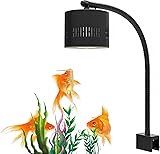
Think of a 15-gallon cube refugium on a tight shelf, or a tall rimless 20-gallon where a full rail bar just doesn’t mount cleanly. The Lominie 80W clip-on feels purpose-built for that. Its 360° gooseneck arm gives you placement flexibility rigid rails can’t — aim it at a specific carpet zone, or pull intensity off a low-tech side.
At an aggressive price point for 80W of full-spectrum output, the watt-per-dollar value is hard to ignore. The included dimmer remote (note: no app control — this isn’t a Bluetooth smart unit like Hygger or Chihiros) keeps it straightforward. If you don’t want phone-based scheduling, that’s a plus, not a minus.
The 4.6 rating lines up with owner feedback. The gooseneck holds position without drooping — a common failure point on cheaper clip-ons. On 10-gallon tanks, folks often find it too strong at max, which means real headroom to dial back and favor steady plant growth over algae spikes.
- 360° gooseneck for precise aim — perfect for cubes and refugiums
- Includes a dimmer remote for easy intensity control
- Full-spectrum output that reliably supports freshwater plants
- Clip-on mounting — no drilling or tank modification
Fluval Aquasky 2.0: The Most Practical Smart Aquarium Light for Everyday Planted Setups
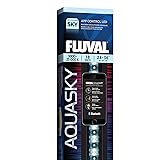
Fluval took a different approach than Chihiros or AquaIllumination. Instead of chasing raw power, the Aquasky 2.0 delivers an 18W Bluetooth LED designed for 24″–36″ owners who want stable smart features and a painless setup — and it nails that brief.
The IP67 waterproof rating stands out. Many lights at this tier only offer splash resistance. IP67 means submersible up to 1 meter — so water changes, feeding splashes, and humid canopies aren’t threats. That’s real engineering value at this price point.
The RGB plus 6500K white array covers the spectrum most planted tanks need. A 120-degree wide light spread delivers genuinely broad coverage, reducing shadowing behind taller stems compared to narrow-beam designs. Some users report occasional Bluetooth re-pairing after phone OS updates — mildly annoying, but manageable.
Weather simulations and a fully automated 24-hour cycle make this a bona fide smart light. Thunderstorms, passing clouds, slow sunsets — they create a more natural photoperiod for fish and plants. With a consistent 4.6 rating, it’s an easy recommendation for mid-size planted aquariums.
- IP67 waterproof — far beyond basic splash resistance
- RGB + 6500K white for solid planted-tank spectrum coverage
- App-controlled weather effects and 24-hour cycles
- Wide 120° beam that cuts down on shadowing
Hygger 40W Smart Light: The Right Entry Point for a 30″–36″ Freshwater Tank
The hygger 40W is the step-up I recommend to most hobbyists leaving a stock light behind. It won’t out-punch Twinstar or ONF, but for a budget-friendly price the package is compelling.
You get full Bluetooth app control, a real 24/7 cycle, five lighting modes, and an adjustable timer. For a 30″–36″ planted tank, that’s a complete feature set. The app lets you customize each phase — ramp up to midday, then taper to a gentle red/blue dusk before lights out. That kind of automated photoperiod supports plant health and keeps algae in check.
The 4.2 rating is fair. The build isn’t as robust as Fluval or Chihiros — thinner aluminium, and rimless fitment can need minor tweaks on tightly covered tanks. But the essentials — grow plants, look good, run on schedule — are reliable.
- Bluetooth app with five modes tailored for planted tanks
- Automated 24/7 cycle with adjustable timer
- Covers 30″–36″ layouts — great for standard 20-gallon and similar
- Full-spectrum output that supports common aquarium plants
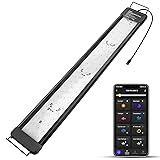
Hygger 50W Smart Light: Splitting the Difference Between Small and Large Planted Tanks
This 50W model sits neatly between the 40W and 60W, and it’s the one to get if your tank measures 36″–42″ — a range many brands skip over. Plenty of 40–48 gallon planted tanks live here.
At a modest step up in price, the move from 40W makes sense once you factor in coverage. Run a 40W on 42″ and the corners fade — plant growth at the edges lags. The 50W fills that gap without jumping to the 60W tier.
Feature-wise, it mirrors the 40W: Bluetooth app control, five modes, 24/7 scheduling, and a proper full-spectrum output for planted tanks. The 4.2 rating matches the series — dependable performance, slightly plasticky feel, functionally complete for most hobbyists.
- 50W coverage tuned for 36″–42″ planted tanks
- Bluetooth control with five customizable modes
- Full 24/7 automation plus adjustable timer
- Full-spectrum LED suitable for moderate to higher light needs

Hygger 60W Smart Light: The High-End Hygger for a 48″–55″ Planted Aquarium
A 48″–55″ planted tank is a serious project. Bigger bio-load, more ambitious hardscape — and getting even light without hot spots is tough. The hygger 60W, at a reasonable price for its size, is built for this challenge.
In this category, many fixtures cost a lot more without meaningfully better app control or spectrum. The 60W version delivers the same full-spectrum output, 24/7 automation, Bluetooth connectivity, and timer control as the 40W/50W — just scaled up. For a 55-gallon, that consistency inspires confidence.
The same caveats apply: occasional re-pairing after major app/OS updates, and long-tank mounting can feel a touch imprecise on first install. Neither is a dealbreaker. For the money, it’s one of the stronger smart LED values for this size range. Rating holds at 4.2.
- 60W sized for 48″–55″ planted aquariums
- Full-spectrum LED with Bluetooth app control
- Five lighting modes and an automated 24/7 cycle
- Adjustable timer for set-and-forget photoperiods

AquaIllumination AI Prime 16: Precision Spectrum Control for the Serious Aquascaper
The AI Prime 16 is the most technically advanced single unit in this list. At a mid-premium price, it’s aimed at aquascapers who think like 2hr aquarists — not casual plug-and-play users.
Its hallmark is granular, multi-channel spectrum control. You’re not just dimming; you’re programming individual channels — multiple whites, blues, enhanced reds — via one of the most polished lighting apps in freshwater. The AI community is huge on both planted and marine sides, with shared presets for specific plants and layouts.
It’s notably energy-efficient for the output it delivers — a long-standing AquaIllumination strength. The fixture is compact and solidly built. It does rely on a proprietary mount (flex arm or rack), so account for that if you’re running rimless.
With a 4.3 rating, it’s not universally adored — largely because the depth of options can overwhelm plug-and-play expectations. It rewards users who want to engage with their lighting.
- Multi-channel spectrum control for pinpoint photosynthetic tuning
- Highly detailed app scheduling and interface
- Energy-efficient LED engineering with a strong track record
- Compact form factor — great on nanos or mid-size tanks with proper mounting

Buyer’s Guide: What Actually Matters When Choosing a Smart LED Planted Tank Light
Choosing the best aquarium led lights is about more than wattage. Here’s the practical framework — minus the marketing gloss.
Match the Light to Your Tank Size First, Everything Else Second
A nano light built for 10 gallons won’t carry demanding plants in a 40. You can’t cheat physics: PAR falls off with distance and spread.
General sizing guidelines for planted aquarium LED lights:
- 5–20 gallon tanks: 10W–30W nano LED or a clip-on lamp (the Lominie’s gooseneck is especially useful)
- 20–40 gallon tanks: 40W–50W smart bar covering 30″–42″
- 40–55 gallon tanks: 60W+ or a high-intensity single unit like the AI Prime 16 with supplemental coverage
- Large or deep tanks: Consider the 180W Chihiros WRGB VIVID3, or multiple units — a single 60W rarely saturates a 55’s depth evenly
Understanding 24/7 Lighting Cycles and Why Photoperiod Matters
Plants don’t need “more” light; they need consistent, well-timed light. An 8-hour moderate cycle typically beats 12 hours at high intensity for algae control while still driving strong growth. Any smart LED worth buying in 2026 should automate this.
Look for gradual sunrise/sunset ramps — not hard on/off. Abrupt changes stress fish and disrupt circadian rhythms. Fluval’s weather modes, Hygger’s 24/7 cycle, and the Chihiros app all implement smooth transitions well.
Dimmable Control Is Non-Negotiable for New Planted Tank Setups
Blasting a new tank at full power is a fast track to green water. The biology isn’t ready yet. A dimmable LED — via app, remote, or dial — lets you start around 50%–60% and ramp up over 4–6 weeks as the tank stabilizes. This is standard practice in the planted community and central to the 2hr aquarist approach.
App Stability: What the Reviews Actually Tell You
Bluetooth control has improved a lot, but it’s not perfect. Watch for:
- Hygger uses Bluetooth — pairs solidly within ~10–15 feet, but struggles through thick walls
- Fluval’s Aquasky app sometimes needs a quick re-pair after major iOS updates
- AquaIllumination’s platform is mature, with strong long-term firmware/app support
- Chihiros offers deep functionality — expect 20–30 minutes to dial in your first profile
Common Mistakes When Buying Smart LED Planted Tank Lights
Mistake #1: Buying by Wattage Alone Without Checking Spectrum
A 60W light heavy on cool white with weak reds can underperform a well-tuned 30W full-spectrum that hits 660nm red and solid blues. Wattage reflects energy use, not plant performance. If a brand won’t publish spectral peaks, consider that a warning sign.
Mistake #2: Ignoring IP Rating for High-Humidity Environments
Planted tanks evaporate constantly. High humidity near the surface can damage drivers if the fixture isn’t sealed. IP67 (like on the Aquasky 2.0) means moisture intrusion is a non-issue. A non-rated bar two inches above a 78°F tank will live a shorter life — full stop.
Mistake #3: Skipping the Lighting Cycle Setup and Running Lights Manually
This is the beginner classic: buy a good light, then flip it on and off by hand. Inconsistent schedules confuse plants, fuel nutrient swings, and almost always lead to hair or green spot algae in weeks. Use the timer. Set the 24/7 cycle. Let the system work for you.
Final Verdict: Which Smart LED Planted Tank Light Should You Actually Buy
If you’re building a serious planted tank — high-light species, competitive aquascape, demanding plants — the Chihiros WRGB VIVID3 is the pick. The WRGB control, build quality, and 180W output aren’t overkill if you’ll use them. Nothing else here offers that level of customizable aquarium LED control.
For most hobbyists running standard 30″–55″ freshwater setups, the hygger Smart series (40W/50W/60W by size) is the practical choice. App control, proper scheduling, full-spectrum output — and the price-to-performance ratio is strong.
If waterproofing and dependable smart features matter more than raw power on a mid-size tank, the Fluval Aquasky 2.0 earns its 4.6 rating. IP67 alone sets it apart from much of the field.
And if your tank shape or space is tricky — cubes, refugiums, tight cabinets — the Lominie 80W clip-on with its 360° gooseneck solves a physical puzzle nothing else here addresses. It’s more capable than it looks, and 80W of full spectrum is serious plant-growing power.
Frequently Asked Questions
What PAR level do I need from the best aquarium LED lights to grow carpeting plants like Hemianthus callitrichoides?
HC Cuba and similar carpets generally need 50–80 µmol/m²/s at the substrate; the most demanding variants push toward 100+. At those intensities you’ll want CO2 injection alongside the light — otherwise excess photons feed algae instead of plants. Units like the Chihiros WRGB VIVID3 or AquaIllumination AI Prime 16 can reach those numbers; budget lights usually can’t sustain them at substrate depth beyond ~12 inches.
Is WRGB full spectrum better than a standard 6500K white LED light for freshwater planted tanks?
For most hobbyists, a well-designed 6500K full-spectrum LED is plenty. WRGB really shines when you want independent control — pushing red to boost stem plants, or trimming blue to manage pigmentation and algae dynamics. If you’re not tuning at that level, a strong 6500K fixture with solid 660nm red (like Fluval Aquasky or the hygger Smart series) will grow healthy plants without the extra complexity.
Can I use the Hygger Bluetooth smart light with a low-tech, no-CO2 planted aquarium?
Yes — in fact, the hygger Smart series is excellent for low-tech. Dimmable control and 24/7 automation let you keep intensity conservative (around 50%–70%), which reduces algae pressure that non-CO2 systems can’t buffer as well. An 8-hour photoperiod via the app is easy to set, and the spectrum is strong enough for Monte Carlo, Java moss, and most Anubias without added carbon.
Does the Fluval Aquasky 2.0 produce enough light intensity to grow medium-light aquarium plants in a 29-gallon tank?
At 18W over a standard 29 (30″ long, 18″ deep), the Aquasky 2.0 sits squarely in medium light. Crypt wendtii, Vallisneria, Amazon swords, and most low-to-medium stems do well. You won’t max out rotalas or run HC Cuba without help, but for a natural-style planted tank, it’s genuinely capable — and the 120° beam spreads light evenly across the floor.
How do I prevent algae when first setting up a new planted tank with a high-powered LED like the AquaIllumination AI Prime 16?
Start at 40%–50% intensity for the first 2–3 weeks, regardless of the fixture’s ceiling. Early on, biology lags and extra light feeds green algae. Use the app to cap the photoperiod at 7–8 hours during break-in. Then raise intensity in ~10% steps weekly or biweekly, watching for early algae on glass and leaves. This “ramp-up method” applies to any high-performance smart LED, not just the AI Prime.