
As an Amazon Associate, I earn from qualifying purchases.
The best automotive battery charger is the one that matches your battery and the job you actually need to do. Bringing a discharged car battery back to service, maintaining a parked vehicle, and supporting a workshop repair are different tasks. A large amp rating does not make one charger the right answer to all three.
For a home garage centered on conventional lead-acid and AGM batteries, my overall pick from these six is the Clore Automotive PRO-LOGIX PL2320. Its selectable charging rates, 6 V/12 V coverage and separate power-supply function give it a useful combination of everyday capabilities. I would choose the Battery Tender Plus for a storage-first setup and the NOCO GENIUSPRO50 for documented multi-voltage workshop requirements—not simply because it has the largest number on the label. [1] [6] [13]
This comparison covers the six selected U.S.-market listings. It focuses on battery compatibility, charging controls, maintenance behavior and included connections rather than star ratings or untested speed claims.
Editorial Note: This is a research-based comparison, not a hands-on test. I reviewed manufacturer specifications, operating manuals and the selected listings. Recommendations are my assessment of those documented features. I have not measured charging speed, restoration success, temperature rise or long-term reliability. Prices and seller availability can change; check the linked offer before buying.
Key Takeaways
Start with compatibility: battery voltage and chemistry come before charging current. The reviewed CTEK, Battery Tender and TowerTop versions are 12 V products; the Schumacher and Clore also cover 6 V; the NOCO adds 24 V. [1] [4] [6] [8] [11] [13]
Match the job: the Battery Tender’s 1.25 A output suits a maintenance-first shortlist, while the higher-current models offer different charging and workshop options. These are documented capability differences, not results from a head-to-head charging test. [6] [13] [17]
Read mode-specific warnings: repair, recondition, force and power-supply modes are not interchangeable with ordinary automatic charging. A charger’s normal protections may not apply in every operating mode. [5] [14]
Top Picks Summary
Best Overall for a Home Garage — Clore Automotive PRO-LOGIX PL2320. My choice for a varied 6 V/12 V lead-acid charging routine, with selectable rates and a separate supply mode. [1]
12V Battery-Care Pick — CTEK MXS 5.0 NA. An alternative for drivers who favor a lower-current charging and maintenance unit over workshop power functions. [3] [4]
Storage-Maintenance Pick — Battery Tender Plus. A straightforward choice when maintaining a compatible parked vehicle is the main purpose. [6] [7]
Simple Automatic Pick — Schumacher SC1280. Automatic 6 V/12 V detection with a 15 A rating at 12 V and float maintenance. [8]
Manual-Control Pick — TowerTop BC0253. Selectable 2/10/25 A charging, an LCD and a manual winter setting. [11] [12]
Professional Multi-Voltage Pick — NOCO GENIUSPRO50. The specialist option here for 6 V/12 V/24 V batteries and higher-output supply work. [13] [14]
Automotive Battery Charger Comparison Table
Current figures below describe charger output, not engine-start current. Check each battery manufacturer’s permitted charging rate. “Included accessories” lists confirmed connections and items, not every possible retailer bundle.
| Product | Battery Voltage | Charging Current | Maintenance | Supported Battery Types | Included Accessories |
|---|---|---|---|---|---|
| Clore PL2320 | 6 V / 12 V | 2 / 10 / 20 A | Automatic multi-phase | STD, AGM, GEL and other listed lead-acid types; lithium requires revision confirmation | Attached clamp leads; separate accessory bundle not verified [1] [2] |
| CTEK MXS 5.0 NA | 12 V | 0.8 / 4.3 A | Float / pulse | Lead-acid, including AGM and EFB; no lithium mode | Charge clamps and manual confirmed; check the offer for additional connectors [3] [4] [5] |
| Battery Tender Plus | 12 V | 1.25 A | Automatic float | Flooded, AGM, GEL and sealed lead-acid | Two-in-one alligator clips / ring-terminal cable; manual [6] |
| Schumacher SC1280 | 6 V / 12 V | 2 A at 6 V; up to 15 A at 12 V | Automatic float | Standard and AGM; current manufacturer page also lists GEL and deep-cycle lead-acid | Clamp leads; user manual [8] [9] |
| TowerTop BC0253 | 12 V | 2 / 10 / 25 A / Auto | Float / pulse | STD, AGM and GEL lead-acid | Battery clips; instruction manual [11] [12] |
| NOCO GENIUSPRO50 | 6 V / 12 V / 24 V | 50 A at 6/12 V; 25 A at 24 V | Automatic | Listed lead-acid types and LiFePO4 batteries with a BMS, in the correct mode | Clamps with removable eyelets, 10 ft extension, EVA case and AC leads; regional contents vary [13] [14] [15] |
Version matters: the CTEK entry is the North American 40-206 model, and the TowerTop entry is the 12 V BC0253 linked to the selected ASIN. Do not substitute specifications from another regional version or another TowerTop model. The Clore lithium documentation caveat is explained below. [2] [3] [5] [11]
Product Reviews
Clore Automotive PRO-LOGIX PL2320 — Best Overall for a Home Garage


The PL2320 is my first choice when the shopping brief is broader than keeping one parked car topped up. It offers 2 A, 10 A and 20 A settings for 6 V/12 V charging, rather than locking every job to one output. Its documented lead-acid coverage includes conventional flooded, AGM and gel batteries. That combination makes it a sensible starting point for a garage shortlist, provided the battery’s own charging requirements match. [1]
My reason for choosing it is flexibility, not an assumption that 20 A is always better. I would value the lower setting when the battery calls for it, and the higher settings when a compatible battery and the job justify them. Someone maintaining only one vehicle during storage has a narrower requirement; for that buyer, I would compare the simpler Battery Tender before choosing a unit with additional workshop functions.
Clore documents a multi-phase process with soft-start and reconditioning behavior, followed by storage-management phases. The display can show voltage or charge percentage. I would use those readings as operating feedback, not as a substitute for a battery-health diagnosis. The same manual instructs users to check the charger daily during extended maintenance; “automatic” is not a promise to ignore the setup indefinitely. [2]
A separate 0–20 A power-supply mode is the feature that makes this especially interesting for repair work. It is intended to help maintain system voltage, but the instructions specifically exclude vehicle-module flash programming. I would not buy it as a universal programming supply, even when a seller groups those tasks together. Choose the equipment required by the actual service procedure. [2] [18]
Check the lithium revision before buying: Clore’s linked manual mentions LiFePO4 support, yet its operating instructions and illustrated control panel still show STD, AGM and GEL. I have therefore based this recommendation on the clear lead-acid capabilities. For lithium, obtain confirmation for the delivered unit and its dedicated setting rather than relying on the model name alone. [2]
Reasons to Buy
- Three selectable charging rates and 6 V/12 V coverage.
- Separate power-supply function for appropriate repair tasks.
- A useful all-purpose shortlist candidate for lead-acid garage work.
Reasons to Avoid
- Not a vehicle-module flash-programming supply.
- Lithium compatibility needs exact-unit confirmation.
- More functions than a storage-only buyer may need.
My take: choose the PL2320 for its range of jobs, not for a claimed speed advantage. For a lead-acid-focused home garage, its adjustable output is the strongest reason to start here. [1] [2]
CTEK MXS 5.0 NA — 12V Battery-Care Pick

The CTEK makes sense when the goal is routine care of a compatible 12 V lead-acid battery, rather than high-output workshop support. The selected product is MXS 5.0 NA, item 40-206. Despite its name, this North American version has a maximum charging current of 4.3 A, plus a 0.8 A small-battery program—not a 5 A output. [3] [5]
That distinction changes how I would shop. I would consider the CTEK for regular charging and maintenance where a modest output is acceptable, but I would not choose it to duplicate the Clore’s higher-current role. There is no reason to pay for capabilities you do not need; equally, a buyer whose priority is repeated higher-current charging should not mistake the CTEK’s model number for a comparable output specification.
CTEK documents an eight-step sequence, temperature compensation, an AGM setting and float/pulse maintenance. Its North American sheet separates the charging range—1.2–110 Ah—from maintenance up to 160 Ah. That is a useful distinction: permission to maintain a larger battery is not the same claim as charging it across the full operating range. [4]
The RECOND setting deserves more attention than its convenient label suggests. The current North American manual explicitly says not to use RECOND on AGM or GEL batteries. That does not make AGM batteries incompatible with the charger; it means the correct AGM charging program and the reconditioning program are different choices. I would verify the battery label before changing modes. [5]
The manufacturer lists a five-year warranty. Charge clamps and a manual are confirmed in the current package documentation, but I would check the selected offer before assuming that a particular eyelet lead or storage accessory is included. I would rather verify the connector bundle before purchase than discover that the convenient permanent connection I planned requires another order. [3] [5]
Reasons to Buy
- Separate small-battery and normal charging programs.
- AGM support and automatic float/pulse maintenance.
- A focused alternative to a larger workshop charger.
Reasons to Avoid
- 12 V lead-acid only; no lithium charging mode.
- 4.3 A maximum, not the European model’s 5 A specification.
- RECOND is not permitted for AGM or GEL batteries.
My take: shortlist the CTEK when its supported charging range fits your battery and convenience matters more than high output. Its narrower job description is not a disadvantage when it matches your needs. [3] [4] [5]
Battery Tender Plus — Storage-Maintenance Pick

The Battery Tender Plus is the option I would put first for a compatible vehicle that spends long periods parked. The reviewed 021-0128 is a 12 V, 1.25 A charger and maintainer for supported flooded, AGM, gel and sealed lead-acid batteries. Its appeal is a focused maintenance role, not a collection of workshop operating modes. [6]
I would approach this purchase with a simple question: am I primarily preserving charge during storage, or regularly trying to replenish a significantly discharged battery? For the first brief, this is a logical candidate. For the second, I would compare a suitable higher-output model before deciding. That is a selection judgment based on the intended task, not a timed comparison of these six chargers. [17]
After charging, the unit moves into storage/float maintenance. Its red and green indicators communicate operating status rather than presenting a detailed numerical dashboard. The manual also states that it will not initiate charging when it cannot detect at least 3 V at the battery. I would treat that as a documented operating limit—not a reason to improvise a bypass when a battery may need assessment or replacement. [7]
The supplied two-in-one alligator-clip/ring-terminal cable is relevant to the storage use case. A buyer planning repeat connections should consider the connection method, accessible charging points and safe cable routing as carefully as the charger itself. Battery Tender also advertises a ten-year limited warranty for this model. That is a written coverage term, not evidence that every unit will last ten years. [6]
This would not be my pick for lithium batteries, 6 V equipment or engine-start assistance. I also would not interpret a maintenance function as permission to place the charger anywhere: its instructions prohibit exposure to rain or snow. A sheltered, correctly connected storage arrangement is a different use case from charging in an exposed parking space. [6] [7]
Reasons to Buy
- Automatic storage/float maintenance.
- Clip and ring-terminal connection options are included.
- A focused choice when storage is the main job.
Reasons to Avoid
- Low output is not a reason to expect quick recovery.
- This version supports 12 V lead-acid batteries, not lithium.
- Charging will not start below its documented detection threshold.
My take: choose it because you need a maintainer, not because every battery problem can be solved by leaving a low-current charger attached. For a storage-first brief, that focus is its main attraction. [6] [7] [17]
Schumacher SC1280 — Simple Automatic Pick
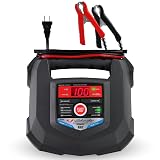
The SC1280 is worth considering when you want automatic charging with a clear automotive role. It detects 6 V or 12 V batteries and is rated at 15 A for 12 V charging. The voltage distinction matters: the model’s specification table lists 2 A at 6 V, so the front-of-box 15 A figure should not be carried over to both voltages. [8] [9]
I would compare it with the Clore for a garage purchase, but with a different priority. My case for the Schumacher is the automatic charge-and-maintain workflow rather than a separate workshop supply function. A buyer who does not plan diagnostic support work may prefer to keep the decision centered on battery compatibility, rate selection and an uncomplicated charging routine.
The SC1280 manual describes a lower-current setting for smaller batteries and maintenance, alongside the automotive charging setting. It also documents a digital display, battery-type selection and warning indicators. Those controls give you information to check before and during charging; they do not eliminate the need to match the battery’s permitted voltage, chemistry and charging rate. [9]
Once charging is complete, the automatic maintenance behavior supplies charge as required rather than making the maximum current a continuous delivery target. Schumacher’s instructions also discuss aborted charging and unsuccessful desulfation. I would read a fault indication as a reason to investigate the connection or battery condition—not as an inconvenience to work around until the charger starts. [10]
There are some version-sensitive details to check before purchase. The current product page lists additional lead-acid applications, including gel and deep-cycle use, while older SC1280 instructions emphasize Standard/AGM selection. Warranty wording also differs between documents. I would use the supplied manual and confirm the current seller’s coverage rather than promise one universal warranty term for every SC1280 offer. [8] [9]
Reasons to Buy
- Automatic 6 V/12 V detection and float maintenance.
- 15 A output for the supported 12 V charging role.
- Display and warning indicators for operating feedback.
Reasons to Avoid
- The 15 A rating does not apply to 6 V charging.
- Do not assume lithium support or cordless jump-start capability.
- Confirm battery-type instructions and warranty for the supplied version.
My take: the SC1280 belongs on a shortlist for straightforward automatic charging. I would choose between it and the Clore by the jobs required, then compare the current offers—not by assuming that either wins every charging situation. [8] [9] [10]
TowerTop BC0253 — Manual-Control Pick

The manual linked from the selected TowerTop listing identifies this charger as BC0253: a 12 V unit with 2 A, 10 A, 25 A and automatic settings. It lists STD, AGM and GEL batteries. These specifications belong to the selected model; I would not transfer features from a different TowerTop listing just because the brand and headline output look similar. [11] [12]
The LCD and separate controls are the reason I would shortlist it. They suit a buyer who wants to choose a rate and inspect the displayed charging information, rather than select a storage-focused unit with only basic indicators. The listing describes an automatic sequence with maintenance after charging, but I have not independently tested its charge-state estimates or repair outcomes. [12]
Its winter setting adds 0.2 V to the selected charging voltage. That is a manual operating choice, not proof that the charger is suitable in any cold environment. The manual’s stated working range starts at 32°F / 0°C, and frozen batteries must not be charged. A snowflake button should not override either instruction. [11]
The model also has engine-start assistance, but it still relies on AC power. I would not treat that as a substitute for a cordless roadside jump starter or repeat a guaranteed starting-time claim. Battery clips and an instruction manual are confirmed; the main purchase decision remains whether you need these controls and will check them for each battery. [11] [12]
Reasons to Buy
- Three selectable rates plus automatic operation.
- LCD feedback and separate mode controls.
- A manual winter-voltage setting.
Reasons to Avoid
- This is a 12 V lead-acid model, not a lithium charger.
- Winter mode does not permit frozen-battery charging.
- Engine assistance requires AC power.
My take: consider it for its control layout, not unverified speed or battery-restoration promises. [11] [12]
NOCO GENIUSPRO50 — Professional Multi-Voltage Pick

The GENIUSPRO50 has the broadest documented voltage coverage in this six-product comparison: 6 V, 12 V and 24 V. Its rated charging output is 50 A at 6/12 V and 25 A at 24 V. I would consider it for a workshop with defined requirements at those voltages, rather than automatically recommending the highest-output charger to every car owner. [13]
Its battery modes extend beyond the lead-acid-only choices here. NOCO specifies compatible LiFePO4 batteries equipped with a battery management system, using the appropriate lithium mode. That is not universal permission to charge any lithium battery. The guide also documents a 10 A reduced-current option in supported modes, useful to check when the connected battery does not call for full rated output. [14] [16]
The power-supply specifications require particular care because NOCO’s own materials are inconsistent. I used the model-specific 1.6.2026A user guide: it lists 13.6 V supply at up to 50 A and 27.2 V supply at up to 25 A. Some website text gives lower figures. Before a critical workshop purchase, confirm the supplied unit’s manual and the service procedure’s voltage/current requirements. [14] [16]
More capability also means more responsibility. The guide warns that Force and Supply modes disable safety features and can energize the clamps. Its repair-mode instructions call for disconnecting the battery to protect sensitive electronics from elevated voltage. I would not recommend experimenting with those modes simply because normal charging has failed. Their presence is not proof that a damaged battery can be restored. [14]
The documented kit includes a case, a 10-foot extension and clamps with removable eyelets, while AC-cord contents depend on the regional package. The product is rated IP20; this is not the charger I would choose for an exposed wet setup. Those practical details belong in the purchase decision alongside the electrical specifications. [13] [15]
Reasons to Buy
- 6 V, 12 V and 24 V charging coverage.
- Higher-output charging and dedicated supply modes.
- Documented LiFePO4-with-BMS compatibility and a workshop accessory kit.
Reasons to Avoid
- Unnecessary capability for many storage-only buyers.
- Override/supply modes need careful, informed handling.
- IP20 protection and conflicting supply copy warrant attention.
My take: choose the GENIUSPRO50 when a documented workshop requirement leads you to it. For one ordinary maintenance task, I would first establish why a simpler charger would not meet the brief. [13] [14] [15]
How to Choose an Automotive Battery Charger
Decide whether you need charging, maintenance or starting help
Write down the problem before comparing products. “My car sits for weeks” suggests a different shopping brief from “I need to recharge compatible batteries regularly” or “I need stable power during a repair.” Charging and maintenance can coexist in one product, but engine assistance and workshop supply functions must be explicitly documented. None of the six products here is presented as a cordless jump pack. For other roadside equipment, see my best portable tire inflator comparison, which covers a separate emergency-preparedness task. [1] [6] [11] [14] [17]
My practical approach is to make one task essential and treat the others as optional. Otherwise, it is easy to buy an impressive collection of modes that does not improve the job you will perform most often. Do not count an extra mode as a benefit until you know when you would use it and which restrictions apply.
Match nominal voltage and battery chemistry first
Check the battery label and the vehicle’s charging instructions. Nominal battery voltage identifies the system a charger is intended to serve; it is not necessarily the voltage displayed throughout charging. AGM, GEL and flooded batteries are all lead-acid types, but the charger’s selected program still matters. A product supporting one lithium chemistry is not automatically suitable for another. [5] [7] [14]
For a mixed garage, I would keep a short list of each battery’s voltage, chemistry and permitted charging current. Compare the charger against that list, not against the vehicle names in a marketing headline. “For cars, boats and motorcycles” is less useful than an exact match to the battery in front of you.
Choose an appropriate current, not the largest available number
A current rating describes an output capability; it is not a guaranteed charge time. Automatic chargers change their behavior as charging progresses, and battery size, initial charge, condition and temperature affect the process. Use the battery manufacturer’s allowed rate rather than assuming that the largest selectable setting is appropriate. [5] [7] [9]
Be careful with numerical comparisons. A maintainer rating, a maximum charging output and an engine-assist rating describe different functions. The useful question is whether the correct charging mode can serve your battery and schedule. Without a controlled test under matched conditions, I would not promise that one of these units finishes a real battery a fixed number of times faster.
Understand what a repair or recondition button does not establish
The presence of a repair function shows that a manufacturer provides a particular operating routine. It does not demonstrate that your battery is repairable. Manufacturer troubleshooting guidance includes batteries that will not accept or retain charge and may need replacement. CTEK also excludes AGM and GEL from its RECOND program, while NOCO warns about elevated-voltage repair operation around vehicle electronics. [5] [10] [14]
I would treat repeated charging errors as information to investigate, not a challenge to overcome by trying every button. Correct connections and a suitable program come first. A charger comparison cannot diagnose the battery, its wiring or the vehicle’s charging system remotely. If you also need to investigate a check-engine warning or retrieve diagnostic trouble codes, my best OBD2 scanner comparison explains the different diagnostic capabilities and their limits.
Plan the physical setup and follow the safety instructions
Read the charger, battery and vehicle instructions together. Use the specified charging points, provide ventilation, protect your eyes and keep sparks or flames away from the battery. Do not charge a frozen or visibly damaged battery. Protect the charger and connections from conditions their instructions prohibit; temperature compensation is not permission to ignore environmental limits. [7] [10] [14]
Before ordering, picture where the charger will sit, where the outlet is and how the cable will reach the correct connection points without being pinched. Confirm whether the advertised length refers to the AC lead, the DC lead or the combined reach. I would also check whether a ring-terminal lead is actually included rather than assuming it comes with every bundle.
Keep workshop power supply separate from ordinary maintenance
A supply mode can help support a specified electrical task, but a maintainer is not automatically a service power supply, and a service supply is not automatically suitable for programming control modules. Clore specifically excludes flash reprogramming from the PL2320’s supply role. Follow the vehicle service procedure’s equipment requirements; do not select a supply solely by the charger’s headline amperage. [18]
Frequently Asked Questions
What is the best automotive battery charger for a typical home garage?
From these six, my lead-acid-focused starting point is the Clore PL2320 because of its selectable rates and 6 V/12 V coverage. That is an editorial choice, not a measured performance win. For storage rather than regular recharging or repair work, I would start with the Battery Tender Plus instead. [1] [6] [17]
Can I leave an automatic battery charger connected during storage?
Only when the model, selected mode and battery are approved for that use, and the setup follows their instructions. A maintenance function does not remove the need for checks. Clore’s manual, for example, specifically calls for daily monitoring during extended maintenance. Follow the supplied instructions rather than a generic “set and forget” claim. [2] [7]
Will an AGM setting also charge a lithium battery?
No. Do not substitute an AGM program for a required lithium program. NOCO’s lithium instructions specify LiFePO4 batteries with a BMS; other lithium chemistries must not be assumed compatible. For the PL2320, resolve the exact-unit documentation and mode-label inconsistency before making a lithium purchase. [2] [14]
Can these chargers fix a completely dead battery?
There is no universal guarantee. A battery can fail to charge, fail to retain charge or fall outside a charger’s detection range. Those situations do not all have the same cause. Manufacturer manuals include replacement among the possible outcomes, and override functions introduce additional cautions rather than proving the battery can be recovered. [5] [7] [14]
Do more charging stages mean a better charger?
I would not rank products by stage count alone. The important comparison is the actual routine: compatible chemistry, appropriate current, fault response and maintenance behavior. A stage count is a description of the manufacturer’s process, not a controlled comparison of battery life or charging quality across brands. [2] [4] [17]
Can I use a U.S. version on a 230 V outlet with a plug adapter?
Do not assume so. Check the electrical input label, not just the plug shape. The CTEK NA manual specifies 110–120 V AC, while the reviewed NOCO guide specifies 100–240 V AC. A physical plug adapter does not change the charger’s rated input. Buy the correct regional version and approved cord arrangement. [5] [14]
Final Verdict
My overall choice is the Clore Automotive PRO-LOGIX PL2320 for a home garage working with supported lead-acid batteries. I would choose it for adjustable output and a useful range of charging tasks, while treating its power-supply and lithium-version limitations seriously. [1] [2]
For a narrower job, I would buy more narrowly: CTEK MXS 5.0 NA for its 12 V care-focused role, Battery Tender Plus for storage maintenance, Schumacher SC1280 for straightforward automatic charging, and TowerTop BC0253 for its selectable controls. The NOCO GENIUSPRO50 belongs on the shortlist when multi-voltage workshop requirements justify it. [3] [6] [8] [11] [13]
Before choosing, match the exact battery, confirm the supplied version and check the current offer. That is more valuable than buying the highest amp rating or the longest list of recovery claims. You can also explore related equipment in my Automotive & Garage buying guides.
Sources and Product Documents
Research reviewed October 1, 2026. Manufacturer-written manuals hosted by Amazon are identified as such; they are not described as manufacturer websites. Where documents disagree, the relevant limitation is stated in the comparison.
- Clore Automotive PL2320 product information. Manufacturer product information; charging rates, voltage support, features and output leads.
- Clore PL2310/PL2320 operator’s manual. Manufacturer-written manual hosted by Amazon and linked from the selected PL2320 listing. See printed pages 2, 3 and 6–8, especially the lithium-revision inconsistency and power-supply limitations.
- CTEK MXS 5.0 NA — item 40-206. Manufacturer page for the North American product, not the European 5 A version.
- CTEK MXS 5.0 NA product sheet. North American specifications, 4.3 A output, charging/maintenance capacities and charging stages.
- CTEK MXS 5.0 North America user manual. Printed pages 7–9: controls, package information, RECOND restrictions and technical specifications.
- Battery Tender Plus 12V 1.25A — SKU 021-0128. Manufacturer specifications, supported lead-acid batteries, included connection cable and warranty.
- Deltran Battery Tender Plus user instructions. Printed pages 1–6: charging, storage maintenance, indicator lights, low-voltage detection and safety.
- Schumacher SC1280 product information. Manufacturer product page for SC1280, including voltage-dependent output and package information.
- Schumacher SC1280 owner’s manual. Manufacturer-written manual hosted by Amazon. Printed pages 7–10 distinguish charge-rate settings, maintenance and 6 V/12 V current ratings.
- Schumacher instructions linked by the current product page. Manufacturer-linked instructions for automatic charging, float maintenance, battery checks and safe operation.
- TowerTop BC0253 manual. TowerTop-written manual linked from ASIN B07QPSNZPP; Amazon-hosted, not a standalone manufacturer website. PDF pages 1, 3, 4 and 7 identify the model, package, ratings and winter mode.
- TowerTop selected listing — B07QPSNZPP. Exact selected 12 V 2/10/25 A listing and its product-document link. Marketing charging-time, efficiency and starting-current claims are not used as measured results.
- NOCO GENIUSPRO50 specifications. Model-specific charging current, battery-voltage support, protection rating and technical specifications.
- NOCO GENIUSPRO50 user guide — 1.6.2026A. English PDF pages 4 and 7: charging/supply currents, LiFePO4 with BMS, reduced-current modes, safety overrides and specifications. This guide is used where website copy conflicts.
- NOCO GENIUSPRO50 product sheet — 02.21.2024. Model-specific package illustration: clamps, extension cable, EVA case and AC leads. Regional cord contents must match the purchased bundle.
- NOCO GENIUSPRO50 support. Mode descriptions and cautions. Supply-current text differs from the current model-specific user guide; the guide controls the figures used here.
- Battery Tender charging and maintenance overview. Manufacturer explanation of charging versus maintaining and chemistry-specific charger selection.
- Clore — Perfect Source of Stable Power. Manufacturer explanation of maintenance power during repairs and the distinction from high-current vehicle-module programming.