
As an Amazon Associate, I earn from qualifying purchases.
The best canister filter is not automatically the one with the largest tank rating or the highest advertised flow. For a medium freshwater community aquarium, I would start with the Fluval 307: it combines a useful media capacity with a serviceable basket layout. For a smaller setup, the Fluval 207 offers a more compact footprint. The OASE BioMaster 2 350 is the alternative I would prioritize when convenient prefilter cleaning matters most.
This 2026 review compares six complete aquarium canister filters, from the beside-the-tank Zoo Med Nano 30 to the larger Fluval FX2. Finding the best aquarium canister filters for different setups means considering tank size, cabinet space, and maintenance together. The comparison below explains where each model fits and which compromises matter.
Editorial Note: My recommendations are based on verified manufacturer specifications and independent reviews, not hands-on testing.
Key Takeaways: Choosing a Canister Filter for Your Aquarium
Capacity is only the starting point. Two aquariums with the same volume can have different filtration demands. Stocking, feeding, circulation, and cleaning access help determine whether a canister filter suits the size of the tank.
Flow figures need their labels. Pump output, maximum flow, and filter circulation do not necessarily describe the same test. Even a published circulation figure is not a promise of the flow you will obtain with your chosen filter media and plumbing.
Placement can decide the purchase. The Zoo Med Nano 30 instructions specify placement beside the aquarium at the same level, not below it. That makes it a different installation proposition from a conventional cabinet-mounted canister. [8]
Best Aquarium Canister Filters: Quick Picks by Tank and Need
Best Overall for Medium Aquariums — Fluval 307. My starting point for a medium community aquarium, with more basket capacity than the 207 without moving to the FX2 footprint.
Smaller-Aquarium Pick — Fluval 207. The narrower 07-series option when the aquarium fits its stated range and the additional capacity of the 307 is unnecessary.
Value Alternative — Penn-Plax Cascade 1000. A three-basket alternative worth considering when it costs meaningfully less than comparable filters and its servicing arrangement suits your setup.
Prefilter Maintenance Pick — OASE BioMaster 2 350. The choice for separate access to the prefilter. This is the standard version, not a Thermo package with a heater.
Small-Tank Beside-the-Aquarium Pick — Zoo Med Nano 30. A compact option for an installation that follows its same-level placement instructions.
Large-Aquarium Pick — Fluval FX2. The larger-capacity choice here, with automatic startup and air-purge functions rather than a conventional manual primer.
Aquarium Canister Filter Comparison: Tank Size, Flow, and Media
These are the selected US-market configurations. The last column lists documented supplied equipment, not optional upgrades. Media-volume terms are retained as published: basket volume, filter volume, and biological volume are not interchangeable measurements.
| Product | Aquarium Rating | Published Flow | Media Capacity / Power | Service / Placement | Included Accessories |
|---|---|---|---|---|---|
| Fluval 307 [1][3] | 40–70 US gal | 303 GPH pump output; 206 GPH filter circulation | 3.1 L basket volume; 16 W at 120 V / 60 Hz | EZ-Lift basket stack; AquaStop connection | Hoses, intake/strainer, output nozzle, AquaStop valve, foam, BIOMAX, carbon, fine pads |
| Fluval 207 [2][3] | 20–45 US gal | 206 GPH pump output; 121 GPH filter circulation | 1.8 L basket volume; 10 W at 120 V / 60 Hz | EZ-Lift basket stack; smaller footprint than 307 | Hoses, intake/strainer, output nozzle, AquaStop valve, foam, BIOMAX, carbon, fine pads |
| Cascade 1000 / CCF3UL [4][5] | Up to 100 US gal | 265 GPH advertised flow | Three baskets; liter capacity and wattage not stated in the reviewed instruction sheet | Push-button priming; position below aquarium water level | Hoses, valves, intake, spray bar/directional outlet, sponge, floss pads, carbon |
| OASE BioMaster 2 350 [6] | Up to 90 US gal | 300 GPH maximum flow, per US product page | 5.6 L filter volume; 0.5 L prefilter volume; 16 W | Removable EasyClean prefilter; allow clearance above | Hoses, connection hardware, intake/outlet, diffuser, foams, Hel-X media; no heater |
| Zoo Med Nano 30 / TCN-32 [7][8] | 10–30 gal | 160 GPH advertised flow | Mechanical sponge, ceramic media, carbon; wattage/volume not stated in reviewed sources | Beside aquarium, at the same level—not below the tank | Hoses, intake/outlet fittings, spray bar, mechanical sponge, ceramic media, carbon |
| Fluval FX2 / A213 [9][10] | Up to 175 US gal | 475 GPH pump output; 343 GPH filter circulation | 3.9 L biological volume; 27 W at 120 V / 60 Hz | Automatic startup/air purge; no FX4/FX6-style utility drain valve | Hose, valves, intake strainer, output nozzle, baskets, foam, BIOMAX, carbon |
Specifications checked against the linked manufacturer material on October 11, 2026. US-gallon ratings are retained as published rather than recalculated from inconsistent gallon/liter pairs. The FX manual specifies that its circulation figures exclude media and in-tank intake/output accessories. Compare the labels and installation conditions, not just the largest GPH number.
Best Canister Filter Reviews: Six Models Compared
Fluval 307 Canister Filter — Best Overall for Medium Aquariums


The Fluval 307 canister filter is my overall starting point for a medium freshwater community aquarium, particularly when choosing between compact and much larger systems. Its appeal is the balance: useful media space, a manageable body, and a basket arrangement designed around routine access. I would evaluate it first for a typical 55-gallon setup, then adjust the choice for stocking and available space.
Fluval rates it for 40–70 US gallons. The published specifications separate 303 GPH pump output from 206 GPH filter circulation, with 3.1 liters of basket volume and a 16-watt draw for the 120 V model. That distinction matters: the basket figure describes space for filter media, not a measured biological processing capacity. [1]
Maintenance is its more useful differentiator than a headline flow number. The EZ-Lift center handle lifts the media baskets from the top as one stack, while the AquaStop connection and motorhead clamps support disconnection and access. The vertical prefilter has its own location inside the canister; unlike the OASE arrangement, it is not a separate externally removable cleaning module. [3]
Against the 207, the decision is relatively straightforward: the 307 provides more basket volume and a higher published circulation figure, but needs more floor area and power. Its listed dimensions are 9.5 × 7 × 16.5 inches. Both models are the same published height, so moving down to the 207 will not solve an overhead-clearance problem. [1][2]
Choose the 307 when your tank benefits from its extra capacity and you have room to service it. Choose OASE instead if separate prefilter access matters more. For a heavily stocked aquarium near the upper rating, I would assess the whole filtration arrangement rather than assume the “70 gallons” label settles the question.
Reasons to Buy
- More basket volume than the Fluval 207.
- EZ-Lift basket access and an AquaStop connection.
- Separate pump-output and circulation specifications.
Reasons to Avoid
- Not the same separate prefilter-cleaning arrangement as OASE.
- A wider footprint and higher rated power draw than the 207.
Fluval 207 Canister Filter — Smaller-Aquarium Pick
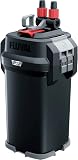
The Fluval 207 canister filter makes sense when the 307 would add capacity you do not need. It is not a different philosophy of filtration: it is the smaller implementation of the same 07-series approach. That makes it a useful comparison for owners who like accessible media baskets but want to limit cabinet footprint and running power.
The selected US version is rated for 20–45 US gallons, with 206 GPH pump output, 121 GPH filter circulation, and 1.8 liters of basket volume. Its rated power is 10 watts. The body measures 7.5 × 7 × 16.5 inches, meaning the space saving versus the 307 is in the footprint, not height. [2]
This Fluval canister filter retains the AquaStop connection, manual primer, and EZ-Lift media handling of the larger 07-series models. Fluval’s series material lists supplied foam stages, biological media, carbon, and fine filtration pads. Having media included simplifies the initial shopping list, but does not mean a new filter arrives biologically established. [3]
Compared to filters like the Nano 30, the 207 offers a different installation and service layout. Both can enter a small-tank shortlist, but their plumbing and placement requirements are not equivalent. The Nano’s beside-the-aquarium placement is a specific limitation to check; the 207 should be assessed against the installation instructions supplied with it, rather than treated as interchangeable plumbing.
The 207 is the more proportionate choice within its stated aquarium range; move to the 307 when extra basket capacity is a clear requirement. The lower wattage is useful only after that suitability decision: buying an undersized system to save electricity would be the wrong compromise.
Reasons to Buy
- Smaller footprint than the 307.
- 10-watt rating for the selected US configuration.
- Retains the 07-series media-access features.
Reasons to Avoid
- Less basket volume and lower published circulation than the 307.
- No reduction in published height versus the 307.
Penn-Plax Cascade 1000 Canister Filter — Value Alternative

The Penn-Plax Cascade 1000 canister filter is my value alternative. If you are searching for the best budget option, compare its current price with the Fluval 307 before deciding. A worthwhile saving depends on the complete package, replacement parts, and service arrangement, rather than the initial price alone.
Penn-Plax’s aquatic catalog lists the Cascade 1000 / CCF3UL for tanks up to 100 gallons, with 265 GPH advertised flow. Its three media baskets, rotating flow valves, and push-button primer give it a conventional, manually primed design. The reviewed package includes plumbing and starter media rather than requiring a separate initial media purchase. [4][5]
The manufacturer’s instruction sheet is useful for understanding how that layout should be handled. Baskets must be seated correctly, and media must not prevent proper closure. It specifies installation below the aquarium water level. I would check both the service route out of the cabinet and the hose arrangement before buying, not merely whether the canister body fits. [5]
Its larger advertised aquarium rating does not establish that it outperforms the Fluval 307. Penn-Plax’s advertised flow and Fluval’s separately labeled circulation figure are not a controlled head-to-head measurement. Nor does a lower initial price settle ownership cost if the exact replacement items you need are difficult to obtain locally.
Compare its current price with the 307 and OASE, then decide whether their service differences justify the gap. A meaningful discount makes the Cascade more compelling. A small discount makes the choice more dependent on layout preference and parts support. I would not pay extra for the “up to 100 gallons” wording alone.
Reasons to Buy
- Three baskets for organizing filter media.
- Manual primer and adjustable plumbing connections.
- Worth comparing when the purchase-price saving is substantial.
Reasons to Avoid
- Its 265 GPH advertised flow cannot be directly compared with Fluval’s circulation figure.
- A small price saving may not offset differences in service access or parts availability.
OASE BioMaster 2 350 Canister Filter — Prefilter Maintenance Pick

The OASE BioMaster 2 350 canister filter has the clearest routine-maintenance distinction in this group. Its EasyClean prefilter can be removed separately, allowing attention to the first debris-catching stage without opening the main canister body. That is the feature I would pay attention to—not a vague promise that the filter needs little maintenance.
The US product page lists an aquarium size up to 90 gallons, 300 GPH maximum flow, 5.6 liters of filter volume, and a separate 0.5-liter prefilter volume. Rated power is 16 watts. Those volume labels differ from Fluval’s basket and biological-volume specifications, so I would not use them to calculate a supposed filtration advantage. [6]
The standard package includes foams and Hel-X biological media, along with the plumbing components needed for the intended installation. It supports a HeatUp heater retrofit, but the selected standard BioMaster 2 350 does not include a heater. Do not substitute a Thermo listing’s equipment description just because the filter body looks similar. [6]
For a separate heating setup, my aquarium heater comparison can help organize the options. In this article, the OASE recommendation is based on filtration maintenance; heating is a separate configuration decision. Keeping those purchases distinct also prevents an apparently complete package from becoming an unexpected extra expense.
This OASE canister has a listed body size of 9.4 × 9.4 × 16.7 inches. Leave clearance above the top of the filter for removing the prefilter: a cabinet that fits the closed unit may still obstruct its main convenience feature. Choose it over the 307 when that access makes regular cleaning easier. [6]
Reasons to Buy
- Separately removable EasyClean prefilter.
- Supplied mechanical and Hel-X biological media.
- Optional HeatUp integration without requiring the Thermo package initially.
Reasons to Avoid
- Heater not included in this standard version.
- The prefilter still needs access above the installed unit.
Zoo Med Nano 30 Canister Filter — Small-Tank Pick

The Zoo Med Nano 30 canister filter earns a place for a specific small-aquarium setup, rather than as a miniature version of every cabinet filter above. Its key buying consideration is where it must stand. Shortlist it only if there is suitable space beside the aquarium.
Zoo Med describes the TCN-32 for 10–30-gallon aquariums with 160 GPH advertised flow. The package includes mechanical sponge, ceramic biological media, carbon, and a spray bar. Adjustable flow and a removable hose connection are listed features. The reviewed material does not provide a comparable liter-capacity specification, so I have not invented one. [7]
The placement instruction is important: the manual says to put the filter on a flat surface next to the tank at the same level, not below the tank. It is not suitable for a plan that requires hiding the unit on the floor of an aquarium cabinet. Its name and compact appearance do not override that instruction. [8]
The spray bar and adjustable output provide options for arranging water return around fish and other aquatic inhabitants. Suitability still depends on their needs and the tank layout. A small fish tank does not automatically need the strongest possible current. Check intake protection for small animals and avoid treating any advertised size range as a substitute for observing the aquarium.
Against the Fluval 207, this is primarily a placement and scale decision. Choose the Nano 30 canister filter when its documented installation works and a compact beside-the-tank filter suits the setup. Choose a different model when that location is impractical. That is a more useful distinction than awarding it a universal “best nano filter” badge.
Reasons to Buy
- Targets the stated 10–30-gallon aquarium range.
- Spray bar and mechanical, biological, and carbon media supplied.
- Adjustable output and a removable hose connection.
Reasons to Avoid
- Manual excludes below-the-tank placement.
- Its “Nano” name is not approval for every very small aquarium.
Fluval FX2 Canister Filter — Large-Aquarium Pick

The Fluval FX2 canister filter is the option I would investigate when the smaller canister filters here no longer match the planned aquarium. It has a larger body, higher published circulation, and a different startup arrangement than the 207 and 307. That makes it the upper-capacity reference in this six-product comparison.
Fluval publishes an aquarium rating up to 175 US gallons, 475 GPH pump output, and 343 GPH filter circulation. The US specification lists 3.9 liters of biological volume and 27 watts. The body measures 13.4 × 13.4 × 16.5 inches: substantially broader than a 307, but not taller by the published body dimensions. [9]
The FX manual adds essential context: circulation figures exclude media and the in-tank intake/output accessories. They are not measurements of your fully assembled aquarium. Use the FX2’s specification to understand its capacity class, not to predict a particular installed turnover rate. [10]
Startup is another real distinction. The manual calls for at least 5 liters (1.4 US gallons) of water to be added before power is connected; the automatic sequence is not permission to run the filter dry. The system also pauses periodically to release trapped air. These operating steps are worth understanding before interpreting every planned pause as a fault. [10]
Do not transfer every Fluval FX6 feature to the FX2. In particular, the manual’s utility-valve water-changing procedures apply to the FX4 and FX6, not this model. I would choose the FX2 for its capacity and operating design when they suit the aquarium, but would check access for lifting and servicing a filled unit before committing to the larger footprint. [10]
Reasons to Buy
- Larger-capacity option within this selected group.
- Automatic startup sequence and periodic air purge.
- Supplied media and a documented biological-volume specification.
Reasons to Avoid
- Broader footprint and higher rated power than the 07 models here.
- No FX4/FX6-style utility drain valve.
How I Selected the Canister Filter Models in This Review
I used an Amazon product-candidate list as a starting point, then checked the selected models against manufacturer information. The article concentrates on freshwater home aquariums and six specific configurations. I researched these models; I did not test or install them for a hands-on comparison.
I prioritized identifiable products, useful installation differences, access to filter media, and documented specifications. Ratings and review counts did not decide the selection: an aggregate listing score cannot establish a particular model’s filtration performance. Price informed the value discussion, but it was not treated as evidence of effectiveness.
Including two 07-series sizes is deliberate: the 207 and 307 address different capacity and footprint decisions. OASE adds separate prefilter access, Cascade adds another multi-basket design, and Nano 30 and FX2 widen the installation range. Other models, including the EHEIM Classic canister family, remain alternatives. The six reviewed options address specific needs rather than representing every suitable model on the market.
When buying a canister filter, use the current selected offer and confirm the package. A temporary discount can change which option is best value without changing any technical specification.
Price Context: Compare the Exact Package
The WPH01 Amazon research snapshot from October 11, 2026 recorded these offer prices: Fluval 207 $159.99, Fluval 307 $217.00, Penn-Plax Cascade 1000 $174.99, OASE BioMaster 2 350 $269.99, Zoo Med Nano 30 $79.99, and Fluval FX2 $296.99. These are historical listing observations, not live prices or a price guarantee. Seller, availability, and included equipment can change. Use the current product card and verify the exact model and package before ordering.
In that snapshot the Cascade 1000 cost $42.01 less than the Fluval 307. That difference helps explain its value-alternative role, but it does not establish lower lifetime cost or equivalent filtration performance. If the gap narrows, maintenance access and replacement-parts support become more important than the old price comparison.
Buying the Best Canister Filter: Find the Right One for Your Aquarium
Start With Tank Size, Stocking, and Feeding
Tank size establishes the first boundary, not the final answer. The amount and type of fish, feeding routine, and accumulated debris influence what the filter must handle. A lightly stocked community aquarium and a heavily fed fish tank of the same volume do not present identical conditions.
I would start within the manufacturer’s stated aquarium range, then assess media capacity and the maintenance burden. For a demanding setup near a maximum rating, build a filtration plan rather than assume the number on the box provides a safety margin. More capacity is useful only when the aquarium also receives appropriate circulation and routine care.
Aquarium Filter Flow: Pump Output vs. Filter Circulation
GPH means gallons per hour, but the label alone does not identify the test. A pump-output figure may describe a different arrangement from filter circulation. The FX2 documentation explicitly excludes media and in-tank accessories from its circulation measurement. [10]
Hose routing, lift, fittings, filter media, and accumulated debris can affect the final result. This is why I would not declare the Cascade stronger than a Fluval simply by comparing its advertised flow with the Fluval’s circulation figure. The conditions need to match before the numbers support that conclusion.
Assess circulation throughout the display tank, not only at the outlet. A forceful stream in one corner can coexist with poor movement elsewhere. Place the return around the aquarium layout and inhabitants, then reassess after the filter has been operating and collecting debris.
Canister Filter Media: Mechanical, Biological, and Chemical
Mechanical media catches particles. Coarse sponge and finer filter pads perform different stages of that work. Biological media provides surfaces for the microorganisms involved in processing waste. Chemical filtration media addresses particular water-treatment needs; it is not a reason to ignore stocking or water changes. [11]
The important comparison is usable media organization, not the largest vaguely labeled volume. Fluval’s basket-volume figures, OASE’s filter and prefilter volumes, and the FX2’s biological-volume figure describe different things. A larger number under a different heading is not proof of a better biological filter.
Keep the manufacturer’s water path in mind. Water flowing into the canister must follow the model’s specified route through the media. Seat the media baskets correctly and avoid overpacking or copying another filter’s layout. Prepare the supplied canister filter media according to its instructions.
Canister Filter Installation: Cabinet Space and Water Flow
Once you have matched capacity to the size of your aquarium, measure the closed main canister body and allow room for hoses, connections, and servicing. Keep enough space next to the filter to reach its valves and remove it safely. A full canister is heavier than the empty unit; plan how you will disconnect and carry it before ordering.
Check height instructions model by model. Cascade specifies below-water-level installation, while Nano 30 specifies beside-the-tank, same-level placement. OASE’s removable prefilter also needs space above it. These differences can rule out a purchase before price or brand becomes relevant. [5][8]
Separate body dimensions from operating clearance. The 207, 307, and FX2 all list 16.5-inch body heights, yet have different footprints and service arrangements. Do not assume that choosing the smallest aquarium rating always solves a cabinet problem.
Best Value Canister Filter: Purchase Price and Ownership Cost
Compare the initial package, replacement media, seals, hoses, and impeller parts you may need. An expensive canister filter still needs to fit a service routine you can maintain. Identify the exact model before ordering parts: components for Fluval filters, for example, can differ by size and generation.
Rated power can help estimate the electricity difference. As an illustration, a constant six-watt difference—the gap between the selected 207 and 307 ratings—equals about 52.6 kWh over 365 days. Multiply that by your electricity price for an estimate; it is arithmetic based on rated power, not a measured annual bill.
Finally, consider the cleaning routine you will actually maintain. Paying more for accessible mechanical filtration may be reasonable if access is your main obstacle. Paying more for a canister filter you cannot accommodate or service is much harder to justify.
Do You Need a Canister Filter? Comparing Types of Fish Tank Filters
An external canister filter stores media outside the display tank. Canister filters provide room for organizing filtration stages; compared to other filters, they also introduce more plumbing and a separate body to accommodate. Compare the types of filters against your available space and maintenance routine before buying.
Hang-on-the-back filters, often called HOB filters, can be easier to reach for routine work, but need space at the back of the tank. They include many familiar power filters. Internal filters sit inside the aquarium and use display space. Sponge filters offer another arrangement for suitable small-animal or breeding setups. Among fish tank filters, the best choice depends on stocking, available space, and how you will service the equipment.
For an air-driven sponge setup or supplementary aeration, my aquarium air pump guide covers that separate equipment decision. An air pump is not a substitute for choosing appropriate filter media and a workable maintenance routine.
Canister Filter Maintenance: Keep Flow and Biology in Balance
Use the Manual and the Aquarium, Not a Universal Calendar
Canister filters require regular inspection, with cleaning guided by the model and aquarium’s condition. Reduced output, accumulating debris, or unfamiliar sounds warrant attention. Start with the manufacturer’s maintenance guidance and adjust the routine to the aquarium’s loading rather than waiting for visibly dirty water.
Accessible mechanical media helps, but it does not make a filter maintenance-free. OASE’s prefilter still needs cleaning, and the main body and plumbing still require attention. Likewise, an FX2 air-purge feature does not clean its media or replace inspection of hoses and connections.
Preserve Established Biological Media
Avoid replacing all established biological filter media at once. The Cascade instructions call for aquarium water when rinsing its biological sponge, while the FX instructions allow aquarium or dechlorinated water for foam but specify aquarium water for biological media. Follow the instructions for the actual media rather than washing every component in the same way. [5][10]
When moving to a new canister filter, do not assume the included ceramic or other biological media is already established. Plan the transition to retain existing biological filtration and monitor water quality. OASE’s guidance discusses running old and new filters together during a transition; elapsed time alone is not confirmation that the new system can carry the full load. [11]
Inspect Seals, Plumbing, and the Impeller Area
Disconnect equipment as its instructions require before servicing, and maintain the specified electrical precautions. Clean sealing surfaces around the canister lid, check hoses and valve connections, and inspect accessible components for damage. Do not improvise a lubricant: use only one approved for the relevant seals.
After reassembly, inspect for leaks and confirm circulation has resumed. New rattling or reduced output deserves investigation rather than an assumption that the motor has failed. Keep a record of recurring changes so you can distinguish a dirty filter from a damaged or incorrectly seated part. [12]
Filling and Priming: Check the Canister Filter Instructions
Whether and how to fill the canister with water before startup depends on the model. Nano 30 has its own same-level filling procedure; Cascade uses manual priming; the FX2 requires water before its automatic sequence. Follow the exact manual before connecting the filter to power. [5][8][10]
Filtration also does not eliminate water changes or testing. Clear tank water is not a complete water-quality assessment. Continue the aquarium’s appropriate testing and partial-water-change routine alongside mechanical cleaning. [13]
Frequently Asked Questions
What Is the Best Canister Filter for a 55-Gallon Aquarium?
The Fluval 307 is my first model to evaluate for a typical medium community aquarium because 55 gallons falls within its published 40–70-US-gallon range. OASE BioMaster 2 350 is the alternative when separate prefilter access matters more. Stocking and maintenance still influence suitability; tank volume alone does not settle the choice.
Which Canister Filter Should I Consider for a 75- or 100-Gallon Tank?
The 307’s published range stops at 70 US gallons. Among these six, the FX2 is the larger-capacity starting point I would investigate. Cascade is rated for 100 gallons as a maximum, which places it in consideration, but that label does not establish equivalent capacity under the same conditions. At the upper limit, assess the full filtration demand rather than treating the rating as a guarantee.
Does Every Canister Filter Need to Sit Below the Aquarium?
No. Installation depends on the model. The Cascade instructions call for a below-water-level position, but the Zoo Med Nano 30 manual specifically says to place it beside the aquarium at the same level, not below the tank. Follow the exact instructions instead of assuming all external filters share a siphon arrangement. [5][8]
Does the OASE BioMaster 2 350 Include a Heater?
The standard model selected here does not. It supports an optional HeatUp retrofit; the Thermo version is a different package. Confirm the precise listing and supplied equipment before ordering, especially when photographs or retailer titles show several versions together. [6]
Which Is the Quietest Canister Filter?
I cannot name a measured noise winner because I have not tested these filters under matched conditions. Manufacturer quiet-operation claims are not a comparable decibel test. For an installed system, follow the setup guidance and investigate air, vibration, debris, or incorrectly seated components when noise changes. [12]
Can the Included Filter Media Be Used Immediately?
Prepare and install it according to the manufacturer’s instructions. Supplied filter media makes the initial package more complete, but does not establish biological filtration immediately. When replacing an existing filter, preserve its established biological support during the transition and monitor water quality before relying entirely on the new system. [11]
Is the Fluval FX2 Just a Smaller FX6 With the Same Features?
Do not assume that. The FX manual distinguishes the models, including utility-valve procedures that apply to the FX4 and Fluval FX6 but not the FX2. Select by the exact model’s capacity, equipment, and maintenance instructions—not features borrowed from the larger family member. [10]
Final Verdict: Which Canister Filter Is Best?
For a medium community aquarium, I would start with the Fluval 307. Choose the 207 canister filter when its smaller capacity and footprint already fit the job. Choose OASE BioMaster 2 350 when separately accessible mechanical prefiltration is the feature most likely to improve your cleaning routine.
The Cascade 1000 deserves consideration when the current price makes it an attractive alternative. The Nano 30 suits a smaller aquarium only when its beside-the-tank placement works. The FX2 is my large-aquarium reference among these six, with a broader footprint and its own operating procedure.
Before buying, settle three questions: does the selected aquarium filter suit the tank’s demands, can it be installed as instructed, and can you service it comfortably? Finding the best canister filter means answering all three. A larger rating or a higher price alone cannot tell you that it’s the best fit for your aquarium.
Return to the six picks or compare the specifications and included equipment before checking the selected offer.
Sources and Product Documents
Manufacturer specifications, instructions, and supporting references
Research checked October 11, 2026. Product specifications are manufacturer declarations, not independent performance measurements. Recommendations and comparisons are editorial judgments. The table uses each source’s own capacity and flow labels; the US OASE page lists 300 GPH maximum flow.
- Fluval 307 — official US product specifications: sizing, basket volume, power, and dimensions.
- Fluval 207 — official US product specifications: sizing, flow, basket volume, power, and dimensions.
- Fluval 07 Series — official feature and media information: basket access, prefilter arrangement, and supplied media.
- Penn-Plax aquatic catalog — Cascade 1000 / CCF3UL (PDF): model identity and advertised capacity/flow on PDF page 12.
- Penn-Plax Cascade 700/1000 instructions (PDF): baskets, placement, priming, and maintenance.
- OASE BioMaster 2 350 — official US specifications: standard package, EasyClean prefilter, media volumes, maximum flow, and heater retrofit.
- Zoo Med Nano 30 — official product information: aquarium range, flow, and supplied equipment.
- Zoo Med Nano 30 / TCN-32 instructions (PDF linked by Zoo Med): same-level placement, filling, and servicing.
- Fluval FX2 — official US product information: capacity, dimensions, and included components.
- Fluval FX2/FX4/FX6 instructions (PDF): model-specific specifications, circulation measurement conditions, startup, and maintenance.
- OASE — upgrading filtration and filter media: filtration roles and transitions between filters.
- Penn-Plax — customer service and troubleshooting: noise, seals, and filter maintenance checks.
- OASE — aquarium cleaning guidance: water-quality checks, partial water changes, and maintenance.