
The best electric patio heater should suit where you sit, how it can be positioned, and the electrical supply already available—not just have the largest wattage on the box. An adjustable tower beside a seating area and a permanently mounted 240 V unit solve different problems. Start with that distinction before choosing a brand.
Among these patio heaters, my first freestanding choice is VAGKRI’s 42-inch model. Investigate Briza for mounting flexibility or Dr. Infrared DR-239 for a higher-power fixed installation. The other electric outdoor heaters here are a lower-wattage SereneLife tower, a rotary-control Haimmy, and a simpler SereneLife wall unit. Compare their controls and documentation as well as their output.
Editorial Note: My recommendations are based on verified manufacturer specifications and independent reviews, not hands-on testing.
Key Takeaways for Choosing Patio Heaters
Choose the installation before choosing the output. Most configurations here specify 120 V; the DR-239 manual specifies 240 V and a matching grounded connection. A higher-power purchase is not a workaround for an unsuitable outlet. See the DR-239 electrical requirements before pricing that option.
Think in seating zones, not whole-backyard coverage. Manufacturer guidance on infrared heating explains that radiant energy warms people and surfaces directly. My buying approach is therefore to map the seats and the intended direction of warmth, rather than assume every part of a large patio area will feel alike.
Look beyond the headline feature. A timer is not permission to leave an appliance running unattended. A control lock does not make hot surfaces safe to touch. An IP rating describes enclosure protection, not an unrestricted promise of outdoor use. The delivered manual remains essential.
Top Picks: Which Electric Patio Heater Fits Your Setup?
Best Overall Freestanding Pick — VAGKRI 42-inch 1500W. My starting point for a tower with several output steps and remote adjustment, provided the exact revision and placement instructions match the delivered unit.
Versatile Mounting Pick — Briza 1500W. Consider its advertised tripod and mounting-hardware package when flexibility matters. Obtain the exact model manual before deciding where to install it.
Lower-Wattage Pick — SereneLife SLOHT52. A candidate for someone deliberately comparing lower maximum power; its inconsistent amperage and coverage entries need clarification.
Rotary-Control Tower Pick — Haimmy UEH500. My alternative for a buyer who prefers a physical adjustment knob, with an important base-surface requirement.
High-Power Mounted Pick — Dr. Infrared DR-239. The higher-output option for an appropriately planned 240 V installation, not an ordinary 120 V plug-in substitute.
Wall-Mounted Pick — SereneLife SLOHT28. A simpler fixed-position choice when one output level is acceptable and the installation satisfies its clearance rules.
Best Patio Heaters Compared: Power, Controls, and Equipment
For each patio heater on this list, the table describes the selected configuration—not every product sold under the same brand. IP ratings are source-stated, not independently tested for this guide. I have omitted advertised square-foot coverage because the available figures are not a reliable like-for-like comparison. Exact stock, price, and package contents should be checked with the seller.
| Product | Power / Supply | Format / Placement | Heat Controls | Stated IP Rating | Included Accessories |
|---|---|---|---|---|---|
| VAGKRI 42-inch Source | 1500 W max 120 V | Freestanding tower 42 in advertised height | 9 levels Remote; up to 24 h timer | IPX5 | Remote; user guide |
| Briza IT-HEQQ-1831 Source | 1500 W max 120 V | Adjustable tripod; wall/ceiling hardware advertised | 900 / 1200 / 1500 W Remote; 1–9 h timer | IP55 Listing claim | Adjustable tripod, mounting hardware, remote |
| SereneLife SLOHT52 Source | 900 W max 120 V; amperage entry conflicts | Freestanding tower 37.4 in; 9 in base | 300 / 450 / 900 W Remote; up to 9 h timer | IP65 | Remote, cap, Allen key, assembly screws |
| Haimmy UEH500 Source | 1500 W max 120 V | Freestanding tower Flat, hard surface required | 9 levels: 700–1500 W Knob, remote; 1–9 h timer | IPX5 Listing claim | Remote, base components, handle, guard, assembly screws |
| Dr. Infrared DR-239 Source | 3000 W max 240 V per manual | Wall or ceiling At least 7.9 ft mounting height | 2 levels Remote; up to 24 h timer | IP55 | Remote, mounting brackets and hardware; remote batteries excluded |
| SereneLife SLOHT28 Source | 1500 W 120 V | Wall mounted At least 6.9 ft above floor | 1 output level Remote on/off | IP65 | Remote, wall bracket, 4 anchors, 4 screws |
Read the individual reviews for the VAGKRI revision check, Briza’s listing-only evidence, and the SereneLife documentation conflicts. Neither SereneLife package includes the remote’s AAA batteries. Before purchase, obtain the exact instructions and verify the complete delivered package.
Electric Infrared Heater Reviews: Six Options Compared
VAGKRI 42-inch 1500W — Best Overall Freestanding Pick


VAGKRI is my first pick among these patio heaters for a movable tower with a broad choice of heat settings. Its combination of controls and format suits a defined seating zone without committing to a wall location. First identify a stable position within reach of a suitable supply; then compare how its controls fit your routine.
The brand’s 42-inch heater page lists 1500 W, nine levels, remote control, and a timer up to 24 hours. The VA-OH01 family manual documents 120 V operation, IPX5, a control lock, and tip-over and overheat shutdown. These are published features; I have not measured their performance against the other patio heaters.
The adjustable heat level is a reason to compare this tower with the single-output SLOHT28: it gives you more choice than simply switching the element on or off. Before choosing the floor-standing format, check the space with chairs pulled out and people walking past. The advertised height says little about the complete clearance area.
The selected listing identifies VA-OH01 New-2, whereas the accessible PDF covers VA-OH01. Obtain the matching instructions with the purchase. I retained shared headline features rather than transfer unconfirmed assembly details or a minimum wattage from another revision. That is the main documentation check attached to this pick.
Choose VAGKRI when you prefer its button-based adjustment; compare Haimmy when a rotary knob is more appealing. For a narrow walkway, investigate a fixed option instead. My overall choice favors the complete freestanding control package, not a claim that it produces the most heat or has the largest outdoor coverage.
Reasons to Buy
- Nine advertised output steps and remote adjustment.
- Tower format avoids committing to a wall location.
- Accessible model-family documentation supports key features.
Reasons to Avoid
- Confirm instructions for the selected New-2 revision.
- Floor placement and electrical reach still limit the setup.
Briza 1500W — Versatile Mounting Pick

Briza stands out among these patio heaters for its advertised mounting package. It is the option I would investigate when deciding between a tripod and a fixed position. That flexibility is useful to consider during planning, provided the exact installation instructions support the arrangement you intend to use.
The selected IT-HEQQ-1831 listing specifies 120 V, heat settings of 900, 1200, and 1500 W, and a one-to-nine-hour timer. It lists a remote, adjustable tripod, wall/ceiling mounting hardware, IP55, and a tip-over function. These details are listing-based; an exactly matched manufacturer manual was not retrieved.
For a stand-based arrangement, measure the tripod with its legs fully opened. For a fixed arrangement, assess the structure and the intended direction of heat toward the seats. I would compare those two completed layouts, including cable routing, rather than assume a bundle with more mounting parts automatically fits the property better.
Before ordering, request the IT-HEQQ-1831 manual and confirmation of approved outdoor placement, all clearances, and the delivered kit. A manual for a different Briza model is insufficient. This unresolved check makes Briza a conditional candidate, rather than an unconditional recommendation for an exposed deck or a particular covered patio.
Its lowest listed heat setting is 900 W. Buyers who specifically want a gentler electrical input range should compare that with SLOHT52’s settings, while resolving the SereneLife documentation issue. Keep Briza on the shortlist for the advertised mounting choice; choose an integrated tower when the extra hardware would simply go unused.
Reasons to Buy
- Tripod and fixed-mount hardware are advertised together.
- Three specified power levels and a remote timer.
- A distinct alternative to an integrated tower base.
Reasons to Avoid
- Exact model manual was not retrieved during research.
- Confirm outdoor placement and clearances before selecting a mounting position.
SereneLife SLOHT52 900W — Lower-Wattage Pick

SLOHT52 belongs in a comparison of patio heaters when lower maximum power is a deliberate preference. I would examine it for a localized seating position rather than a whole outdoor entertaining area. Its three lower-power choices give it a distinct role alongside the 1500 W towers, but an electrical documentation conflict needs resolution first.
SereneLife’s model page describes 300, 450, and 900 W settings, a nine-hour timer, IP65, and a remote. Published dimensions are 37.4 inches tall with a nine-inch base. The aluminum frame has a stainless steel base cover. Assembly screws and an Allen key are listed; the remote’s AAA batteries are excluded.
The lower settings are worth comparing when choosing a level of warmth for a small occupied zone. They do not establish a comparable heating result at lower cost. A heater using less input power can be the right choice for your priorities without being inherently more efficient than a larger electric heater.
The SLOHT52 manual repeats 900 W and 120 V alongside a 12.5 A maximum-amperage entry. It also lists both 15 square feet and 5–10 square meters for coverage. Those entries do not reconcile. Ask for a confirmed rating plate and corrected documentation; this comparison should not be used to size its circuit.
Treat my Lower-Wattage Pick label as conditional on that clarification. I would skip this configuration when the seller cannot resolve the electrical information, or when a local comfort zone is too limited a brief. Its reason to consider is the published lower-power range—not an unsupported promise of equal heat for less money.
Reasons to Buy
- Published 300 / 450 / 900 W choices.
- Remote and timed shutoff are included in the specification.
- Smaller advertised maximum power than the other five selections.
Reasons to Avoid
- Amperage and coverage entries are inconsistent.
- Lower input power is not evidence of equal warmth at lower cost.
Haimmy UEH500 1500W — Rotary-Control Tower Pick
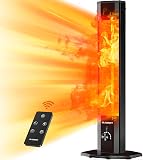
Haimmy is my tower alternative for someone who prefers a physical adjustment knob. Among patio heaters with several levels, that everyday interaction can be more relevant than another marketing claim about rapid startup. Compare its control layout with VAGKRI, then check whether the base is suitable for the surface where it will stand.
The UEH500 manual linked to the offer documents 120 V, nine heat levels from 700 to 1500 W, a one-to-nine-hour timer, rotary and remote adjustment, and a panel lock. The 42-inch listing advertises IPX5 and overheat protection. The lower end of its range is different from the smaller SereneLife tower’s.
The manual explains an important limitation: carpets, lawns, or decks with gaps may leave the bottom tip-over switch disengaged and prevent startup. It specifies a flat, hard supporting surface. For this outdoor heater, the ground beneath the base is therefore a concrete pre-purchase check, not a minor detail to address after assembly.
A plan to stand the heater directly on grass or across widely spaced boards needs reconsideration. Choose a compliant location or a different mounting arrangement rather than improvise around the switch. Never tape down or bypass it. A fixed heater may suit a site where no appropriate floor position is available.
The panel lock helps prevent unintended setting changes; hot surfaces still require separation and supervision. Choose Haimmy for the knob and documented base requirements when both fit your routine. It offers a different way to control the heat, not evidence of a larger warming zone than another 1500 W tower.
Reasons to Buy
- Rotary adjustment plus remote operation.
- Documented nine-level range and timer.
- Manual explains the base-switch limitation before purchase.
Reasons to Avoid
- Grass or gaps in decking can prevent proper switch contact.
- Panel locking does not remove hot-surface hazards.
Dr. Infrared DR-239 3000W — High-Power Mounted Pick

DR-239 is the option to investigate for a planned fixed installation with higher available heat output. It is the largest electrical commitment among these patio heaters. Price the complete installation before ordering. When you want to heat a larger seating area, ask whether its extra power suits that layout rather than infer twice the coverage from twice the wattage.
The manufacturer page specifies a 3000 W infrared heater, wall or ceiling mounting hardware, IP55, two output levels, and remote operation. Its owner’s manual adds a timer up to 24 hours and a minimum mounting height of 7.9 feet. The remaining clearance and orientation requirements also apply.
The connection is the decisive difference. The manual specifies 240 V with a matching grounded plug and outlet, and rejects a plug adapter. Have a qualified electrician assess the supply and installation requirements. Do not confuse DR-239 with a similarly named 1500 W model or order it for an ordinary 120 V connection.
For a permanent seating arrangement, compare the installed cost with a lower-powered wall unit. Include the supporting structure, cable route, and access for servicing. A remote is convenient once the heater is properly positioned; a fixed installation remains a different commitment from bringing a tower out of storage for an evening.
The High-Power Mounted Pick label refers to its published maximum output. The manual acknowledges reduced useful coverage in cold or windy conditions, so I would still request a layout assessment. Choose it when the complete project supports the extra heat; choose a lower-output setup when that better matches the site and budget.
Reasons to Buy
- Higher published maximum output than the other selections.
- Documented wall and ceiling mounting options.
- Remote, mounting kit, and full owner’s manual available.
Reasons to Avoid
- Requires a suitable 240 V installation; not a 120 V substitute.
- Mounting height and all clearances must fit the structure.
SereneLife SLOHT28 1500W — Wall-Mounted Pick

SLOHT28 is the simpler wall-mounted heater in this comparison. I would investigate it when a permanent position is desirable and adjustable output is not a priority. Its appeal is keeping a base out of the walking area while using the lower-voltage supply specified for this configuration.
The SLOHT28 manufacturer page lists 120 V, one 1500 W heat level, a two-meter cable, IP65, and remote control. The package includes a wall bracket, four anchors, four screws, and a remote without AAA batteries. The selected ASIN corresponds to SLOHT28; other SereneLife model numbers are not interchangeable.
One heat level is the main compromise. Choose a multilevel model when you expect to vary intensity while keeping the seating distance fixed. Consider the simpler on/off arrangement when it meets a stable installation brief. For my purchase, that everyday preference would matter more than saving a little on equipment that needs different controls.
The installation manual requires a position at least 6.9 feet above the floor, plus separate wall, ceiling, and combustible-material clearances. Check the full layout. A low roof, nearby fabric, or awkward cable route can rule out a location even when the heater’s body dimensions look suitable.
The brand page also gives incompatible area claims: 18 square feet and 10–15 square meters. I have excluded both from the coverage comparison. Choose SLOHT28 for a compliant fixed position and simple controls; choose an adjustable electric heater when lower settings are important. Confirm the installation before treating its listed output as a solution for the entire space.
Reasons to Buy
- Fixed wall format without a tripod occupying the floor.
- Listed 120 V supply and included mounting hardware.
- A model-specific manual is available.
Reasons to Avoid
- Only one output level is specified.
- Coverage claims conflict; installation needs more than a height check.
How to Choose the Best Electric Patio Heater for Your Setup
Freestanding vs. Wall-Mounted Patio Heaters
Compare the types of patio heaters against your furniture layout, including chairs pulled out and the route from the door. The best patio heaters for a compact setup need a workable position throughout normal use. A tripod’s legs and required separation can occupy considerably more floor space than the heating head suggests.
Outdoor-heating layout guidance distinguishes movable positions from installations designed around the architecture. I would compare freestanding patio heaters when furniture moves regularly, and fixed models when the seating zone is established. Check the supporting surface or structure and the full electrical route in either case.
A small space can have little usable clearance once everyone is seated. Obtain the assembly instructions before relying on “easy to assemble” language. For a movable setup, check handling and storage needs rather than assuming that every portable model is lightweight.
Infrared Patio Heater Placement: What Warmth Should You Expect?
Infrared patio heaters provide warmth by directing radiant energy toward people and surfaces. Bromic’s heating explanation helps distinguish that process from warming the surrounding air. That distinction shapes what to expect from an electric patio heater: a warmer occupied zone, not a sealed-room temperature across the whole outdoor area.
Compare how radiant heat is directed at the intended seats. Similar wattage does not establish similar distribution: orientation, distance, reflector design, and conditions matter. This guide has no comparative coverage measurements, so ask the supplier for placement guidance and assess the return terms before committing to an unfamiliar arrangement.
Also ask about the visible light the elements emit, display brightness, and control beeps when evening atmosphere matters. “Instant heating” describes startup, not a measured time to warm everyone at a table. I would prefer a practical direction of heat and comfortable controls over a one-second claim without comparable test conditions.
120 V vs. 240 V: Check the Supply Before Checkout
Compare the exact nameplate with the intended outlet and circuit. Patio heaters can share an electrical supply with equipment elsewhere, so a nearby socket alone is insufficient evidence of capacity. Have an electrician resolve uncertainty about grounding, capacity, outdoor protection, or the condition of the connection before purchase.
Keep the DR-239 installation separate from the 120 V choices. Its model-specific requirements determine the connection and mounting plan; an adapter is not a solution. Include electrical work in the purchase budget. For a wall-mounted electric heater, the installed cost is more informative than the appliance price alone.
Apply the same discipline to inconsistent documentation. SLOHT52 needs clarification of its electrical entries before a purchase decision. An unanswered supply question should take priority over a sale, a review count, or the number of available heat levels.
Heat Output and Coverage: Avoid the Biggest-Number Trap
Wattage is useful for comparing input power, but it is not a measured comfort radius. For patio heaters, ask where an area claim applies: inside or outdoors, at what mounting height, in what weather, and with how many exposed sides. Meaningful coverage comparisons need matching conditions.
SLOHT52 and SLOHT28 each provide incompatible area figures on their own pages. I have omitted these promises from the table. Choosing the larger number would make the comparison look more complete while making it less dependable.
Describe your outdoor space to the supplier and request guidance for the exact product. A long table and an L-shaped seating group present different placement questions. For a large exposed site, a planned outdoor heating layout may be more useful than choosing one outdoor heater with a bigger headline heat output.
Running Costs: Compare Watts, Time, and Your Electricity Rate
The energy-use calculation explained by The College of New Jersey is: watts ÷ 1000 × hours × price per kilowatt-hour. Apply it to the input and running time you expect, using your own tariff. This makes electrical cost comparisons between patio heaters transparent without inventing a national average.
At an assumed $0.20 per kWh, continuous input of 900 W costs $0.18 per hour; 1500 W costs $0.30; and 3000 W costs $0.60. These are illustrative calculations, not measured bills. A lower selected heat level or a shorter session changes consumption.
At the stated inputs for equal time, 900 W consumes 40% less electricity than 1500 W. That does not establish equal comfort with a 40% saving. Compare cost for the heat level and layout that meet your needs, rather than label the lowest-wattage appliance most efficient without a comparable heating result.
IPX5, IP55, and IP65: Read the Two Positions Separately
The IEC’s ingress-protection explanation separates protection against solid particles from protection against water. An X in the first position does not assign a dust-protection level. A first digit of 5 denotes dust protection; 6 denotes dust-tightness. The final 5 in these codes concerns water jets, not immersion. IP65 therefore does not simply mean “more waterproof” than IP55.
For the selected models, these are published enclosure ratings—not a certification audit performed by this guide. They do not establish that a plug, remote, extension connection, or every installation is equally protected. Follow the model’s restrictions on weather exposure, cleaning, and storage. Do not translate an IPX5 claim into “resistant to dust” or take a marketing photograph as installation approval.
Electric vs. Propane Patio Heaters: Keep the Buying Brief Clear
Bromic’s gas-versus-electric guidance treats the available energy supply, ventilation, layout, and desired control as the starting questions. An electric heater avoids a fuel-cylinder routine, while propane heaters can be relevant to a different outdoor installation brief. Neither category is universally the best choice for every property.
A pyramid propane patio heater may appeal when a visible flame is part of the goal, but that is a different buying brief. Compare a gas patio heater separately using its own ventilation and clearance instructions. Gas heaters are not substitutes to add to this electric-only shortlist merely for a larger heat output number or a more dramatic photograph.
Heater Features: Controls, Support, and Ownership Costs
Patio heaters come with different control schemes: rotary adjustment, stepped buttons, a remote, or straightforward on/off operation. Compare how you would use each one from your seat. An accessible control layout may be a better fit than the longest feature list; more settings matter only when you use them.
Include essential mounting items, appropriate electrical work, and storage in the budget. Confirm the seller, delivered version, return conditions, and written warranty. Ask about replacement controls and elements for the exact model; keep the rating-plate details and instructions with the purchase records.
For cleaning compatible outdoor patio surfaces before arranging the furniture, my pressure washer comparison covers that separate job. Move portable patio heaters out of the cleaning area and protect fixed equipment according to its instructions. A water-resistance claim is not permission to pressure-wash a heater.
Using Patio Heaters: Placement, Supervision, and Storage
Set up a suitable connection. CPSC guidance for portable electric heaters says not to use an extension cord or power strip. Inspect the appliance, cord, and plug; do not operate damaged equipment or use a loose outlet. Stop use if the plug, outlet, or faceplate becomes hot and arrange appropriate inspection. Outdoor connections must also meet the exact appliance instructions and applicable local requirements.
Follow clearances for the actual installation. CPSC’s portable-heater guidance calls for separation of at least three feet from combustible materials. A mounted product has additional model-specific rules: consult the SLOHT28 manual or DR-239 manual, as appropriate. Do not use the general three-foot advice as a replacement for mounting height, side-wall, ceiling, or angle requirements.
Keep the appliance stable and attended. Put towers only on an approved, stable surface; the Haimmy instructions show why the bottom switch matters. Never bypass a safety device. Follow CPSC’s advice not to leave a heater running unattended or while sleeping. Timers, locks, and auto shut-off functions are backups, not permission to abandon supervision.
Allow for movement around hot equipment. Keep children, pets, curtains, cushions, and other combustible items away from the heater as the instructions require. Do not drape clothing over it, cover it while operating, or move it while hot. A protective grille is not proof of a safe-to-touch surface. Keep hands dry and protect the electrical connection from water.
Switch off, isolate, cool, and maintain. Follow the model’s shutdown and cleaning sequence. The DR-239 maintenance instructions call for cooling and disconnecting before cleaning and prohibit immersion. Use the approved storage method and seek authorized service for damage; do not improvise internal repairs. Check the exact model against official recall information before use; this guide is not a complete recall audit.
My pre-purchase check: “What exact model will arrive, where is its matching manual, can my supply and mounting location support it, and what is included?” Resolve those questions before comparing another marketing claim.
Frequently Asked Questions About Patio Heaters
Which heater is the best starting point for a typical seating area?
For a movable setup, VAGKRI is my first comparison within this shortlist. Haimmy is the knob-controlled alternative. I would investigate mounted patio heaters when a floor position is impractical, and a different heating plan for a large exposed site. The selection is based on documented features and fit, not comparative hands-on testing.
Can I use an electric patio heater under a covered patio?
Only when the exact product’s permitted installation, electrical requirements, and clearances suit the structure. Electric radiant heating can be appropriate for covered spaces, but a low roof or nearby fabric can change the answer. Check the relevant mounting instructions; do not treat “covered patio” as blanket approval for a gazebo, awning, or enclosed porch.
Is 1500 W enough for my whole patio?
Wattage alone cannot answer that. Describe the seating group and exposure, then seek guidance for the exact model. A targeted zone of heat is a more useful starting brief than assuming one appliance warms every corner equally. This article does not assign an unmeasured radius to any of the six patio heaters.
Do nine heat settings mean a heater has a thermostat?
No. Several selectable heat levels do not establish temperature-sensing control that maintains a chosen temperature. The table describes documented adjustment, not a thermostat inferred from a button icon or marketing title. Require explicit confirmation in the exact model’s instructions when thermostatic operation is important.
Does IP65 mean I can leave the heater outside indefinitely?
No. An enclosure rating does not replace the manufacturer’s exposure, cleaning, storage, or connection requirements. It also does not promise immunity to corrosion or cover every component in the installation. Use the exact manual, keep the electrical connection appropriate for the setting, and do not immerse a heater or wash it with a pressure washer.
Why might Haimmy fail to turn on when placed on decking?
The UEH500 instructions describe a bottom-switch contact requirement. Check that its placement matches the specified surface. Never bypass the switch to force startup; failure in a compliant position requires manufacturer support. This is one reason to assess patio heaters against the actual ground, not a listing photograph.
Do electric models require less maintenance than propane heaters?
They eliminate the fuel-cylinder and combustion-related routine associated with propane equipment, but they are not maintenance-free. Inspection, approved cleaning, secure mounting, and correct storage still matter. My comparison would include support and replacement-part access rather than assume that avoiding fuel makes every electric purchase equally easy to own.
Final Verdict: Find the Best Fit for Your Patio
My first comparison: VAGKRI for a freestanding setup, Briza for its advertised mounting flexibility after a manual check, and DR-239 for a properly planned higher-power installation. These are different buying briefs, not interchangeable substitutes.
Haimmy is the rotary-control alternative when its base requirements fit the location. SLOHT28 offers simpler fixed-position operation, while SLOHT52 belongs in a lower-wattage comparison only after its inconsistent electrical information is clarified. The reasons to skip a configuration are as important as its most attractive feature.
Select the best fit by starting with your furniture, power supply, and permitted installation. A patio heater that works with that layout is more useful than a larger coverage promise. For an outdoor electric patio heater, documented placement and realistic comfort expectations matter more than treating six wattage labels as a complete performance test.
Sources and Product Documents
Reviewed October 9, 2026. Manufacturer statements and selected listing details are distinguished below. Prices, seller stock, delivered revisions, and support terms can change. No hands-on testing, laboratory certification check, or complete recall audit was performed. Follow the instructions supplied with the exact appliance.
- VAGKRI: brand page; selected ASIN B0CJ28BHZ1; VA-OH01 family manual, revision 1.0 (mirrored manufacturer PDF). The selected listing uses VA-OH01 New-2. Family documentation is not proof that every revision-specific detail is identical.
- Briza: selected ASIN B07WCQZG5T / IT-HEQQ-1831. Specifications and package descriptions are listing-based. An exactly matched manufacturer manual was not retrieved; request it before deciding on outdoor placement or mounting.
- SereneLife SLOHT52: manufacturer page; manufacturer manual; selected ASIN B0DBZXY3NG. Amperage and coverage fields are inconsistent. No corrected nameplate rating or guaranteed coverage has been invented.
- Haimmy UEH500: selected ASIN B0B573YWRH; original manufacturer manual hosted with the offer. Printed pages 4–7 show the parts, controls, and bottom-switch placement warning. IPX5 and overheat wording follow the listing.
- Dr. Infrared DR-239: manufacturer page; owner’s manual; selected ASIN B09RTVKR83. The manual specifies 240 V and a matching grounded connection. Do not substitute instructions for DR-238 or another model.
- SereneLife SLOHT28: manufacturer page; manufacturer manual; selected ASIN B09D3YJ161. This is SLOHT28, not SLOHT26. Conflicting heating-area claims were excluded from the comparison table.
- General heating guidance: Bromic outdoor-heating layout and radiant-heating explanation; Bromic gas-versus-electric guide. Used for general context, not as evidence of the six products’ measured performance.
- Safety: U.S. Consumer Product Safety Commission: Reducing Fire Hazards for Portable Electric Heaters. General precautions do not replace a mounted heater’s specific installation manual.
- Ingress protection: IEC IP-ratings explanation. Ratings in the table are source-stated; they were not independently certified by this guide.
- Cost arithmetic: The College of New Jersey: Estimate Your Energy Use at Home. The $0.20/kWh tariff is an illustrative assumption, not a current nationwide rate.