
The best elliptical machine is the one that fits your movement, your room, and the way you will control each session. A long stride, a large weight-capacity claim, and a screen full of programs answer different questions. Start with the space and the person using it; then compare resistance, controls, and the exact version being sold.
My starting point in this six-model comparison is the Sunny SF-E3889SMART for connected controls and an 18-inch stride, provided its user limit and room requirements work for you. I would compare the SF-E3912 for a shorter, console-led setup, and Niceday CT11PRO-20 for a longer-stride alternative. YOSUDA introduces a climbing-style motion; pooboo and ANCHEER remain conditional candidates with documentation questions explained below.
Editorial Note: My recommendations are based on verified manufacturer specifications and independent reviews, not hands-on testing.
Key Takeaways: Choosing an Elliptical Trainer for Home
Match the actual variant. The Niceday selection is the 20-inch version, not one machine with every stride length in its family title. The two Sunny models also have different dimensions, limits, and connection features. Keep the model code beside the shopping link.
Separate three kinds of adjustment. Resistance changes the effort setting. A pedal-angle adjustment changes the footplate orientation. A climbing-style path describes a different movement. None of these, on its own, establishes a motorized incline ramp.
Leave space for operation, not just storage. Measure the machine, access around it, and overhead clearance. A folding claim without a stored footprint and locking instructions is not enough to plan a tight cupboard installation.
Top Picks Summary: Best Ellipticals for Different Setups
Connected 18-Inch Pick — Sunny SF-E3889SMART. My first comparison for app-connected sessions and electronic resistance, subject to its 265 lb limit and longer frame.
Console-Led Alternative — Sunny SF-E3912. The option I would examine when built-in programs matter more than native Bluetooth connectivity.
Longer-Stride Candidate — Niceday CT11PRO-20. A 20-inch selection for buyers who want to investigate a longer movement; confirm the delivered model’s instructions and limits.
Manual-Control Candidate — pooboo E399 / E39905. A knob-controlled alternative, with a 350/400 lb documentation discrepancy that must not be ignored.
Climbing-Motion Alternative — YOSUDA DSJ-01. Consider it for a deliberately different stepping path, not as a like-for-like substitute for a long horizontal stride.
Pedal-Angle Candidate — ANCHEER AMA006033. Worth further investigation for its advertised footplate settings, but not a recommendation based on its unverified high-capacity or folding claims.
Elliptical Machine Comparison Table
These are the selected U.S. configurations. Dimensions are published overall measurements in inches, not the complete operating envelope. Maximum user weights are source claims, not load-test results. No common-condition noise, resistance-force, or durability ranking is implied.
| Product | Stride / Motion | Resistance / Controls | Published User Limit | Overall L × W × H | Included Accessories |
|---|---|---|---|---|---|
| Sunny SF-E3889SMART Manufacturer | 18 in | 16 electronic levels; console and SunnyFit Bluetooth control | 265 lb | 68.3 × 24.2 × 66.9 in | Power adapter, assembly hardware/tools, manual; integrated bottle/device holders |
| Sunny SF-E3912 Manufacturer | 15.5 in | 16 electronic levels; 24 program modes; base model without native Bluetooth | 330 lb | 55 × 23 × 64.5 in | 9V/1A adapter, assembly hardware/tools, manual; integrated bottle/device holders |
| Niceday CT11PRO-20 Selected listing | 20 in selected variant; not a verified adjustable-stride range | 16 magnetic levels; Kinomap support advertised; no wall power required per listing | 500 lb in selected details; mixed family wording and missing matched manual require confirmation | 42.5 × 20 × 64 in listed; verify complete moving clearance | Assembly tools and user manual listed; no mat or tablet established as included |
| pooboo E399 / E39905 Selected listing | 15.5 in selected version; brand page also contains a 15 in entry | 16-level magnetic knob; LCD; app sensor advertised | 350 lb selected listing / 400 lb brand page: unresolved | 49.2 × 29.92 × 62.2 in | Tool kit and manual listed; storage-fold details not established |
| YOSUDA DSJ-01 Selected listing | 15.5 in listed; 45° climbing-style geometry, not a verified adjustable ramp | 16 magnetic levels; basic monitor; Kinomap/Fed app support advertised | 300 lb in selected technical details; do not borrow higher family figures | 38 × 21 × 62 in | Assembly tools and instructions listed; no extra resistance-band kit confirmed |
| ANCHEER AMA006033 Selected listing | 16 in; pedal angles of 5°, 10°, and 16° advertised | 16 magnetic levels; LCD and pulse sensing advertised | 550 lb listing claim; matched operating manual not obtained | 44 × 24 × 63 in listed | Assembly tools and instructions mentioned in sales text; no itemized accessory kit established |
The Sunny manuals identify the named models and their limits. Several other figures rely on selected seller/brand listings. pooboo’s conflicting limits are not averaged, and the larger limit is not endorsed. Niceday and YOSUDA family text covers other configurations. None of these six is presented as having a verified motorized incline ramp.
Elliptical Reviews: Six Different Buying Decisions
Sunny SF-E3889SMART — Connected Elliptical Trainer with an 18-Inch Stride
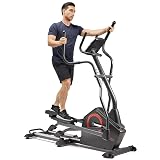

The SF-E3889SMART is my starting point when someone wants a conventional standing trainer with connected controls rather than a phone merely balanced on a shelf. I would choose it for that combination after checking the available room and personal fit. It is not automatically the right choice for someone whose priority is the smallest possible machine.
Sunny’s product page specifies an 18-inch stride and 16 electronic resistance settings controlled from the console or SunnyFit. It describes 12 preset workouts plus four user programs. The distinction is useful: a built-in program, an app session, and manual adjustment are different ways to use the same equipment, not three separate improvements in physical performance.
My shopping check would be a complete session without relying on advertising labels. Can I reach the controls, see the display, and return comfortably to the hand grips? Would I actually use a program, or mostly repeat one familiar setting? Someone who likes a structured session may appreciate the interface; someone who avoids connecting a phone should still evaluate the onboard controls first.
The manufacturer-authored SF-E3889 SMART manual confirms a 265 lb user limit and lists the power adapter and assembly hardware. Its availability also makes the purchase easier to plan: the correct setup and parts list can be examined before delivery rather than discovered after a large box arrives. The copy reviewed here is hosted by a third party.
Against the SF-E3912, this is a choice about longer movement, connected operation, and a different room commitment. Against Niceday, I would weigh the app-control arrangement against the desire to investigate a longer stride. I would not stretch the stated user limit to preserve a preferred recommendation. A machine that fails that basic requirement leaves the shortlist regardless of its screen or programs.
Reasons to Buy
- Console and SunnyFit resistance control are documented.
- Preset sessions and user programs offer different ways to train.
- Matched manufacturer-authored instructions and an adapter are identified.
Reasons to Avoid
- 265 lb maximum excludes some buyers.
- The longer frame needs substantial dedicated space.
Sunny SF-E3912 — Console Programs Without a Built-In App Requirement

The SF-E3912 is the model I would compare when the preferred routine begins at the machine’s console, not inside an app. It offers a different balance from the SMART model rather than simply being the same equipment with connectivity removed. I would especially examine it when a shorter frame and shorter movement are priorities together.
Sunny publishes a 15.5-inch stride, 16 resistance settings, and a 330 lb user limit for this version. Its 24-program headline needs reading carefully: the SF-E3912 manual includes 12 preset profiles within that broader collection of modes, rather than 24 distinct preset routes. I would compare the controls I expect to use, not reward the larger headline count automatically.
Imagine wanting to repeat the same session a few times a week and record the result separately. A readable console and predictable resistance changes may be more valuable than another connected account. Conversely, someone specifically buying for automatic app-led control should not assume that access to SunnyFit exercise videos means this base machine has native Bluetooth. SF-E3912 and SMART-branded variants need separate treatment.
The published frame is shorter than the SF-E3889SMART, but I would still measure access to both sides, the movement area, and the route into the room. Transport wheels help reposition equipment; they do not answer whether one person can safely carry it upstairs. The included power adapter also means planning a suitable socket without placing its cable across the approach to the pedals.
This is my console-led alternative when its motion suits the user. I would choose the other Sunny for a deliberate connection requirement, or compare Niceday for a longer step. The useful question is not which Sunny has the greater maximum on one specification line. It is which exact configuration fits the person and the intended daily routine without requiring a compromise on basic access or operating limits.
Reasons to Buy
- Built-in resistance programs without needing native app connectivity.
- Shorter published frame than the SF-E3889SMART.
- Model-specific setup and maintenance documentation.
Reasons to Avoid
- 15.5-inch stride will not suit every movement preference.
- The base model should not be bought expecting integrated Bluetooth.
Niceday CT11PRO-20 — A Longer-Stride Elliptical Candidate

The Niceday earns a place for a specific reason: it is the longer-stride candidate in this selected group. I would investigate it when shorter machines feel restrictive, not assume that every tall person needs precisely the same measurement. A preferred movement still needs checking alongside pedal spacing, handle reach, and the equipment’s position in the room.
The selected offer identifies CT11PRO-20, with a 20-inch stride, 16 magnetic settings, and an advertised 18 lb flywheel. The 15.5/16/20-inch wording in its family title describes different options; it does not establish an adjustable range on this machine. Kinomap support is advertised, but that is not proof that an app can electronically change its resistance.
For my purchase plan, the appeal would be straightforward sessions without organizing a wall-power location, as described in the listing. A display and an optional app can still help record activity, but neither would outweigh an uncomfortable movement. I would request a demonstration of the exact version before committing when physical fit is the reason for choosing it.
There is a documentation limitation. Selected specifications claim a 500 lb maximum, while family wording also contains a lower figure; I did not obtain a full, exactly matched operating manual. I would not use that headline to recommend training near the claimed ceiling. Obtain the delivered version’s manual and written limit confirmation, especially when capacity is the deciding requirement.
Compared with the connected Sunny, I would prioritize this model only when the longer motion is a useful difference and the documentation questions are resolved. Compared with the smaller-frame alternatives, I would measure the complete moving envelope rather than take a compact housing measurement at face value. It remains a longer-stride candidate, not a tested comfort or heavy-duty winner.
Reasons to Buy
- The selected version explicitly identifies a longer 20-inch stride.
- Magnetic resistance with no wall-power requirement advertised.
- Assembly tools and instructions are listed.
Reasons to Avoid
- Mixed family descriptions require exact-version checks.
- The high user-limit claim lacks a retrieved matching manual.
pooboo E399 — A Manual-Resistance Alternative with a Capacity Caveat
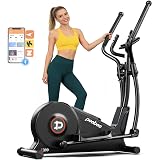
I would consider the pooboo for a buyer who prefers a physical resistance knob and a basic display. That is a legitimate preference rather than an automatic downgrade from electronic controls. The purchase becomes less attractive when someone needs a precise storage-fold arrangement or a high user limit that the documentation cannot consistently establish.
The selected E39905 offer is the black 15.5-inch version, not a verified 15-to-17-inch adjustable machine. The brand’s E399 page describes 16 knob-selected magnetic settings, a rear drive system, a 16 lb flywheel, and an app sensor. I would buy primarily for the physical controls; advertised data connection is not the same as automatic resistance.
The capacity discrepancy matters more than the marketing adjectives. The selected listing gives 350 lb, while the brand page gives 400 lb. That page also contains both 15 and 15.5-inch stride entries. I have retained the selected listing’s identification, flagged the conflict, and not promoted the higher user limit. Ask for a manual and rating label matched to the actual delivery.
For a shared room, I would map out where the equipment stays during use before considering its folding claim. A product that can be folded in some way may still be awkward to move or too large for the intended corner. Without a confirmed stored footprint and locking procedure, I would plan permanent floor space rather than promise quick storage after every session.
Against the SF-E3912, this is a manual-control versus console-program decision, with less consistent supporting documentation. Someone who simply wants to choose a setting and pedal may find that trade-off acceptable after verification. Someone whose purchase depends on the disputed capacity or folding dimension should pause here; an attractive configuration is not a reason to fill a missing specification with optimism.
Reasons to Buy
- Physical resistance knob and straightforward display format.
- Brand describes a rear-drive magnetic system and app sensor.
- Tool kit and instructions are listed.
Reasons to Avoid
- User-limit and stride wording conflict across sources.
- Folded dimensions and locking instructions were not established.
YOSUDA DSJ-01 — Climbing-Style Elliptical Exercise in a Different Format

The DSJ-01 is the specialist comparison here. I would examine it for a stepping or climbing-style session rather than buy it as a smaller imitation of a long-stride elliptical. The shorter-looking layout is only useful when that movement is what the user actually wants. It should not be selected from dimensions alone.
The selected DSJ-01 listing describes 45-degree climbing geometry, 16 magnetic settings, an 18 lb flywheel, and a 300 lb technical user limit. Its 15.5-inch stride entry does not describe the same purchasing experience as a conventional horizontal sweep. Nor does the family’s 12°/45° wording establish a motorized range that changes between those angles.
My practical check would be whether I can maintain the intended motion comfortably while reaching the controls and using the handlebars as directed. Someone who enjoys a deliberate upward-stepping pattern may prefer this arrangement. Someone looking for a flatter, longer movement should compare the conventional models instead. There is no useful reason to make both buyers share one universal recommendation.
The offer advertises Kinomap/Fed app support and lists assembly tools and instructions. I did not retrieve a complete matched DSJ-01 manual, so app automation, exact clearance, and maintenance details need confirmation before purchase. Related FED/YOSUDA product pages are not enough to assign extra accessories or another model’s operating instructions to this ASIN.
Against the Sunny machines, choose by movement before comparing screen features. Against Niceday, decide whether a climbing emphasis or a longer stride is the intended experience. I would not turn an incline angle into a promise about calories, muscle development, or suitability for a joint condition. This is a different equipment format, not a proven shortcut to better results.
Reasons to Buy
- Distinct climbing-style motion for a deliberate stepping preference.
- Magnetic resistance and app support advertised.
- A separate alternative to the conventional long-frame designs.
Reasons to Avoid
- 45° geometry is not a verified adjustable incline range.
- A full matching manual was not retrieved.
ANCHEER AMA006033 — Investigate the Adjustable Pedals Before Buying

The ANCHEER is included as a verification-first candidate, not a default recommendation for heavy users or rehabilitation. Its advertised footplate adjustment creates a potentially useful question for someone comparing pedal positions. The supporting evidence is weaker than for the two Sunny models, so I would settle the documentation before treating that feature as a reason to order.
The selected listing identifies AMA006033, a 16-inch stride, 16 magnetic resistance settings, and pedal-angle positions of 5°, 10°, and 16°. Those are footplate angles, not a whole-machine incline specification. The advertised LCD and pulse sensors describe the monitoring equipment; they do not establish accuracy or therapeutic suitability.
I would ask the seller to show how each pedal position is secured, whether adjustment must be made off the machine, and which instructions accompany it. That request is especially important when several people will share the equipment. A feature is useful only when it is clear how to set, check, and repeat it correctly without improvising a mechanism.
The same offer claims a 550 lb maximum and a folding construction, but I could not retrieve matched instructions establishing those operating and storage details. Its sales text mentions tools and instructions but gives no itemized accessory inventory. I have not added a mat or power adapter to the package, and I would not rely on an isolated “lifetime” warranty field without written terms.
Against pooboo, both purchases need document checks; against Sunny, the accessible instructions make preparation more concrete. I would keep ANCHEER on a research shortlist only when the pedal adjustment is a genuine priority and the supplier can resolve the questions. Otherwise, choose a better-documented configuration that fits rather than letting the largest capacity headline make the decision.
Reasons to Buy
- Advertised pedal-angle positions offer a specific feature to investigate.
- Standing design with magnetic resistance and a basic monitor.
- Exact listing identity is recorded for supplier questions.
Reasons to Avoid
- The 550 lb limit and folding arrangement lack a retrieved matched manual.
- The accessory inventory and full warranty terms remain unclear.
Buying Guide: What to Look for in an Elliptical
Stride Length: Match the Movement, Not a Height Slogan
Stride length is a useful first filter, not a complete fit assessment. I would shortlist a few plausible sizes and then compare the movement, pedal spacing, and handle reach together. A claim that one machine suits the “average user” is not specific enough to decide a large equipment purchase.
This group illustrates the choice: conventional selected lengths run from 15.5 to 20 inches, while the YOSUDA follows a different climbing-style path. Bigger is not automatically better. A person seeking a shorter movement should not be pushed toward 20-inch strides just because they occupy the premium end of a comparison.
Before ordering remotely, I would request a demonstration of the exact model and read the return conditions. During a supervised tryout, pay attention to whether the motion feels natural rather than stretched or cramped. Do not use another person’s comfort report as proof of personal fit, and do not treat discomfort as something a more expensive console will fix.
Resistance, Incline, and Pedal Adjustment Are Different Features
The number of resistance levels tells you how many selectable steps a system offers. It does not establish the actual amount of resistance at each setting. Two machines with 16 positions need not feel the same, and this comparison contains no shared force measurement that would establish an intensity winner.
The selected Sunny SMART model documents electronic control; the pooboo describes a physical knob. I would choose between them by how I want to make changes during a session. Program-led changes can be useful, but manual control may better suit a repeatable routine with few adjustments.
Keep an incline feature separate from both. A machine would need an explicitly documented adjustable ramp or path before I described selectable incline levels. None is established for this six-model group. ANCHEER’s footplate tilt and YOSUDA’s climbing geometry must not be converted into motorized incline claims. Buyers who specifically require that function should choose a differently documented shortlist.
Footprint, Ceiling Height, and the Space Around the Pedals
Mark the published frame dimensions on the floor, then add operating clearance, the moving parts’ sweep, and access for getting on and off. Include nearby doors, furniture, and a ceiling fan. A machine can fit inside a room while still being poorly positioned for use or servicing.
Ceiling planning needs more than the height of the console. Sunny publishes a maximum pedal height of 18.1 inches for SF-E3889SMART, compared with 14.57 inches for SF-E3912. Those are useful inputs, not a universal headroom formula. Confirm clearance with the user’s full movement and the manufacturer’s requirements.
I would also plan delivery separately from daily storage. Check door openings, turns, stairs, the assembly location, and who will handle the equipment. Wheels are not stair-climbing equipment. Likewise, “foldable” does not tell you the folded height, width, locking arrangement, or whether folding is realistic after each session.
Weight Capacity, Build Quality, and the Right Documentation
Treat the stated maximum user weight capacity as a limit to verify, not a score for build quality. An alloy-steel frame, a heavy-duty label, and a large number do not provide the same evidence as matched instructions. Do not exceed the delivered model’s limit or infer that a safety margin makes a disputed rating usable.
pooboo’s selected 350 lb entry and brand’s 400 lb claim illustrate why this matters. I would not average the two or pick the more convenient figure. Request the rating label and matching manual; when the discrepancy affects suitability, postpone the purchase until it is resolved.
For multiple users, confirm every person’s requirements rather than optimize for one and assume the rest can adapt. I would ask about part support and permitted home use at the same time. A higher price is easier to justify when it buys a requirement that matters, not merely a stronger-sounding adjective.
Console, Bluetooth, Grip, and Workout Programs
Decide what must happen on the equipment itself and what may happen on your own phone. A device holder does not make the console a touchscreen. An app listing does not prove automatic resistance control, and being able to watch exercise videos does not establish a connection to the machine’s sensors.
I would test the practical interface before counting features: can I reach a handlebar comfortably, read the selected resistance level, and see the relevant number with a phone in the holder? Water bottle holders and a usable display position may contribute more to a consistent workout routine than functions I would rarely open.
There is no measured comparison here of grip comfort, cushion performance, or monitoring accuracy. Oversized foot pedals are not automatically cushioned pedals. Treat displayed calories and pulse as equipment feedback rather than a personalized medical assessment; a pulse display alone also does not establish compatibility with a chest strap.
Assembly, Warranty, and the Complete Cost of Ownership
I would budget for delivery, assembly assistance when needed, suitable floor protection, and the actual accessories supplied. A tablet in a product photograph is not proof it comes with the trainer. The table distinguishes listed tools and adapters from accessories that were not established as included.
Read frame and parts coverage separately. Both SF-E3889SMART and SF-E3912 product pages list three years for the structural frame and 180 days for other parts and components. That is not three years of complete coverage. Ask about labor, shipping, exclusions, and the process for obtaining an exact replacement.
My preference is a supplier who can identify a pedal, adapter, or control component from the model and part number before purchase. That question is more useful than assuming an online warranty field guarantees convenient service. Keep proof of purchase and the correct documentation with the equipment record.
Standing Ellipticals, Climbers, and Under-Desk Equipment
This comparison focuses on standing machines, including one climbing-style alternative. A seated under-desk device is a different purchase, not simply a smaller version with an interchangeable workout experience. Decide whether the equipment will support a dedicated exercise session or movement while doing another task.
For walking during desk work, my walking pad comparison addresses a separate setup. It is not a reason to squeeze a standing elliptical under a desk. Plan a machine around the activity you want to repeat, rather than let the available corner determine an unsuitable movement.
The best ellipticals for a shared home gym will not necessarily be the best choices for a compact work area. I would write the intended use in one sentence before shopping: where the equipment stays, who uses it, and which controls are essential. That keeps a long feature list from distracting from the actual job.
Elliptical Setup, Safety, and Maintenance
Use the delivered model’s instructions. Match the code on the machine, manual, and order. A family-name resemblance is not enough. Check the supplied parts before assembly and follow the documented orientation of the pedals and arms. Arrange assistance when the size or weight makes handling unsafe; do not improvise a lifting point from a handle’s appearance.
Keep the movement area clear. The SF-E3889SMART instructions specify a solid, level surface and at least two feet of free space around the equipment. Use the applicable requirement for each other model rather than assume identical clearances. Keep children, pets, loose clothing, and trailing cables away from moving parts.
Inspect rather than train through a fault. Follow the model’s checks for fasteners, footplates, retaining parts, and supports. New looseness, damaged parts, or abnormal mechanical noise calls for stopping and resolving the issue. A machine continuing to move is not evidence that it remains suitable for use, and extra resistance is not a repair for an unstable setup.
Make care specific and repeatable. Sunny’s SF-E3912 maintenance guidance calls for checking assembly bolts and pedals weekly, wiping perspiration after use, and protecting the console from excessive moisture. Follow the prescribed cleaning method; do not spray or lubricate internal parts indiscriminately. Store the equipment in the conditions permitted by its own manual.
Keep exercise suitability separate from shopping features. A low-impact description is not permission to exercise through pain or a promise of rehabilitation. The Sunny manuals exclude therapeutic use. Seek individualized advice when a health condition affects exercise selection, and stop a session if concerning symptoms occur rather than relying on a reassuring console reading.
A useful pre-purchase question: “For this exact model, what are the stride and user limit, how much operating and overhead space is required, what is adjustable, and where can I read the matching instructions?” Clear answers matter more than a larger headline number.
Frequently Asked Questions About Elliptical Machines
Which is the best elliptical machine in this comparison?
I would begin with Sunny SF-E3889SMART for connected controls, provided its fit and limit suit the buyer. The SF-E3912 is my console-led alternative; Niceday is the longer-stride candidate after document checks. Those are recommendations within this selected group, not a claim to have tested every machine on the market or established one universal winner.
Is a 20-inch stride always better than 15.5 or 18 inches?
No. It is a different movement length, not a quality rating. Compare the foot path, pedal spacing, and hand reach as well. A person comfortable on a shorter trainer may not benefit from a longer one. A climbing-style machine’s nominal stride should also not be treated as interchangeable with a conventional horizontal movement.
Do these models have adjustable incline?
I have not established a motorized incline ramp on any of the six. The selected ANCHEER advertises pedal-angle adjustment, and YOSUDA uses climbing-style geometry. Neither proves adjustable whole-machine incline. Changing resistance is another separate function. A purchase that depends on automatic elevation needs explicit model-specific documentation, not an interpretation of the word “incline.”
Can I choose an elliptical by its weight limit alone?
No. The correct limit is essential, but it does not answer whether the stride, mounting access, controls, or room layout fit. Resolve conflicting ratings before ordering. I would not use the largest unverified figure in this table to select a machine for a heavier user, nor treat a smaller published limit as evidence of worse engineering.
Does Bluetooth mean an app controls resistance?
Not necessarily. A connection may send activity data without changing the load. Sunny explicitly describes resistance control on SF-E3889SMART; that feature should not be transferred to the base SF-E3912 or to another brand’s sensor-equipped machine. Check the exact app function, compatible version, and any optional equipment before making connectivity the deciding feature.
Which model is the quietest?
This research does not establish a winner. Advertising such as “silent” or “hyper-quiet” does not supply a comparable test across the six configurations. I would ask about sound under the intended conditions, including floor vibration, and use a suitable return policy when room noise is critical. A magnetic system alone is not proof of inaudible operation.
Will a standing elliptical fit into a small room?
Possibly, but the frame rectangle is only the starting point. Add operating clearance, moving-part travel, overhead room, and access for assembly and service. Check the delivery route too. A folding claim without stored dimensions and a secure procedure does not settle the question. Avoid planning a purchase around an unverified folded size.
Final Verdict: Choose the Trainer That Fits the Whole Setup
I would start with the Sunny SF-E3889SMART for a connected, conventional setup, or the SF-E3912 when a shorter, console-led arrangement makes more sense. The Niceday CT11PRO-20 is the longer-stride comparison, with exact-version documentation still important before purchase.
The other three answer narrower questions. pooboo E399 suits a manual-control shortlist after its conflicting specifications are clarified. YOSUDA DSJ-01 belongs with buyers deliberately seeking climbing-style movement. ANCHEER AMA006033 needs stronger operating and accessory documentation before I would turn interest in its adjustable pedals into a purchase recommendation.
The best ellipticals are not determined by a single number. Choose a supported user limit, suitable motion, accessible controls, adequate space, and a realistic ownership plan together. When a key fact remains unresolved, asking for the right manual is a better next step than assuming the most attractive claim is correct.
Sources and Product Documents
Reviewed October 6, 2026. Product selection began with a six-ASIN shortlist from the supplied WPH01 export. Technical research was conducted separately. Published claims, document conflicts, and my editorial purchase scenarios are distinguished throughout. Availability, supplied revisions, and seller bundles can change; no comprehensive recall audit or hands-on testing is claimed.
- Sunny SF-E3889SMART — B07XSNZGSY: selected model identity; manufacturer specifications; official assembly resource; manufacturer-authored manual, third-party-hosted PDF (PDF pages 2 and 4: safety, limit, package, and parts). The SMART suffix is part of the selected identity.
- Sunny SF-E3912 — B07SRDFKQR: selected base-model listing; manufacturer specifications; manufacturer manual hosted on Amazon (PDF pages 2, 6, 11, and 15: limit, adapter/tools, care, and preset profiles); official assembly resource. Native Bluetooth was not borrowed from later SMART models or optional cadence sensors.
- Niceday CT11PRO-20 — B0G58VRFTJ: selected 20IN Stride Brown Orange offer. Model fields and selected-version details were distinguished from family wording. No full CT11PRO-20 manual was retrieved; high-capacity and complete operating-clearance claims remain purchase checks.
- pooboo E399 / E39905 — B0D62Z5GS9: selected 15.5IN-Stride Black offer; brand E399 page. The 350/400 lb discrepancy and inconsistent stride entries remain unresolved. Folded dimensions and a matched folding/locking procedure were not established.
- YOSUDA DSJ-01 — B0B81FKZVJ: selected offer and model-specific technical fields. The climbing geometry is not a confirmed adjustable incline range. Related SC1/E9 family descriptions were not used to add accessories or override the selected 300 lb entry; no complete matched DSJ-01 manual was retrieved.
- ANCHEER AMA006033 — B0H3NL8DQS: selected offer, which also lists part number C41100327th. Pedal settings, dimensions, and capacity are listing claims. No full matching manual, folded footprint, detailed accessory inventory, or complete warranty terms were obtained.