
The best jump starter for your car is not necessarily the one with the biggest peak-amp number. Start with your vehicle’s voltage and engine requirements, then compare the clamps, controls, charging adapter, and storage plan. For a car emergency kit, I would prioritize equipment I can keep charged and understand before a drained battery leaves me needing help.
I compare six portable car jump starters with different strengths. For a well-equipped standalone kit, I would start with the WOLFBOX MV24, especially when USB-C charging matters. The GOOLOO A3 adds tire inflation, while the AstroAI S8 1500A takes a simpler approach for vehicles within its narrower engine guidance. The exact model and included accessories matter more than a familiar brand name alone.
Editorial Note: My recommendations are based on verified manufacturer specifications and independent reviews, not hands-on testing.
Key Takeaways: Choosing a Portable Jump Starter
Start with compatibility. Check the vehicle’s required jump-start voltage and procedure before comparing engine-size claims. These selected units target 12V applications; a bigger amp label does not make a unit suitable for a different electrical system.
Read input and output separately. WOLFBOX documents 65W USB-C in both directions. HULKMAN distinguishes its own 65W charging mode from 18W USB-C output. That difference matters when the same purchase is supposed to support electronics as well as a vehicle. WOLFBOX specifications; HULKMAN specifications.
Choose extras deliberately. The A3 combines two roadside tools. The JNC660 instead emphasizes a conventional jump-box layout and a replaceable internal battery. Decide which arrangement you will actually maintain and keep accessible, not which description contains the most features.
Top Picks Summary: Six Car Jump Starters
Fast USB-C Kit Pick — WOLFBOX MegaVolt24 / MV24. My first shortlist option when a documented high-output USB-C connection and an included wall charger are priorities.
Standalone Alternative — GOOLOO GP4000. Worth comparing for starting assistance without a compressor; verify the charging specification of the supplied revision.
Air Compressor Pick — GOOLOO A3. The combination option for buyers who want tire-pressure top-ups in the same device.
Garage Pick — Jump-N-Carry JNC660. A traditional lead-acid unit with a charge gauge, built-in AC charging, and manufacturer-supported battery replacement.
Status Display Pick — HULKMAN Alpha85. The option I would prioritize when a large screen showing charge, operating status, and errors is the main attraction.
Compact Essentials Pick — AstroAI S8 1500A. A simpler starting point for a compatible smaller vehicle, without paying for an inflator or laptop-oriented output.
Portable Jump Starter Comparison Table
These are published specifications for the named configurations, not results obtained under identical loads. Engine limits are manufacturer guidance, not guarantees that a unit will start every vehicle of that displacement. Package contents below describe the reviewed documentation; check the actual seller bundle.
| Product | Battery / Peak Current | Published Vehicle Application | Recharging / USB Output | Controls / Air Compressor | Included Accessories |
|---|---|---|---|---|---|
| WOLFBOX MV24 Manual | Lithium; 88.8Wh 4,000A peak | 12V; up to 10L gas / 10L diesel | USB-C PD: up to 65W input and output; USB-A: 18W | Charge/status display; flashlight; no compressor | Clamps, USB-C cable, 65W wall charger, EVA case |
| GOOLOO GP4000 Product information | Lithium polymer 4,000A peak | 12V; current page advertises up to 10L gas / 10L diesel | USB-C input/output; reviewed manual lists 15W, conflicting with current sales wording | Charge-level indicators; smart clamps; no built-in compressor | Clamps, USB-C cable, EVA case; standard kit excludes wall charger |
| GOOLOO A3 Product information | Lithium polymer 3,000A peak | 12V; up to 9L gas / 6.5L diesel | USB-C input: 5V/2A; USB-A output: 5V/2.4A | Pressure display, presets, auto-stop; 150 PSI maximum advertised | Clamps, USB cable, carrying bag, pump hose, five nozzles; no wall charger |
| Jump-N-Carry JNC660 Manufacturer manual | Sealed lead-acid 1,700A peak in selected listing | 12V lead-acid systems; reviewed manual does not set one displacement ceiling | Built-in AC charger; separate 12V accessory outlet; no native USB listed | Analog charge gauge, cable holsters; no compressor | Attached cables/clamps and 12V charging lead; AC extension cord not included |
| HULKMAN Alpha85 Specifications | Lithium polymer; 74Wh 2,000A peak | 12V; up to 8.5L gas / 6L diesel | Input: proprietary SC1.0 65W or PD18W; USB-C output: PD18W | 3.3-inch status/error screen; flashlight; no compressor | Clamps, USB-C cable, DC adapter; confirm charger and case with seller |
| AstroAI S8 1500A Manual | Lithium; 37Wh 1,500A peak | 12V; up to 6L gas / 3L diesel | USB-C input: 5V/3A; USB-A output: 5V/2.4A | Charge bars, smart-clamp indicators, flashlight; no compressor | Clamps, USB-A-to-C cable, storage bag; charging block not included |
GP4000 charging claims remain version-sensitive. I have not treated its current “100W” sales heading as a confirmed port rating. A3 is not A3 Pro; Alpha85 is not Alpha85S; MV24 is not MV24A; S8 here means the original 1500A version, not S8 Air or Ultra. Source details appear at the end.
The Best Portable Jump Starters for Different Drivers
WOLFBOX MV24 — Portable Jump Starter with 65W USB-C
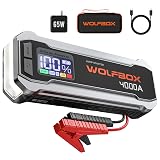

The WOLFBOX is my starting point for someone who wants a standalone unit with a complete charging setup. Its appeal is not simply the largest-looking amp number. It is the combination of an informative display, a defined USB-C specification, and the charger needed to take advantage of it.
WOLFBOX’s MegaVolt24 product page advertises 4,000A peak and use with 12V vehicles up to 10L gas or diesel. The manual’s specification and packing pages identify an 88.8Wh battery, 65W USB-C input/output, and a matching wall adapter. That is a more useful basis for comparison than assuming every device described as “fast charging” uses the same connection.
The buying distinction is clearest beside the Alpha85. Both advertise a 65W charging capability, but HULKMAN’s documented USB-C output is lower and its faster input requires a specific charging mode. I would choose the WOLFBOX arrangement for a travel kit where compatible USB-C electronics are a meaningful second job. Check the connected device’s power requirements; this is not a promise that every laptop will charge at its full speed.
Keeping the adapter, cable, and clamps together would be part of my ownership plan. Otherwise, the feature that helped justify the purchase may not be available when the pack needs recharging. The case is useful for organization, but it does not turn vehicle storage into a set-and-forget task. I would still inspect charge and condition before a trip.
The trade-off is straightforward: this MV24 does not inflate tires, and its feature set is more than a buyer seeking only basic starting assistance may need. Choose it for the charging kit and interface, not an unmeasured claim that it out-cranks every smaller label. For inflation, compare the A3; for fewer extras, compare the S8 against your vehicle’s requirements.
Reasons to Buy
- Documented 65W USB-C input and output.
- Wall charger and carrying case included in the reviewed kit.
- Display shows charge and operating status.
Reasons to Avoid
- No built-in tire inflator.
- Extra charging capability may be unnecessary for a basic emergency-only purchase.
GOOLOO GP4000 — Standalone Jump Starter with USB Outputs

The GP4000 belongs on the shortlist when you want a standalone starter and already have a tire inflator. It is also the GOOLOO jump starter I would compare against the A3 before deciding whether combining tools genuinely improves the purchase. Similar branding does not make their controls, ports, or accessories equivalent.
The current GP4000 page advertises a 4,000A peak rating, 12V operation, smart clamps, dual USB-A connections, and USB-C input/output. Its standard package includes an EVA case and charging cable but not the wall adapter. I would price the complete usable kit rather than compare one bare package with another product that already includes its charger.
There is an important specification caveat. The manufacturer-hosted GP4000 manual lists 15W USB-C, while current sales copy uses a 100W heading. Those documents do not establish that the selected unit has been upgraded. For an order dependent on charging speed, ask the seller for the exact unit’s port label and matching manual; I have not awarded it a high-output USB advantage.
That uncertainty does not erase the model’s basic role, but it changes how I would compare it. Consider it when the actual offer is attractive and its straightforward indicator-based interface meets your needs. Choose the WOLFBOX instead when verified USB-C capability is central, or the Alpha85 when a larger status display matters more than minimizing the feature list.
I would not buy the GP4000 simply because its peak rating exceeds another pack’s. Nor would I choose it over the A3 on the assumption that omitting a compressor automatically means better starting performance. Those are questions for comparable testing. Here, the useful decision is whether a separate starter, confirmed charging specification, and your existing accessories make the better complete setup.
Reasons to Buy
- Standalone design for buyers who already own an inflator.
- USB-A connections plus USB-C input/output.
- EVA case is listed in the standard kit.
Reasons to Avoid
- Published USB-C power claims conflict across documents.
- A wall charger is not included in the standard package.
GOOLOO A3 — Jump Starter with Air Compressor

The A3 makes the most sense when your emergency kit needs both a way to jump your car and an inflator for occasional tire-pressure top-ups. Combining them reduces the number of main devices to organize. It also means both jobs depend on the condition and charge of the same unit, so I would choose the combination deliberately rather than treat another feature as automatically better.
GOOLOO rates the selected A3 at 3,000A peak for 12V vehicles up to 9L gas or 6.5L diesel. Its inflator has pressure presets and automatic shutoff, with a published maximum of 150 PSI. Those controls are the relevant convenience features; maximum pressure is not a measurement of inflation speed on your tires.
The manufacturer’s package list includes a hose, five nozzles, a carrying bag, smart jumper cables, and a USB charging cable. Its charging guide specifies a 5V/2A input and says the wall charger is separate. USB-A output serves smaller electronics; this is not the alternative I would choose for the WOLFBOX’s USB-C role.
For an owner who otherwise would carry no inflator, the all-in-one layout is appealing. Someone who already owns suitable portable tire inflators may prefer the GP4000 or another standalone model instead. I would also keep the hose and adapters inside the same bag: a combination tool stops being convenient when its small parts are somewhere else.
Use the vehicle’s prescribed tire pressure, not the A3’s maximum or an unchecked preset. NHTSA recommends checking cold tires against the vehicle label or owner’s manual. An inflator is not a repair for tire damage. I have not established a continuous heavy-duty inflation rating here, so I would not buy this A3 to replace a workshop compressor.
Reasons to Buy
- Starting assistance and tire inflation in one unit.
- Pressure presets with automatic shutoff.
- Hose, nozzles, and carrying bag are listed as included.
Reasons to Avoid
- Starting and inflation share the same battery reserve.
- No high-output USB-C charging role; wall adapter is separate.
Jump-N-Carry JNC660 — Lead-Acid Jump Box for the Garage

The JNC660 is the different proposition in this comparison: a traditional handle-equipped jump box rather than a slim electronic battery pack. I would consider it for a garage with a convenient charging location. I would not select it for a glove box or describe its conventional appearance as evidence of superior cold-weather performance.
The selected listing identifies the 1,700-peak-amp model. Clore’s manufacturer-authored instructions describe a sealed lead-acid battery, analog charge gauge, side cable holsters, and built-in AC charging. This is also where lead-acid jump starters differ visibly from the USB-centered options above: the charging routine and storage layout are part of the purchase.
A reason to consider it is the documented battery-replacement route through technical service. I value being able to ask about an approved replacement before buying a tool intended to stay in the garage. That is not a guarantee of lifetime parts availability or an invitation to improvise internal repairs; obtain the correct part and service instructions.
The AC charging arrangement uses a household extension cord, which the manual says is not included. Match charging instructions to your revision: the document distinguishes automatic-charging JNC660 versions from older units. I would keep the correct instructions with it instead of apply an old charging timetable to a newer unit, or assume every used JNC660 can be treated identically.
Choose this layout when dedicated storage, organized cables, and serviceability outweigh electronic conveniences. For a numeric screen and USB connections, the Alpha85 is the more relevant comparison; for an included USB-C charging kit, look at WOLFBOX. The JNC660 remains a candidate because it addresses a different ownership pattern, not because a lower or higher peak label can establish a winner.
Reasons to Buy
- Manufacturer documents a battery-replacement service route.
- Built-in AC charging suits a designated garage location.
- Analog gauge and integrated cable holsters.
Reasons to Avoid
- Handle-and-cable-caddy layout is not aimed at compact cabin storage.
- AC extension cord is separate; charging guidance depends on revision.
HULKMAN Alpha85 — Car Jump Starter with a Large Status Display

I would compare the Alpha85 first when clear charge and fault information matters more than a minimal interface. Before trying to jump a car, I want to be able to tell whether the pack is ready and what an error means. Its screen has that documented purpose, although it does not replace the instructions. That gives me something more concrete to assess than a generic claim of “smart” operation.
HULKMAN’s Alpha85 overview identifies a 3.3-inch display and advertises support for up to 8.5L gas and 6L diesel vehicles. The technical specification lists a 74Wh internal battery and 2,000A peak output. I use those as application and feature information, not as proof that the pack is twice as capable as a 1,000A product.
Its charging headline needs careful reading. The specified 65W input uses HULKMAN’s SC1.0 mode; ordinary USB Power Delivery input and USB-C output are listed at 18W. Buying any charger with “65W” printed on it does not establish that it will trigger the faster mode. The reviewed package list also does not confirm a wall charger, so verify the current seller’s contents.
Beside WOLFBOX, I would decide on interface preference versus the USB-C arrangement. Beside the S8, I would decide whether the more informative display and different application guidance justify the complete purchase price. Those are specific reasons to upgrade; a larger display alone does not demonstrate stronger clamps, longer service life, or better starts in freezing conditions.
Make sure the product is Alpha85, not Alpha85S. The manufacturer’s comparison treats them as separate models, so I have not transferred a different model’s cold-weather features here. HULKMAN also warns against charging a wet unit despite its water-resistance claim. I would buy for the status interface, not assume the label promises unrestricted outdoor use.
Reasons to Buy
- Large display for charge, status, and error information.
- Documented 74Wh battery and USB/DC connections.
- Distinctly different interface from basic indicator-only packs.
Reasons to Avoid
- 65W charging requires the specified mode; USB-C output is 18W.
- Charger and case inclusion need confirmation for the actual offer.
AstroAI S8 1500A — Compact Jump Starter for Smaller Engines

The original S8 is the option I would examine when keeping the purchase simple matters more than adding a large screen or inflator. Its role is starting assistance for a compatible vehicle, with modest electronic extras. It does not need to win every specification column to be a sensible shortlist choice.
AstroAI’s 1500A S8 page lists 12V use up to 6L gas or 3L diesel. Those boundaries are narrower than several alternatives here. An illustrative 2L gasoline car falls inside the published displacement guidance; a 5L diesel does not. That is a compatibility screen, not a promise about either vehicle’s actual starting condition.
The S8 manual identifies 37Wh, charge-level indicators, USB-A output, and a flashlight. Its lower stored-energy figure helps explain why I would treat the electronic charging function as a secondary convenience. Someone planning to use the same pack heavily for other devices should compare that plan with the emergency reserve they want to retain.
The documented package includes smart clamps, a USB-A-to-C cable, and a storage bag, but no charging block. I would include a suitable adapter in the total cost unless I already owned one. I would also confirm the orange original S8 is selected: the Air, Pro, and Ultra versions on the same brand’s site have different capabilities and are not substitutes for this specification.
I have not called it the lightest unit or assigned an exact weight because AstroAI’s page contains inconsistent weight entries. The useful case for buying it is simpler: choose fewer extras when the published application fits and the current price makes sense. Choose something else for a larger diesel, a detailed status screen, or integrated inflation rather than expect those jobs from this version.
Reasons to Buy
- Simple interface for buyers who do not need a large display.
- Smart clamps, charging cable, and storage bag included.
- Clearly identified original 1500A configuration.
Reasons to Avoid
- Published engine guidance stops at 6L gas / 3L diesel.
- 37Wh pack and basic USB output are not aimed at substantial electronics use.
How to Choose the Best Jump Starter for Your Car
For a reliable jump starter setup, I would check more than the pack itself: the vehicle match, charging routine, clamps, and instructions all need to fit the job. Use the following questions to narrow the jump starters on the market to the configurations that suit your car and the way you will maintain the equipment.
Gas engine or diesel engine: Check compatibility first
Start with the owner’s manual, not the shopping site’s vehicle filter. Record the required jump-start voltage, engine type and displacement, and approved connection locations. Check gas engine and diesel engine limits separately in the starter manufacturer’s guidance; do not use the larger gasoline figure to justify a diesel purchase.
Also inspect access before ordering. A battery terminal under a cover and a designated remote jump point create different placement questions. Ask whether the supplied clamps can attach as instructed while the unit sits securely and its cables remain away from moving parts. Clore’s instructions explicitly defer to vehicle guidance and allow manufacturer-designated starting points.
How much power do you need? Look beyond peak amps
The peak-amp labels in this table are not a shared test report. To call one unit a more powerful jump starter, I would need comparable load, voltage, duration, temperature, and state-of-charge information. Without that, dividing one label by another creates arithmetic, not a demonstrated starting advantage.
Use the engine guidance as an initial filter, then look at the practical kit and credible evidence for your intended conditions. For a larger engine, confirm the application directly rather than assume the biggest advertised number guarantees enough power. Clore’s manual also identifies battery condition, temperature, and the duration of attempts as factors affecting results.
Lithium-ion batteries, watt-hours, and power bank use
A lithium jump starter’s peak current, watt-hours, and USB output answer different questions. Watt-hours describe nominal stored energy; they are not the current delivered to the starter motor. I would look at that figure when comparing secondary electronics use, while keeping vehicle suitability as a separate decision.
AstroAI provides a useful illustration in its battery explanation: 2,500mAh at 14.8V and 10,000mAh at 3.7V describe the same nominal 37Wh pack. Comparing mAh figures without their voltage can therefore be misleading. Nor does nominal energy equal the exact energy available at a USB socket after conversion.
When comparing lithium-ion batteries for this job, separate vehicle compatibility from the devices you also intend to power. Using a portable battery to charge a phone or laptop draws on the same stored energy you want available for starting assistance. I would plan around keeping an emergency reserve, not calculate a promised number of starts from the watt-hour figure.
Lithium-ion jump starters vs. lead-acid jump boxes
Think about where the equipment will live and how it will be recharged. The lithium-ion jump starters here emphasize portable electronics-style connections and interfaces. The JNC660’s lead-acid design instead comes with a carrying handle, integrated cable storage, and an AC charging routine.
I would favor a compact jump starter for a small organized travel kit, or consider the JNC660 where a dedicated garage position makes sense. That is an ownership preference, not a claim that one battery chemistry always starts more engines, lasts longer, or works better in every climate.
USB charging, battery clamps, and included accessories
Write down three separate items: the pack’s accepted input, its output to other devices, and the adapter included in the box. The WOLFBOX/Alpha85 distinction shows why this matters. A connector shape or a fast-charge headline does not answer all three questions.
For every jump starter you shortlist, check the supplied cable and wall adapter separately. A USB-C socket does not mean a compatible power supply is in the box. Compare the complete package you can actually recharge, not just the device price. Then check the battery clamps and cable routing against the approved connection points on your vehicle.
A USB-equipped starter can be useful as a power bank, but it is not automatically a portable power station for household appliances. Match the documented outputs to the electronics you intend to charge; the connector alone does not establish charging speed or compatibility.
Do you need a jump starter with an air compressor?
A built-in air compressor is worth considering when tire-pressure top-ups are a real part of your emergency kit. The A3 brings a hose, nozzles, pressure presets, and automatic shutoff; the other five reviewed configurations do not include inflation. Compare that convenience with carrying a standalone starter and a separate inflator you already own.
For inflation, compare the actual tire task, hose, pressure controls, and operating limits, not only the maximum PSI number. Starting assistance and inflation also share one battery reserve in a combination unit. I would choose the A3 for the combined job, not assume its extra function makes it a better starter for every driver.
Before buying: “Does this exact version suit my vehicle, where will I store it, which charger is supplied, and can I identify the correct connection and fault indicators?” Answering those questions is more useful than collecting the highest headline ratings.
Using a Jump Starter: Dead Batteries, Preparation, and Storage
Prepare before you need to jump start a car. Charge the new unit, identify its controls, keep the correct manual accessible, and check the vehicle’s procedure. To jump your vehicle yourself, you need to understand its approved connection points and the pack’s fault indications beforehand. This section is a preparation checklist, not one universal connection sequence for six different products.
Check condition and location first. Do not attempt a jump on a frozen, leaking, swollen, or visibly damaged battery. Stop if equipment is damaged, polarity is uncertain, or the location exposes you to traffic or another hazard. Keep clamps apart, use eye protection, and keep sparks and flames away. The Clore safety instructions emphasize battery hazards and protective equipment; seek qualified assistance when the situation is unclear.
Use the normal procedure, not an automatic override. Follow the vehicle and jump-pack instructions for approved connection points, indications, attempt limits, and removal. A BOOST function is not a general answer to every failed start or error light. Resolve the indicated problem and consult the manufacturer rather than bypass a warning to force another attempt.
Separate charging temperature from operating temperature. WOLFBOX specifies charging at 32–113°F in its safety section, narrower than its advertised operating range. A pack being permitted to operate in cold weather does not mean charging it while equally cold is permitted. Avoid improvised heating and follow the exact unit’s instructions.
Make maintenance a routine. GOOLOO’s A3 guidance calls for recharging after use and at least every three months when unused. For a unit you plan to keep in your car, set a reminder to inspect charge and condition rather than rely on a long standby claim. Before a long trip, check the connectors, case, and cables, then store the kit securely within the manufacturer’s limits.
Investigate repeated no-starts. A successful jump does not diagnose why car batteries lose charge. Repeated dead batteries call for battery and vehicle-system assessment, not indefinite reliance on a larger jump pack. When the real task is restoring or maintaining charge while parked, my automotive battery charger comparison covers the different equipment category.
Car Jump Starters: Frequently Asked Questions
What is the best jump starter for most people?
For this shortlist, I would begin with the WOLFBOX MV24 when a complete USB-C charging kit matters, then check its suitability for the vehicle. That is a feature-based recommendation, not a measured best overall result. Choose the A3 for integrated inflation or the original S8 when a simpler compatible option better fits the budget.
How many amps do I need to jump start a car?
There is no single number I would apply to every car. Start with the jump starter manufacturer’s voltage and engine guidance and the vehicle’s requirements. A peak rating without a comparable load test does not tell you how long a unit sustains a particular output or guarantee success with a badly depleted battery.
Can a jump starter recharge dead car batteries?
Jump starters and chargers address different jobs when dealing with dead batteries. Use a compatible battery charger for controlled recharging or maintenance rather than leave a jump pack attached as a substitute. GOOLOO explains this distinction in its A3 guide; a damaged battery may require service or replacement rather than either device.
Can I keep a portable jump starter in my car?
Only within its specified storage conditions, secured against movement and with periodic checks. GOOLOO’s GP4000 guidance specifically discourages prolonged storage in a hot parked vehicle. A glove box is a location, not temperature protection. Follow the manual instead of assuming year-round storage is always acceptable.
Portable jump starter or jumper cables: Which should I carry?
It offers a different trade-off: an onboard energy source instead of depending on another suitable source for starting assistance. In return, the pack itself needs charging and inspection. I would choose based on the help available, storage space, and willingness to maintain it—not assume owning either tool makes the vehicle’s procedure optional.
Which jump starters on this list have an air compressor?
The selected GOOLOO A3 includes an air compressor. The other five configurations do not. Similar-looking names can refer to inflator versions, so verify the exact model. Use the vehicle’s recommended pressure and follow the inflator’s operating limits; do not assume one maximum-pressure figure establishes workshop-level capability.
Can I make multiple jump starts on one charge?
I have not established a comparable count. The number of jump starts depends on engine condition, the vehicle battery, temperature, remaining pack charge, and attempt duration. After using the unit to start your car, plan to recharge according to its exact manual rather than turn an advertised maximum into a maintenance schedule.
Final Verdict: The Right Jump Starter for Your Car
I would shortlist the WOLFBOX MV24 first for its documented USB-C arrangement and charging kit. The HULKMAN Alpha85 is the alternative when the status display is the stronger attraction. Compare their actual bundles carefully rather than assume both 65W headlines describe the same thing.
Choose the GOOLOO A3 when integrated inflation solves a real need. Consider the GP4000 as a standalone alternative after confirming the supplied revision’s charging details. The AstroAI S8 1500A is worth a look for compatible vehicles when fewer extras and the current price are the priority.
The JNC660 belongs in the discussion for a different reason: a conventional garage layout and documented battery service. To find the best match, keep the complete kit and its maintenance routine in view. The best portable jump starters are useful only when they suit the vehicle, remain charged, and can be used according to the correct instructions.
Sources and Product Documents
Sources reviewed October 3, 2026. This comparison covers the six exact configurations identified below by ASIN. Manufacturer sources supplied specifications and guidance; buying scenarios and recommendations are my editorial judgments. Exact seller bundles and availability remain subject to confirmation.
- WOLFBOX MV24, B0CRRKRJ2S: MegaVolt24 product information and official manual, including the package on PDF page 4 and specifications on PDF page 13. The manual contains inconsistent BOOST wording, so no override sequence is reproduced here.
- GOOLOO GP4000, B09HJH1S41: current U.S. product page and GP4000 manual hosted by GOOLOO Canada. This older manual is a single large PDF sheet with multiple printed pages. Its 15W USB-C and capacity figures are not treated as proof of every current U.S. revision; the conflicting 100W sales claim remains unresolved.
- GOOLOO A3, B0D4DLXNR1: product page, manufacturer specification/package image, and manufacturer charging and operating guide. This comparison uses those web sources, not a review of the full A3 manual. A continuous inflation duty cycle was not established.
- Jump-N-Carry JNC660, B000JFJLP6: selected model listing for identity and the advertised peak rating; Clore-authored JNC4000/JNC660 manual, third-party-hosted copy for equipment, charging, service, and safety. Revision-specific instructions are distinguished. No engine-displacement ceiling or cable-gauge claim was invented.
- HULKMAN Alpha85, B08M41FX48: overview, detailed specifications and package list, and manufacturer model comparison. Proprietary input, USB-C output, and seller-dependent charger inclusion are separated.
- AstroAI S8 1500A, B0BZP6HCVS: original S8 product page and official S8 V1.3 manual, especially the package on PDF page 4 and specifications on PDF page 11. Inconsistent website weights were not used to rank portability.
- Tire-pressure guidance: NHTSA TireWise, maintenance and recommended-pressure sections. Vehicle instructions and the actual unit’s manual govern operation.