
Affiliate disclosure: As an Amazon Associate, I earn from qualifying purchases. Some links may earn me a commission at no extra cost to you.
The best torque wrench for cars helps you tighten nuts and bolts to the vehicle’s specified torque. It should cover the fasteners you work on, make the target setting easy to read, and give you a clear stopping signal. A long 1/2-inch wrench is a sensible starting point for wheel maintenance, but it cannot replace a smaller tool for every underhood job.
I compared six models across mechanical click, split-beam, and electronic designs. My priorities are documented accuracy, usable torque range, adjustment, and service support. The biggest distinction is easy to miss: a wrench may let you select a low setting without guaranteeing its headline accuracy there.
Editorial Note: My recommendations are based on verified manufacturer specifications and independent reviews, not hands-on testing.
Quick Answer: Best Torque Wrench for Cars
My overall pick is the TEKTON TRQ52403 for owners who mainly tackle wheels and higher-torque automotive fasteners. Its documented 40–300 ft-lb range and bidirectional calibration make a strong starting point, provided your required settings fit.
Choose the LEXIVON LX-184 for a simpler budget option, the Precision Instruments C3FR250F for frequent wheel work, or the GEARWRENCH 85079 when angle measurement matters. The eTORK EC3250 combines a digital setting display with a mechanical click. For smaller fasteners, the TEKTON TRQ51402 is the more useful companion.
Best Torque Wrenches: My Top Picks
Torque Wrench Comparison
CW means clockwise; CCW means counterclockwise. Accuracy figures below are manufacturer claims, not my own measurements. On smaller screens, scroll the table sideways.
| Model / award | Drive / type | Setting range | Stated torque accuracy | Main trade-off |
|---|---|---|---|---|
| TEKTON TRQ52403 Best Overall | 1/2 in. / click | 40–300 ft-lb | ±3% CW/CCW; full listed range | Long handle; 40 ft-lb minimum |
| LEXIVON LX-184 Best Budget | 1/2 in. / click | 25–250 ft-lb | ±4% CW; test interval not specified in reviewed product information | No calibrated CCW tightening |
| Precision Instruments C3FR250F Best for Frequent Wheel Work | 1/2 in. / split-beam | 40–250 ft-lb | ±4% CW over 50–250 ft-lb | 5 ft-lb graduations; CW only |
| GEARWRENCH 85079 Best Digital with Angle | 1/2 in. / electronic | 25–250 ft-lb | ±2% CW / ±3% CCW over 50–250 ft-lb | Batteries; limited low-end accuracy coverage |
| eTORK EC3250 Best Digital-Scale Click Wrench | 1/2 in. / digital-scale click | 25–250 ft-lb | ±3% CW / ±6% CCW; test interval not specified in reviewed documents | No live torque or angle measurement |
| TEKTON TRQ51402 Best for Lower-Torque Work | 3/8 in. / click | 10–100 ft-lb | ±3% CW/CCW; full listed range | Insufficient for jobs above 100 ft-lb |
For LEXIVON and eTORK, check the supplied certificate or ask the manufacturer if accuracy at a specific low setting is critical. I have not assumed that every brand uses the same calibration interval.
How I Chose These Torque Wrenches
I compared manufacturer specifications, manuals, calibration conditions, and service options, then used independent reviews for usability context. My selections cover occasional maintenance, frequent wheel changes, angle-based procedures, and lower-torque jobs. Customer reviews can highlight practical frustrations, but ratings alone cannot establish accurate torque. Each award reflects a particular use case rather than a hands-on test result.
The 6 Best Torque Wrenches for Cars
1. TEKTON TRQ52403 — Best Overall
At a glance: 1/2-inch drive; 40–300 ft-lb; mechanical click; 90-tooth fixed head; 26.1-inch length.


That makes it a versatile first purchase for wheel and higher-torque work. The 300 ft-lb ceiling offers more capacity than the 250 ft-lb alternatives here, while the 90-tooth head needs just four degrees of movement to ratchet. The handle still needs physical clearance; a fine ratchet cannot make a long wrench compact.
Its main compromise is adjustment resolution. The scale advances in 2 ft-lb increments, and TEKTON says the collar locks at the marked increments. I would check that the required setting can be selected rather than casually rounding a service specification. For jobs below 40 ft-lb, I would reach for a smaller wrench.
Reasons to Buy
- Documented full-range, bidirectional calibration.
- Higher capacity and a serialized certificate.
- TEKTON offers a separate recertification service.
Reasons to Avoid
- Too large for many confined jobs.
- 2 ft-lb increments limit setting choices.
- Needs minimum-setting storage.
Best for: A home garage centered on wheels and larger fasteners. Skip it if: Most of your work needs low torque or a short handle.
Documentation: TEKTON product page and micrometer manual, sources 1–2.
2. LEXIVON LX-184 — Best Budget
At a glance: 1/2-inch drive; 25–250 ft-lb; mechanical click; clockwise measurement; 25-inch length.
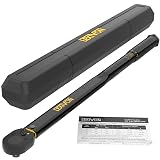
I would pay particular attention to its scale before the first job. The micrometer uses 2.5 ft-lb divisions, which is easy to misread if you are accustomed to one-pound increments. The reversible ratchet is another potential trap: it changes ratcheting direction, but LEXIVON specifies calibrated torque measurement clockwise only.
The brand states ±4% clockwise accuracy. I could not establish a clearly defined accuracy test interval from the reviewed product information, so I would verify low-end requirements against the supplied certificate. This is a reasonable cost-conscious shortlist option, not evidence that an inexpensive wrench will retain calibration indefinitely.
Reasons to Buy
- Simple operation without batteries.
- Case and calibration certificate included.
- Useful capacity for occasional wheel maintenance.
Reasons to Avoid
- No calibrated reverse tightening.
- Coarse scale needs careful reading.
- Low-end accuracy conditions need confirmation.
Best for: Occasional DIY work on a limited budget. Skip it if: You need reverse measurement, finer adjustments, or fully documented low-range coverage.
Documentation: LEXIVON LX-184 specifications and manual, sources 3–4.
3. Precision Instruments C3FR250F — Best for Frequent Wheel Work
At a glance: 1/2-inch drive; 40–250 ft-lb; split-beam click; flex head; clockwise measurement.

I would choose it for a dedicated wheel-maintenance role rather than as my only automotive wrench. The scale uses 5 ft-lb graduations, and the C3 series measures clockwise only. There is also a distinction between its 40 ft-lb minimum setting and the manual’s ±4% accuracy statement: the latter covers 20–100% of full scale, or 50–250 ft-lb for this model.
The flex head can help position the handle around a wheel, but it does not remove the need for controlled technique. Also check certificate requirements before ordering: the manufacturer’s direct listing offers an additional calibration certificate as an option. Do not assume every retailer package includes the same paperwork.
Reasons to Buy
- Convenient adjustments for repeated wheel jobs.
- No need to reset to minimum for storage.
- Flex head and battery-free operation.
Reasons to Avoid
- Clockwise measurement only.
- 5 ft-lb graduations are relatively coarse.
- 40–49 ft-lb is outside the cited accuracy band.
Best for: Frequent wheel work with compatible torque settings. Skip it if: You need low-torque precision, reverse tightening, or angle measurement.
Documentation: Precision Instruments product page, split-beam manual, and FAQ, sources 5–7.
4. GEARWRENCH 85079 — Best Digital with Angle
At a glance: 1/2-inch drive; 25–250 ft-lb; electronic torque and angle measurement; 72-tooth flex head.

GEARWRENCH specifies ±2% clockwise and ±3% counterclockwise torque accuracy over 20–100% of full scale. That means 50–250 ft-lb, despite the selectable range beginning at 25 ft-lb. Ten presets can simplify repeated jobs, while vibration, sound, and a flashing display provide more than one way to notice the target.
The trade-off is extra setup and battery dependence. You must select the correct mode, units, and target before pulling. A torque-and-angle tool also does not tell you whether a fastener is reusable or supply the vehicle’s tightening sequence. Those instructions still come from the service information.
Reasons to Buy
- Measures angle as well as torque.
- Multiple alerts and ten stored presets.
- Bidirectional measurement with published limits.
Reasons to Avoid
- Requires two AA batteries, not included.
- Headline accuracy does not cover 25–49 ft-lb.
- More features than basic wheel work requires.
Best for: Owners who already need a suitable torque-and-angle tool. Skip it if: You want a simple, battery-free wrench or mainly work below 50 ft-lb.
Documentation: GEARWRENCH 85079 specifications, source 8.
5. eTORK EC3250 — Best Digital-Scale Click Wrench
At a glance: 1/2-inch drive; 25–250 ft-lb; backlit digital setting display; mechanical click; four display units.

That distinction is central to this recommendation. The screen shows the selected torque; it is not a live torque readout, and this wrench does not measure angle. Bob Vila’s hands-on review found the setting process straightforward, but that experience should not be mistaken for an independent calibration certificate. The manufacturer’s current specification lists 45 ratchet teeth, despite a conflicting tooth count in that review.
eTORK states ±3% clockwise and ±6% counterclockwise accuracy and includes a calibration certificate. The documents I reviewed do not clearly define a separate accuracy interval. I would verify that detail for low-end work and choose a tighter documented reverse specification if counterclockwise tightening is a major requirement.
Reasons to Buy
- Readable target setting with unit conversion.
- Mechanical click with a locking adjustment.
- Manufacturer provides repair and calibration support.
Reasons to Avoid
- No live torque readout or angle mode.
- Looser stated counterclockwise tolerance.
- Display needs batteries; low-end limits need checking.
Best for: Buyers who want easier setting visibility without changing to electronic torque measurement. Skip it if: You need angle tracking or live torque feedback.
Documentation: eTORK specifications and manufacturer manual; independent review by Bob Vila, sources 9–11.
6. TEKTON TRQ51402 — Best for Lower-Torque Work
At a glance: 3/8-inch drive; 10–100 ft-lb; mechanical click; 90-tooth fixed head; 15.6-inch length.
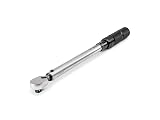
TEKTON lists ±3% accuracy in both directions, 0.5 ft-lb increments, and an individual calibration certificate. Its manufacturer-supplied listing describes full-range calibration. That combination is useful when your maintenance list includes several lower settings and you want finer adjustment than the larger TRQ52403 provides.
I would buy this as a companion to a suitable 1/2-inch wrench. It stops at 100 ft-lb, so it is not a universal wheel tool. Likewise, its 10 ft-lb minimum is still too high for some small fasteners. For those, compare a suitable inch-pound wrench instead of trying to work below the marked scale.
Reasons to Buy
- Lower range and finer setting increments.
- Shorter than the wheel-focused models here.
- Bidirectional calibration and individual certificate.
Reasons to Avoid
- Cannot cover settings above 100 ft-lb.
- Still unsuitable below 10 ft-lb.
- Fixed head can limit access.
Best for: Lower-torque automotive work within its documented range. Skip it if: Your first priority is a wheel specification above its capacity.
Documentation: TEKTON micrometer manual and manufacturer-supplied TRQ51402 listing, sources 2 and 12.
Torque Wrench Buying Guide
Choose the torque range before the brand
Before purchasing a torque wrench, use the service specifications to determine how much torque each planned job requires. Write down the lowest setting, highest setting, required units, and tightening direction. Compare those requirements with the wrench’s documented accuracy interval and adjustment increments, not just its maximum torque rating.
A tool that reaches 300 ft-lb is not automatically better for a 15 ft-lb fastener. Equally, there is no need to invent a universal rule that every wrench is inaccurate near its minimum. Some models explicitly document full-range calibration; others publish a narrower band.
1/2-inch versus 3/8-inch drive
The drive size describes the square connection to your socket. It does not describe the socket opening or guarantee a particular torque range. A 1/2-inch wrench usually makes sense for wheel work and larger fasteners; a shorter 3/8-inch model often suits lower settings and tighter spaces.
A drive adapter does not increase the torque capacity of the wrench or socket. For a growing home garage, I would usually prefer two complementary ranges over one oversized wrench that leaves small jobs uncovered.
Click Torque Wrench or Digital Torque Wrench?
These different types of torque wrenches change how you set the target and recognize when to stop. Choose the feedback that suits your work and access.
Adjustable click torque wrench
A micrometer-style adjustable torque wrench uses a mechanical torque scale and a click signal. Read both scales, lock the preset torque, and stop at the first click. The signal does not prevent you from applying more force. Follow the model’s minimum-setting storage instructions.
Split beam torque wrench
A split-beam mechanism also provides a click. Quick adjustment and convenient storage make it appealing for repeated wheel work. Confirm the tightening direction and scale increments: the C3FR250F measures clockwise only and uses 5 ft-lb graduations.
Electronic torque wrench and digital-scale click models
An electronic torque wrench can display a live torque reading and add alerts, presets, or angle measurement. Check the actual functions. The EC3250’s digital screen displays the selected setting; it does not measure the amount of torque being applied. The 85079 provides electronic torque and angle measurement.
Pointer beam and dial torque wrench
A traditional beam-style torque wrench requires watching a pointer against a scale while pulling, so a clear viewing angle matters. A dial torque wrench displays torque with a dial pointer; some versions retain the peak reading. Neither description alone guarantees a preset alert. These designs are alternatives to the six picks above.
Torque Accuracy, Calibration, and Warranty
Accuracy describes allowable measurement error under stated conditions. Calibration checks the tool against a reference. Warranty covers specified faults and may provide a much shorter calibration guarantee than parts coverage. For example, GEARWRENCH lists one year on parts but 90 days for calibration accuracy.
A percentage is meaningful only with its direction and range. For illustration, ±4% of a 100 ft-lb setting is ±4 ft-lb, not ±4% of the wrench’s maximum capacity. This is an explanation of tolerance, not a recommended wheel setting.
Small display increments describe resolution, not proof of accuracy. Look for useful test records and a practical recalibration route. A lifetime tool warranty is not a promise of lifetime accuracy without checks.
How to Use a Torque Wrench on Wheel Lug Nuts
- Find the exact specification. Use the vehicle’s owner or service information and any applicable wheel instructions. Confirm units, thread condition, sequence, and recheck requirements.
- Prepare the wheel and fasteners correctly. Follow the vehicle’s lifting and installation procedure, inspect the mating surfaces and threads, and start fasteners by hand. Do not add lubricant or anti-seize to a dry-thread specification.
- Set and lock the wrench. Choose a suitable range and correctly fitting socket, then set the desired torque in the correct units. For electronic tools, confirm power and measurement mode.
- Tighten in the prescribed sequence. Follow the manufacturer’s staged tightening procedure and final vehicle position. A star or cross pattern is common, but use the pattern specified for your wheel.
- Apply force smoothly and stop at the signal. Hold the intended grip position. A click or alert does not prevent further tightening if you keep pulling. Recheck afterward only as directed by the vehicle or wheel manufacturer.
An impact wrench can speed removal and initial installation when used appropriately, but it should not replace controlled final tightening. A torque wrench clicking on an already overtightened nut does not establish that the nut was installed correctly.
Wheel maintenance also includes pressure checks. My guide to the best portable tire inflators covers that companion task.
How to Store Your Torque Wrench and Maintain Calibration
For the TEKTON micrometer models, LEXIVON LX-184, and eTORK EC3250, return the setting to the manufacturer’s stated minimum after use. Do not wind below the marked minimum. The Precision Instruments split-beam model can stay at its selected setting; electronic models require their own storage and battery care.
Keep the wrench clean, dry, and protected in its case. After a drop, overload, or suspicious change in operation, have its accuracy checked before relying on it. Follow the manufacturer’s calibration schedule and shorten the interval when workload or handling demands it.
Never add a pipe to the handle or use the wrench as a breaker bar. A straight socket extension and an offset crowfoot are different attachments: an offset attachment can change effective leverage and require a corrected setting. Follow the tool manual’s geometry and calculation instead of guessing.
Frequently Asked Questions
What is the best torque wrench for lug nuts?
For frequent wheel work, I favor the Precision Instruments C3FR250F when the specified setting fits its graduations and documented accuracy band. The TEKTON TRQ52403 is my broader overall choice. Check your vehicle’s requirements before choosing either.
Is a 3/8-inch torque wrench enough for a car?
It can cover many individual jobs, but not every fastener. The TRQ51402 reaches 100 ft-lb; a higher requirement needs another tool. Choose by specified torque and access, then match the socket drive.
Are digital torque wrenches more accurate?
Not automatically. Compare the stated tolerance, measurement direction, and covered range. A display can reduce reading mistakes, but it does not prove calibration or turn a digital-scale click wrench into an electronic torque sensor.
Can I use a torque wrench to loosen bolts?
Use a breaker bar or suitable removal tool for stuck fasteners. A wrench rated for counterclockwise torque may tighten a left-hand fastener, but that rating is not permission to use it for high-force breakaway work.
Do I need angle measurement for automotive repairs?
Only when the specified procedure requires it. A torque-plus-angle instruction needs a suitable angle-measuring method and the correct sequence. Confirm any fastener replacement requirement separately; an angle function cannot determine that for you.
How often should a torque wrench be calibrated?
Use the manufacturer’s interval and your workload, not a universal calendar rule. Precision Instruments recommends at least six-month checks in its FAQ; eTORK’s manual specifies at least annual checks, after abnormal handling or overload, or after 10,000 uses.
Are foot-pounds and inch-pounds interchangeable?
No. One foot-pound equals 12 inch-pounds. Confusing them can create a twelvefold error. Always check the unit printed in the service procedure and the unit selected or marked on the tool.
Final Verdict
The TEKTON TRQ52403 is my Best Overall pick for a garage focused on wheels and larger fasteners. Choose the LEXIVON LX-184 — Best Budget for occasional use, or the Precision Instruments C3FR250F — Best for Frequent Wheel Work for repeated wheel jobs.
The GEARWRENCH 85079 — Best Digital with Angle and eTORK EC3250 — Best Digital-Scale Click Wrench serve different needs. Add the TEKTON TRQ51402 — Best for Lower-Torque Work when smaller fasteners become part of your routine. The best purchase is the one that fits the actual procedure.
For other routine garage tasks, my guides to the best OBD2 scanners and best automotive battery chargers cover diagnostics and battery maintenance.
Sources and Product Documentation
View manufacturer documentation and independent reviews
Research checked October 22, 2026. Product specifications take priority over retailer summaries. Independent reviews inform usability context; awards are my editorial judgments.
- TEKTON TRQ52403 specifications.
- TEKTON micrometer torque wrench manual; warranty.
- LEXIVON LX-184 specifications and warranty conditions.
- LEXIVON LX-184 manual.
- Precision Instruments C3FR250F specifications.
- Precision Instruments split-beam manual.
- Precision Instruments operation and calibration FAQ; warranty.
- GEARWRENCH 85079 specifications and warranty.
- eTORK EC3250 specifications; warranty conditions.
- eTORK manufacturer instruction booklet, hosted copy.
- Bob Vila: eTORK EC3250 hands-on review.
- TEKTON TRQ51402 manufacturer-supplied listing, cross-checked against the model-specific manual.
- Pro Tool Reviews: torque wrench comparison; Automoblog: torque wrench comparison.
- Ford Performance wheel installation example. Its vehicle-specific torque value must not be generalized to other cars.
- Precision Instruments: dial torque wrench operation and display types.