
Affiliate disclosure. As an Amazon Associate, I earn from qualifying purchases.
The best car battery tester should help you decide what to investigate next: a low charge, a weakening starting battery, or a problem in the vehicle’s starting or charging system. The useful differences are battery compatibility, test functions and how easily you can read or keep the results.
For a typical home garage, my starting pick is the TOPDON BT100. I would choose the Autel MaxiBAS BT506 when Bluetooth testing and saving PDF reports on a phone matter, and consider the FOXWELL BT705 when 24V starting and charging-system checks are part of the job. These recommendations reflect the documented features and the jobs each tool can serve.
How this comparison was prepared: I compared manufacturer specifications and operating instructions for six named models. I have not performed hands-on testing of their accuracy, durability or app reliability. Product documentation was reviewed on November 4, 2026. Check the exact model, seller support and current offer before buying.
Key Takeaways
- Check compatibility first: match battery voltage, type and rating standard before comparing extra features.
- Choose the workflow: a standalone screen suits quick checks; reports are useful when keeping records for several vehicles.
- Understand the result: an estimated CCA value describes starting capability, not remaining amp-hour capacity.
Top Picks by Testing Routine
Best Car Battery Tester Comparison Table
The CCA ranges below describe supported battery ratings, not current supplied by the tester. Battery-health testing and vehicle-system testing are separate functions.
| Model | Best fit in this comparison | Battery test / CCA range | System tests | Main consideration |
|---|---|---|---|---|
| TOPDON BT100 | Simple home-garage use | 12V; 100–2000 CCA | 12V cranking and charging | Standalone screen; flooded, AGM, GEL and EFB support |
| KONNWEI KW208 | Basic standalone alternative | 12V; 100–2000 CCA | 12V cranking and charging | Compare its current price with the BT100; confirm the listed battery type |
| ANCEL BA101 | PC-based report printing | 12V; 100–2000 CCA | 12V cranking and charging | USB printing workflow needs a computer; no built-in printer |
| Autel MaxiBAS BT506 | Bluetooth testing and PDF reports | 12V; 100–2000 CCA | 12V cranking and charging | No built-in screen; compatible app and device required |
| FOXWELL BT705 | Mixed vehicle-system work | 12V; 100–2000 CCA | 12V/24V cranking and charging | 24V system support is not a 24V battery-health rating |
| Midtronics PBT-300 | Simple professional-brand option | 12V starting batteries; 100–1400 CCA | Starting and charging voltage checks | Confirm suitability for your battery chemistry; narrower rating range |
All six are diagnostic tools. A charging-system test checks vehicle behavior; it does not mean the tester charges the battery. For charging equipment, see my automotive battery charger comparison.
Product Reviews
1. TOPDON BT100 — My Pick for a Simple Home Garage
At a glance. Standalone 12V testing with an onboard screen and condition LEDs.


The BT100 brings together the three checks I would want for occasional car maintenance: battery condition, engine cranking and charging-system behavior. Its backlit screen and condition LEDs keep the results on the tool, without making a phone part of the routine. TOPDON documents these functions.
Its 12V coverage includes flooded, AGM flat-plate, AGM spiral, GEL and EFB batteries, with a 100–2000 CCA range. That gives it a useful starting specification for a conventional car or SUV, provided the battery label matches. The BT100 manual also explains that a battery below 6V cannot power the unit; a blank screen is therefore not a complete diagnosis.
Reasons to Buy
- Standalone screen and condition LEDs
- Battery, cranking and charging checks
- Explicit AGM and EFB coverage
Reasons to Avoid
- Not for 24V vehicle-system tests
- No phone-report workflow
- Battery below 6V cannot power the tool
2. KONNWEI KW208 — A Basic Standalone Alternative
At a glance. A standalone alternative for 12V battery, cranking and charging checks.

The KW208 covers 12V batteries rated at 100–2000 CCA and includes battery, cranking and charging tests. Its documented battery types include conventional flooded, AGM flat-plate, AGM spiral and GEL. It displays information such as voltage, internal resistance and estimated starting capability. KONNWEI specifications.
I would put it beside the BT100 when comparing offers for a simple home tool. Both cover the core tasks in this article, so the decision should include the delivered price, seller support and which interface you prefer. An identical upper CCA number does not establish identical performance.
Reasons to Buy
- Three core diagnostic tests
- Onboard display without a phone
- 100–2000 CCA rating range
Reasons to Avoid
- Check the supplied battery profiles
- No phone-report workflow documented
- CCA estimate does not measure remaining Ah
3. ANCEL BA101 — For a PC-Based Reporting Workflow
At a glance. USB/computer reporting without a built-in printer.

The BA101 is a 12V analyzer with a 100–2000 CCA range, battery-condition checks and separate cranking and charging tests. ANCEL also documents storing results and printing through a USB/computer workflow. There is no printer built into the handheld unit. ANCEL product details.
That reporting route is its strongest reason for inclusion here. I would consider it when I want a record to discuss with a repair shop or keep alongside maintenance notes, and using a computer is convenient. Check the software and computer requirements before making printing the deciding feature.
Reasons to Buy
- Onboard display for routine testing
- USB/computer reporting option
- Battery and vehicle-system checks
Reasons to Avoid
- Printing requires a compatible computer
- No built-in printer
- 12V operation only
4. Autel MaxiBAS BT506 — For Bluetooth Testing and PDF Reports
At a glance. Bluetooth testing with app-based results and shareable PDF reports.
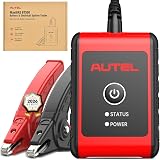
The BT506 is my pick here for drivers who want to keep battery-test records on a phone. It covers 12V battery-condition, cranking and charging checks, with a 100–2000 CCA range and flooded, AGM, AGM spiral, EFB and GEL battery profiles. Autel product specifications.
Its reporting workflow is the main attraction: you can review test history and save, share or print PDF reports. That makes it useful for comparing results over time or discussing a test with a repair shop. The BT506 manual explains the app setup and report options.
There is no built-in screen. For phone use, you need a compatible 64-bit iOS or Android device, the app and an Autel account. I would choose it for recurring checks across several vehicles; the BT100 is simpler when I only need a quick result on the tool.
Reasons to Buy
- Bluetooth testing with phone-based results
- Test history and shareable PDF reports
- Documented AGM and EFB battery profiles
Reasons to Avoid
- No built-in screen; a compatible device is required
- Phone setup requires an app and Autel account
- Reporting features may be unnecessary for occasional checks
5. FOXWELL BT705 — For 12V Batteries and 12V/24V System Checks
At a glance. 12V battery testing plus 12V and 24V starting/charging-system checks.

The BT705 is the option I would investigate for a garage working across different vehicle electrical systems. FOXWELL separates 12V battery testing from 12V and 24V starting/charging-system testing. Its listed battery coverage includes flooded, AGM and GEL, plus start-stop AGM and EFB. FOXWELL product information.
Its documented 100–2000 CCA range overlaps the smaller tools here. The reason to shortlist it is the wider system-testing brief, not a larger CCA headline. For a single 12V family car, I would first ask whether those extra system capabilities solve a problem I actually have.
Reasons to Buy
- 12V and 24V starting/charging checks
- Dedicated handheld interface
- Documented start-stop battery profiles
Reasons to Avoid
- 24V coverage concerns system tests, not battery-health testing
- More capability than a single-car owner may need
- No lithium approval established
6. Midtronics PBT-300 — A Simple Professional-Brand Option
At a glance. A 100–1400 CCA starting-battery tester that requires at least 8V.

The PBT-300 provides conductance testing for 12V automotive starting batteries rated at 100–1400 CCA. It uses a numerical display and condition LEDs, and supports starting and charging voltage checks. The Midtronics PBT specifications describe this deliberately simple feature set.
I would consider it if I specifically wanted a straightforward Midtronics unit and had confirmed its suitability for my batteries.
Reasons to Buy
- Simple display with condition LEDs
- Battery conductance and voltage checks
- Focused starting-battery workflow
Reasons to Avoid
- 100–1400 CCA range
- Battery must supply at least 8V
- Confirm modern AGM/EFB/GEL compatibility
How to Choose a 12V Car Battery Tester
Match 12V Operation and Battery Type First
Start with the label on the battery you own: nominal voltage, chemistry, rating standard and rating value. Make those your shopping checklist. A product description mentioning cars, motorcycles and boats is less useful than a confirmed match to that label.
For an AGM or EFB start-stop battery, look for an explicit matching profile. For lithium, choose equipment specifically approved for that chemistry. A 12V marking alone is insufficient: lead-acid algorithms can give misleading results on lithium batteries. Midtronics explains the chemistry distinction.
Understand CCA, State of Charge and Battery Health
Cold cranking amps describe starting capability under a defined rating standard. A handheld conductance tester uses the battery’s electrical response to estimate that capability. Its displayed CCA value is not a laboratory cold-cranking test, and it does not establish how long the battery can run accessories. Midtronics on interpreting battery-test readings.
State of charge and state of health answer different questions. A battery can need charging without necessarily needing replacement. Conversely, an acceptable voltage reading alone does not settle whether it can perform its starting job. Read the complete result and follow any instruction to recharge and retest.
Decide Whether You Need Reports
For an occasional check, an onboard display may be enough. For several vehicles, a record is more useful if it includes the date, battery identity and test conditions. I would decide where I want those records before choosing between a phone app, computer printing or manually recording the screen.
The same applies to price. If your search is for the best budget car battery tester, compare the current delivered prices of the KW208, BT100 and BA101 after checking compatibility. I would pay more only for a function I expect to use, a preferred workflow or better-supported ownership terms.
Car Battery Tester vs Multimeter vs Load Tester
These tools answer overlapping questions through different test methods:
- Multimeter: measures voltage and other electrical quantities, depending on the meter. It is useful for troubleshooting, but a resting voltage reading alone cannot confirm starting capability. See Fluke’s automotive meter guidance.
- Conductance tester: evaluates the response to a small electrical signal to estimate starting performance. That makes it useful for quick screening, with the correct battery inputs.
- Carbon pile load tester: places a substantial load on the battery and evaluates the voltage response under specified conditions. It is a different procedure from a handheld electronic estimate.
A product marketed as a “battery load tester” is not necessarily a high-current carbon pile tester. Check the method in its manual. Reserve-capacity testing is another requirement and should not be inferred from a CCA display. Midtronics compares the testing technologies.
Car Battery Health and Voltage: Getting Consistent Test Results
Follow the tester, battery and vehicle instructions together. Use eye protection and ventilation, keep ignition sources away, and do not test a visibly damaged or frozen battery. For a normal battery-health test, turn the engine and accessories off; cranking and charging tests use their own procedures.
- Check the connections. Attach each clamp at the specified terminal or test point with clean, secure contact. Poor contact can distort a measurement.
- Enter the actual label data. Select the correct type, rating standard and CCA rating when applicable. Do not substitute an EN number into a CCA setting without the appropriate procedure.
- Account for recent charging. Follow the manual’s preparation and resting instructions rather than comparing readings taken under unrelated conditions.
- Read the whole result. Consider the charge state, starting-capability estimate and any warning. If instructed to charge and retest, complete that step before deciding on replacement.
- Investigate persistent symptoms. A “good” battery result does not rule out a wiring, starter or charging-system problem.
The PBT-300 instructions illustrate why contact quality, vehicle loads and retesting matter. Use your own model’s procedure for the actual test sequence.
Frequently Asked Questions
Are Car Battery Testers Accurate?
They can provide useful screening information when the tool supports the battery and is set up correctly. Accuracy also depends on connections, condition and test method. An unexpected result deserves verification.
Which Is the Best Battery Tester for AGM Batteries?
From this shortlist, I would start with the BT100 for standalone use or the Autel MaxiBAS BT506 for app-based testing and PDF reports. Both have documented AGM support. The BT506 requires a compatible device; choose the correct AGM profile for your battery.
Can a Tester Diagnose an Alternator Problem?
Charging and cranking tests can flag behavior worth investigating, but it does not identify every cause of an abnormal reading. Interpret results using the vehicle’s service specifications and operating conditions. Treat the reading as diagnostic information rather than an automatic instruction to replace the alternator.
Will a Tester Recharge or Jump-Start My Car?
No. The six tools here are for testing. A discharged battery may need a compatible charger; emergency starting requires appropriate starting equipment. My portable jump starter comparison covers that separate purchase.
Does a Good Result Mean the Battery Will Last Another Year?
No test result guarantees a remaining service life. Keep records and investigate changes or recurring starting problems. A screen showing a health percentage should not be read as a countdown of months left. Midtronics recommends considering trends and the complete result.
Final Verdict
For occasional checks on compatible family cars, I would start with the BT100 and compare the KW208 offer. For a more organized record-keeping routine, I would choose between the Autel MaxiBAS BT506 app and PDF-report workflow and the BA101 computer workflow.
The BT705 earns its place when its wider vehicle-system coverage is useful. The PBT-300 is a focused alternative for buyers who want that interface and have confirmed battery compatibility. The best purchase is the one that fits the batteries, tests and reporting habits in your own garage.
Explore more Automotive & Garage guides.
Sources and Product Documentation
View product specifications and battery tester instructions
- TOPDON BT100
- KONNWEI KW208
- ANCEL BA101
- Autel MaxiBAS BT506 specifications
- Autel MaxiBAS BT506 manual
- FOXWELL BT705
- Midtronics PBT-300
- BT100 manual
- documented 100–2000 CCA range
- Midtronics explains the chemistry distinction
- Midtronics on interpreting battery-test readings
- Fluke’s automotive meter guidance
- Midtronics compares the testing technologies
- PBT-300 instructions